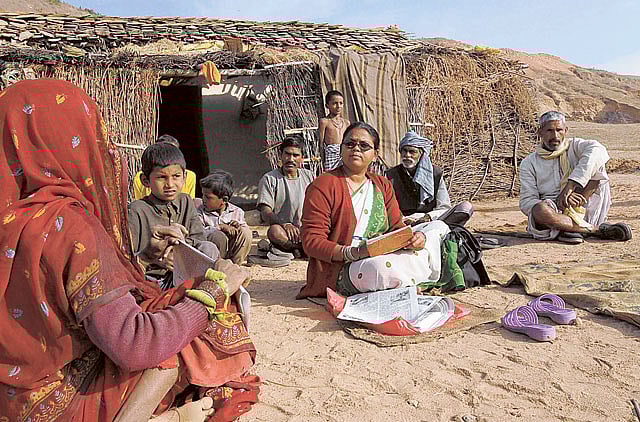
New Delhi: A team of 20 women from a rural background in north India's Uttar Pradesh state have managed in nine years what the administration could not for many decades.
Kavita, Meera, Shanti, Krishna, Sonia and others have changed the way people think and live in several villages of the state.
The efforts of these women have resulted in roads being built and medical officers taking notice of villages in the region.
At other times they raised issues against corruption in ration shops and resisted pressure and threats from the local power lords and criminals. Threatened by village chiefs and councils, they have exposed them on their own turf.
All this has been possible because of Khabar Lahariya (New Waves), a weekly newspaper written, edited, illustrated, produced and marketed by these women — most of them from marginalised Dalit and Muslim communities in Chitrakoot and Banda districts.
Negligence and apathy
Fighting for their rights, the women reporters took up cudgels even with the Superintendent of Police for negligence and apathy in a case. Exposing injustice, they not only wrote about the senior officer but went a step ahead and distributed the newspaper in his own office! Along with all this, the multi-tasking reporters in the 30 to 45 age group have been managing their homes as well. Take for instance 35-year-old Sonia. Quickly completing her household work, she is out in the field gathering information for the story in hand. The reporters have been educating themselves and keeping up with the times. Like many others, Sonia is well-versed with the computer, uses the camera and the dictaphone for efficiency and authenticity.
Kavita, a Dalit, was married at the age of 12. She says, "I wanted to study but could not." After suffering for than 12 years in her marriage, Kavita called it quits. She began living independently, a decision seldom considered by rural women.
"I began educating myself and have done a master's in political science. Initially, to sustain myself, I took up a job with a publication. And then Khabar Lahariya happened," she informed.
The reporters have been threatened by people and even the village heads do not support them. But gone is the tradition when women suffered silently and were expected to remain confined to their homes.
Another senior reporter, Shanti, is from the tribal Kol community. With no access to education as a child, she began studying in her mid-30s. The impact of education was immense. Her newly acquired confidence led her to take up a job with Khabar Lahariya and she not only changed her own life but encouraged other women to study and become independent.
The women working on the newspaper since its launch in 2002 are neo-literates and all have learnt their journalism on the job.
Their steely will and striking skills are unmatched. Despite family pressures and a discriminatory community, they churn out the newspaper week after week.
Network of agents
They walk for kilometres to cover a story, find facts regardless of non-cooperation from men, stay up through power failures, face technical glitches and finally travel 100km to Allahabad to get the newspaper printed.
The eight-page Khabar Lahariya has a print run of 5,500 copies. With an above 50,000 readership, the newspaper priced at Rs2 is distributed in 400 villages. These are sold across Chitrakoot, Banda and Lalitpur by a network of agents, local shopkeepers and the journalists themselves.
Undoubtedly, the mainstay of Khabar Lahariya is the women who live the many issues they write about. Published in Bundeli, the language spoken in nearby villages, they report on cases of violence against women, issues pertaining to the backward classes, bureaucratic corruption and national and international news.
Sign up for the Daily Briefing
Get the latest news and updates straight to your inbox
Network Links
GN StoreDownload our app
© Al Nisr Publishing LLC 2026. All rights reserved.