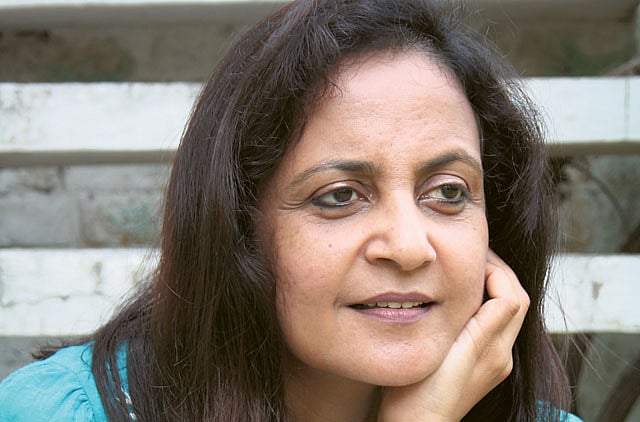
New Delhi: Jaishree Misra's life reads like fiction. "My first novel, Ancient Promises, is semi-autobiographical and describes an unsuccessful arranged marriage and a divorce that followed ten years later," she admits.
The predicament of having an intellectually challenged daughter, Rohini, led her to work in the childcare department of Social Services in Buckinghamshire, England. Jaishree began teaching adults with special needs even as her life went on a rollercoaster ride.
But, made of sterner stuff, she fought it out and took some unconventional and brave steps that changed the course of her life. In a miraculous twist, the woman with an extremely sunny disposition met her school friend Ashutosh in England, and re-married. Her book A Scandalous Secret was launched recently.
Gulf News interviews the author at their Sainik Farms residence.
GULF NEWS: You're referred to as ‘novel-a-year' author? How did you make this possible?
JAISHREE MISRA: The reference is only to the last three books, which the UK publishers had specifically asked for in three years. The fact that in the middle of a recession, when the future looked bleak, a publisher wanting to commit himself for three years, was kind of big. It was a challenge I had to take.
Moreover, I enjoy the process of writing and it hasn't been a huge effort, though I can't also say it's effortless, because every book does exhaust you at the end. My books come easy and have a conversational style and a free-flowing language. They are not literary fiction. I did three drafts before each book was ready. After that it took about six to seven months for each.
One has heard of the trilogy in case of Amitav Ghosh, but your books are different. Was it your idea to play with different stories and characters?
It's not a trilogy, because there's no continuity of a story. The books are a set as it is not uncommon in the world of popular fiction to have somewhat similar titles. I suppose Secrets and Lies, Secrets and Sins and A Scandalous Secret are a result of my having grown up watching too many Bollywood movies!
Since the themes are akin to Bollywood movies, are there any plans to sell the rights to the books?
Filmmakers have approached me for my earlier books. And rights for two were sold. But one didn't work out and the filmmaker moved on, whereas Sushmita Sen bought rights for the other for her film Jhansi ki Rani. She said she wouldn't replicate the book but could use it as a source.
In an interview you said, ‘the best fiction comes from facts'. What inspired you?
Many years back, I had read a report about British International Development Minister Clare Short, who re-united with her son.
As an unwed mother during her teens, she had given him up for adoption. She lost touch with the child because adopted children in the 1940s and 1950s were not given the right to information on their biological parents.
But on growing up, her son, who became an army officer, tracked her down and it all resulted in a happy ending. So, there was that seed in my mind, which sprouted when I was looking for an idea. I transported that into an Indian setting.
Do you visualise yourself as someday being classified as the most popular writer in India like Chetan Bhagat?
If that were to happen, it would be a great position to be in. I enjoyed reading Chetan's Two States but was a bit distressed with the language because I'm quite particular about it.
I like elegant writing and Chetan doesn't offer that. At the same time, I get angry with people who say he shouldn't be allowed to write because he writes badly. There are thousands of people who love his books and there's a market for varied needs.
I believe what we call chick-lit can co-exist with literary books and publishers are keen on lower priced paperbacks.
But I am unhappy with Chetan for once implying that until he started to write, there weren't any readable books. He meant everyone was writing difficult books, which is not correct. I don't think it's good for any writer to consider himself superior to others.
Who is your favourite Indian author?
Vikram Seth, because he is so versatile and perfect. But if we talk about a book, I liked Arundhati Roy's God of Small Things.
After you finish writing a book, how do you unwind?
I read others' books. It's such a relief not to be thinking about your own book's characters all the time. It's like escaping into another world.
Also, I'm a very family person and like spending time with my husband, daughter, mother and mother-in-law.
In the publishing world, why are some authors promoted more than others?
I agree with that and I suppose it's to do with popularity.
If the publisher feels that a particular writer is selling well, he starts pushing that writer more, rather than trying to push others so that they can reach the same level. But then, it means being pragmatic and publishers have to think of their own revenue.
If you were a publisher, what new parameters would you set for the authors?
I would encourage some completely unexplored territories in Indian publishing like commissioning a writer to work on murder mysteries.
We only have to pick up Agatha Christie or James Hadley Chase to read murder mysteries, because publishers are so stuck in their way of thinking.
Thankfully, in India they have recently started transforming and are much more aware, thanks to people like Chetan Bhagat, the Harry Potter series and children's books.
Earlier, nobody thought about children's books. But now this new idea has also evolved that you can actually make money by publishing children's books.
But yes, there's still a lot of literary snobbishness, though with changes happening rapidly, I shouldn't be complaining.
What is your next book? And when will it be released?
The first draft of the book on human trafficking is almost over. And if a publisher is ready, it could be launched in a year!
Internationally recognised
- Jaishree Misra was born on March 18, 1961 in New Delhi to mother Omana and father N.K. Nair, an Indian Air Force officer.
- Educated at Convent of Jesus and Mary and Maitre‘d in New Delhi and Baldwin Girls School, Bangalore.
- Studied at Lady Shri Ram College, New Delhi for a year and did her graduation and Masters in English Literature from Kerala University.
- Went to England in 1990 and got a post-graduate diploma in Special Education from the University of London.
- Diploma in Broadcast Journalism followed by a stint with BBC.
- Has written seven books — Ancient Promises, Accidents Like Love and Marriage, Afterwards, Rani, Secrets and Lies, Secrets and Sins and A Scandalous Secret.
- Currently helping to set up a residential unit in Delhi for people with learning disabilities.
Sign up for the Daily Briefing
Get the latest news and updates straight to your inbox
Network Links
GN StoreDownload our app
© Al Nisr Publishing LLC 2026. All rights reserved.