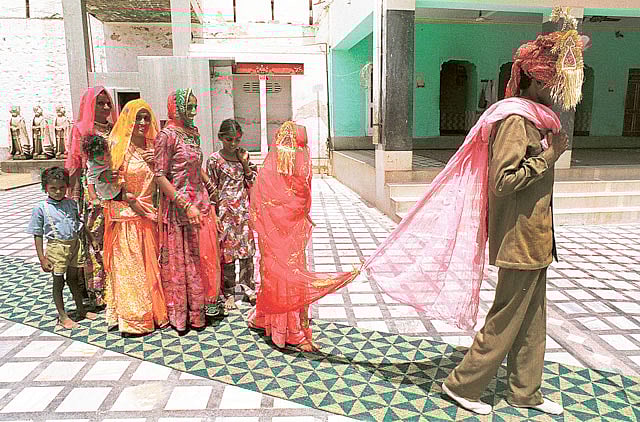
New Delhi: In Rajasthan, where child marriages continue to be a rampant, 17-year-old Lakshmi has just stepped out of what seemed like a nightmare. Lakshmi was told only months ago that she was married off when she was just two years old and that she must go to her husband's house. Instead of doing that, she sought the help of local social activists and got her illegal marriage annulled.
Now Lakshmi wants to study and despite threats from her so-called former in-laws, she stands firm. But not every girl has Lakshmi's courage.
The sad truth is that in most cases, authorities and police officials are unable to stop such practices of child marriage even if they are aware of it.
Worse still, such practices are revered as “traditional” and “customary” and questioning them means losing one's vote bank or invoking the wrath of Khap Panchayats or Sarpanches (rural self-government heads) or self-proclaimed guardians for “hurting their regional sentiments”.
Social activist Nagendra Singh has campaigned for years against this scourge.
“We have tried everything, from trying to educate people to threatening them. But nothing really works. These things are deep rooted. But now, the girls themselves offer a ray of hope, opposing this evil tradition. Maybe, their efforts will pave the way for a big social change,” Singh told Gulf News.
Another victim of child marriage, Rekha, 19, was married at the age of seven to a boy of nine. Children of two traders working in a partnership firm, Rekha and her husband Rakesh knew each other well as children, but never happened to like each other.
However, not bothered about what their children wanted, Rekha's father Surinder Tayal fulfilled the promise he had made to his friend and partner, Suresh Bindal, after arranging Rekha's marriage with Rakesh when they turned 15 and 17, respectively.
The result — not a single day passes by without the couple exchanging verbal volleys.
Rekha regrets not being able to raise her voice like most other child brides in Rajasthan.
“I suffered two miscarriages before I turned 18. My husband shows no love or respect towards me. Our personalities are poles apart. Yet, I have to bear it all and continue to live in silence and pain. My father and my father-in-law are thick friends and if I dare say a thing against my husband or in-laws, it will affect my father's health, who is a heart patient, and also his business,” Rekha told Gulf News.
Many social activists feel that binding two children together for the sake of seeing them grow into a “perfect couple” is nothing short of child abuse.
“First of all, there is no such thing as a perfect couple. Secondly, a child should grow up free to explore all facets of life, friendship and love. Since there is an already existing gender bias, coupled with child marriage, the female child does not even stand a chance to grow into a independent woman.
"Only independent people can make independent choices. To not even give a child a chance to choose his or her own fate is so normal in Indian society. In fact, it makes me doubt whether we will ever progress into a truly secular democracy. The bottom line is that every human being should have the choice to find a partner for him or her,” Reena Bhatt, a Jammu-based child rights activist, says.
“Apart from this, shouldn't the general mindset that ‘people are destined to marry whether they want it or not' change? If you ask a villager, why he is marrying off his daughter so early, his answer is: What else has she got to do? Her sole destiny is to marry, bear children and raise them. These are real time experiences,” Bhatt states.
Interestingly, Prem Saini, 16, who hails from Dausa in Rajasthan, looks and behaves like any other teenager. Yet, she is different from them. Like Lakshmi, she has fought and won the battle of a lifetime.
A few days ago, her parents said it was time for her to honour the marriage she was put through when she was 12 and move in with her husband, who works as a farmer in a village nearby. When Prem's elder sister was married, five years ago, her parents made Prem participate in a simple ceremony.
Since then, Prem has met the groom just a few times at family functions, but she is clear in her mind that she is not yet anybody's wife.
When Prem refused to follow her father Ram Saini's diktat to move to her husband's home, he allegedly beat her up. She contacted the police and lawyers who work with local non-governmental organisations (NGOs). The district administration has now directed her parents to let her complete school and to keep her with them.
Prem says that though legally, she can get married at 18, she intends to become a lawyer and keep herself busy professionally for another six years. Later, she says, she will decide on who and when to marry.
“Marrying off a child when she has no idea of what marriage means is unfair and illegal. I want to study further, pursue a Law course and become a lawyer. I will fight for the cause of women and children in India,” Prem told Gulf News.
In states like Rajasthan, Uttar Pradesh, Madhya Pradesh, Jharkhand, Chhattisgarh, Bihar and Andhra Pradesh the average age of marriage for women is still below the legal age of 18.
Owing to the early and often frequent pregnancies before they are biologically capable of handling such stress, adolescent mothers give birth prematurely. That in turn poses a serious threat to the health of the child and the mother.
Child marriages also make girls more vulnerable to domestic violence, sexual abuse and result in their inability to complete primary education. It has also been found that infant mortality rates are higher than the national average in states where there is a high prevalence of child marriage.
“Child marriage has only one main reason behind it — poverty. All social issues arise out of poverty which, when addressed, ensures education, better health care, decent standard of living and higher morales. The parents know what they are doing and yet they are just forced into it because of poverty. But poverty can never be wiped out of this country and so you cannot abolish child marriages completely,” Singh explains.
According to the recent National Family Health Survey, 47.3 per cent of women aged 20-24 were married by the age of 18 years. Of these, 2.6 per cent were married before they turned 13; 22.6 per cent were married before they were 16; and 44.5 per cent were married when they were between 16 and 17.
In some states, the percentage of child marriage is quite high: Rajasthan 65.2 per cent, Uttar Pradesh 58.6 per cent, Madhya Pradesh 57.3 per cent, Jharkhand 63.2 per cent, Chhattisgarh 55 per cent, Bihar 69 per cent and Andhra Pradesh 54.8 per cent. States where the prevalence is low are Himachal Pradesh 12.3 per cent, Punjab 19.7 per cent and Kerala 15.4 per cent.
Sign up for the Daily Briefing
Get the latest news and updates straight to your inbox
Network Links
GN StoreDownload our app
© Al Nisr Publishing LLC 2026. All rights reserved.