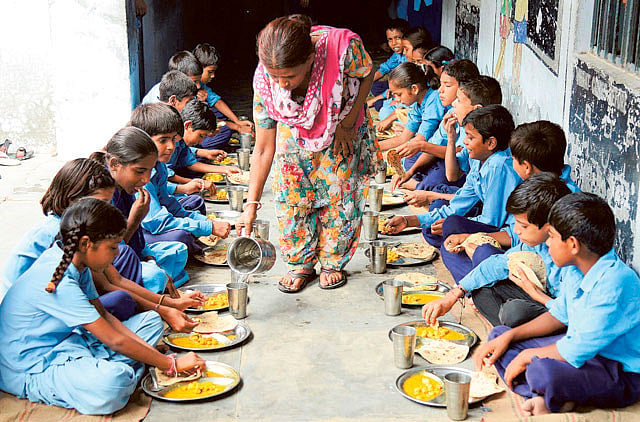
New Delhi: The midday meal scheme of the federal government is a perfect example of how corruption, greed and incompetence can mar a noble scheme.
The scheme has been under intense scrutiny since 24 children died in Bihar after eating the meal.
The whole idea behind the midday meal is to serve hot and nutritious food to poor school students to ensure India’s next generation has a healthy upbringing. At the same time, the idea was also to encourage parents to enrol their children to schools and arrest the high dropout rate.
Poor parents are unable to fund studies and meals of their children, prompting them to make children work and earn money for the family at quite an early age. The scheme covers 120 million poor school children.
The midday meal scheme is the first among many ambitious plans rolled out by the incumbent Congress party-led United Progressive Alliance government.
It was introduced as a fully central government funded scheme in January 2006. Free midday meals to schools students was part of the Congress party’s 2004 election manifesto and figured prominently in the common minimum programme that was agreed upon by various constituents of the UPA and its supporters like the Left Front.
The midday meal scheme has existed in some form or the other in India since 1925. The Madras Municipal Corporation under the British rule was the first to introduce such a scheme in 1925. The French who ruled neighbouring Pondicherry (now Puducherry) introduced it in 1930. Since then it has existed in various parts of the country in some form or the other.
Post-independence Madras state (now Tamil Nadu) started a similar scheme. However, the credit for launching a proper midday meal scheme applicable to an entire state was launched in Gujarat in 1984.
However, it was only during the Congress party-led P.V. Narasimha Rao government in which present prime minister Manmohan Singh who was then finance minister that it became a nation-wide initiative in the name of the National Programme of Nutritional Support to Primary Education (NP-NSPE). The idea was to enhance enrolment, retention and attendance and simultaneously improve nutritional levels among children.
The NP-NSPE scheme was launched as a centrally sponsored scheme on August 15, 1995 initially in 2408 blocks in the country and gradually got expanded to all over the country by 1997-1998.
The Atal Bihari Vajpayee government in 2002 extended it further to cover children studying in centres running under the Education Guarantee Scheme and Alternative and Innovative Education Scheme and Madarsas.
It was further extended to upper primary schools in 2006-2007 by the incumbent Manmohan Singh government and since 2009 the scheme covers children studying in National Child Labour Project schools as well.
The programme was revised in 2004 and renamed as the midday meal scheme. It envisages a provision of cooked, nutritious midday meal to primary and secondary school children. Importantly, it mentions the setting-up of an appropriate mechanism for quality checks.
The federal government was supposed to provide grains free of cost while the respective states were supposed to take care of other expenses like ingredients, salaries and infrastructure. Many states started giving grain supplies by the federal government to parents directly to cut cost.
This, however, was defeating the very purpose as there was no guarantee that the grain would be used to feed the school-going children only.
The Supreme Court delivered a historical order in November 2001 directing all concerned to provide cooked meals in place of dry meal (grain) but was ignored by many states.
Finally, the federal government had to step in and make it a fully centrally sponsored scheme in 2004 to make the scheme universal all across the country.
Sign up for the Daily Briefing
Get the latest news and updates straight to your inbox
Network Links
GN StoreDownload our app
© Al Nisr Publishing LLC 2026. All rights reserved.