India's Supreme Court seeks CBSE reply on Gulf students' plea
Petition seeks grace marks, special exams, admission relief for affected Class 12 students
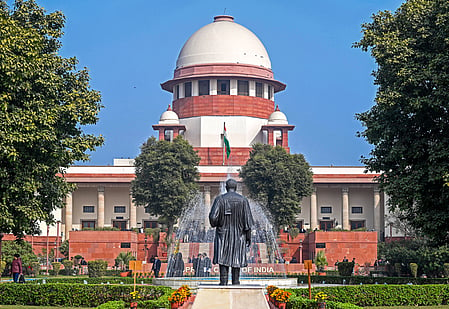
Dubai: The Supreme Court on Wednesday sought responses from the Centre and the Central Board of Secondary Education (CBSE) on a petition filed by Class 12 students from Gulf and West Asian countries seeking relief over disruptions to the 2026 board examinations caused by the regional conflict.
A Bench of Justices K.V. Viswanathan and Alok Aradhe issued notice on the petition, which seeks compensatory grace marks, special examinations, relaxation in admission eligibility and safeguards to ensure affected students do not lose an academic year.
The court directed the petitioner to provide a copy of the plea to the Solicitor General before the next hearing.
Students cite conflict-related disruption
The petition, filed through advocate Vineet Jindal under Article 32 of the Constitution, argues that thousands of CBSE Class 12 students studying in GCC and West Asian countries were forced to take their board examinations under "extraordinary and unprecedented circumstances" because of the regional conflict.
It says the disruption affected not only examinations but also students' preparation, mental well-being and future academic prospects.
According to the plea, the affected students should be recognised as a distinct category entitled to equitable relief because they faced circumstances beyond their control during the examination cycle.
Challenge to CBSE assessment scheme
The petition challenges the CBSE's assessment scheme issued on March 27, claiming it unfairly disadvantages students from the conflict-hit region.
It urges the court to direct the CBSE to adopt a fair, transparent and non-discriminatory evaluation process that better reflects students' actual academic performance.
Among the key demands is a one-time award of moderation or grace marks to compensate for disrupted studies, psychological stress, displacement and examination irregularities caused by the conflict.
What the petition seeks
Compensatory grace marks for affected Class 12 students.
Special fresh examinations in all subjects.
Special improvement exams without limits on the number of subjects.
'Better-of-two' option, allowing students to retain the higher score.
Review and grievance mechanism for students assessed under the March 27 CBSE scheme.
Lower DASA eligibility from 75% to 60% for the 2026-27 academic year.
Similar relaxation for the CIWG admission category.
Provisional admissions where results are delayed or revised.
Special counselling and admission window after revised results to prevent students losing an academic year.
Recognition of Gulf and West Asian students as a specially affected category entitled to equitable relief.
Fresh exams and admission relief sought
The petition also seeks directions for the CBSE to conduct special fresh examinations and special improvement examinations in all subjects, without restricting the number of papers students may choose to retake.
It further requests a "better-of-two" policy, allowing students to retain whichever result is more favourable.
In addition, the plea seeks the creation of a transparent, time-bound review, verification and grievance redressal mechanism for students assessed under the March 27 evaluation scheme.
The petition also asks for a one-time relaxation in admission criteria under the Direct Admission of Students Abroad (DASA) scheme by lowering the minimum aggregate requirement from 75 per cent to 60 per cent for the 2026-27 academic session.
A similar relaxation has been sought for admissions under the Children of Indian Workers in Gulf Countries (CIWG) category.
Concern over loss of academic year
The petition further urges educational institutions, universities and counselling authorities to protect the candidature of affected students by allowing provisional admissions where necessary and ensuring that applications are not rejected because of delayed or revised results.
It also calls for a special admission and counselling window after the declaration of revised results and completion of any special examinations so that no student loses an academic year.
According to the petition, repeated representations by students, parents, schools and community organisations to the CBSE and the Union Ministry of Education failed to result in a comprehensive remedial framework.
It argues that the conflict affected all students, regardless of whether individual examinations were postponed or conducted, because the entire examination environment was overshadowed by war-related uncertainty and psychological distress.
The petition also refers to representations from educational institutions that reported unusually low pass percentages, saying the assessment methodology does not accurately reflect students' academic ability and has jeopardised their higher education prospects.
The petitioners have urged the apex court to intervene, saying the educational future of thousands of students has been placed at serious risk by circumstances entirely beyond their control.
-- With IANS inputs
Sign up for the Daily Briefing
Get the latest news and updates straight to your inbox
Network Links
GN StoreDownload our app
© Al Nisr Publishing LLC 2026. All rights reserved.