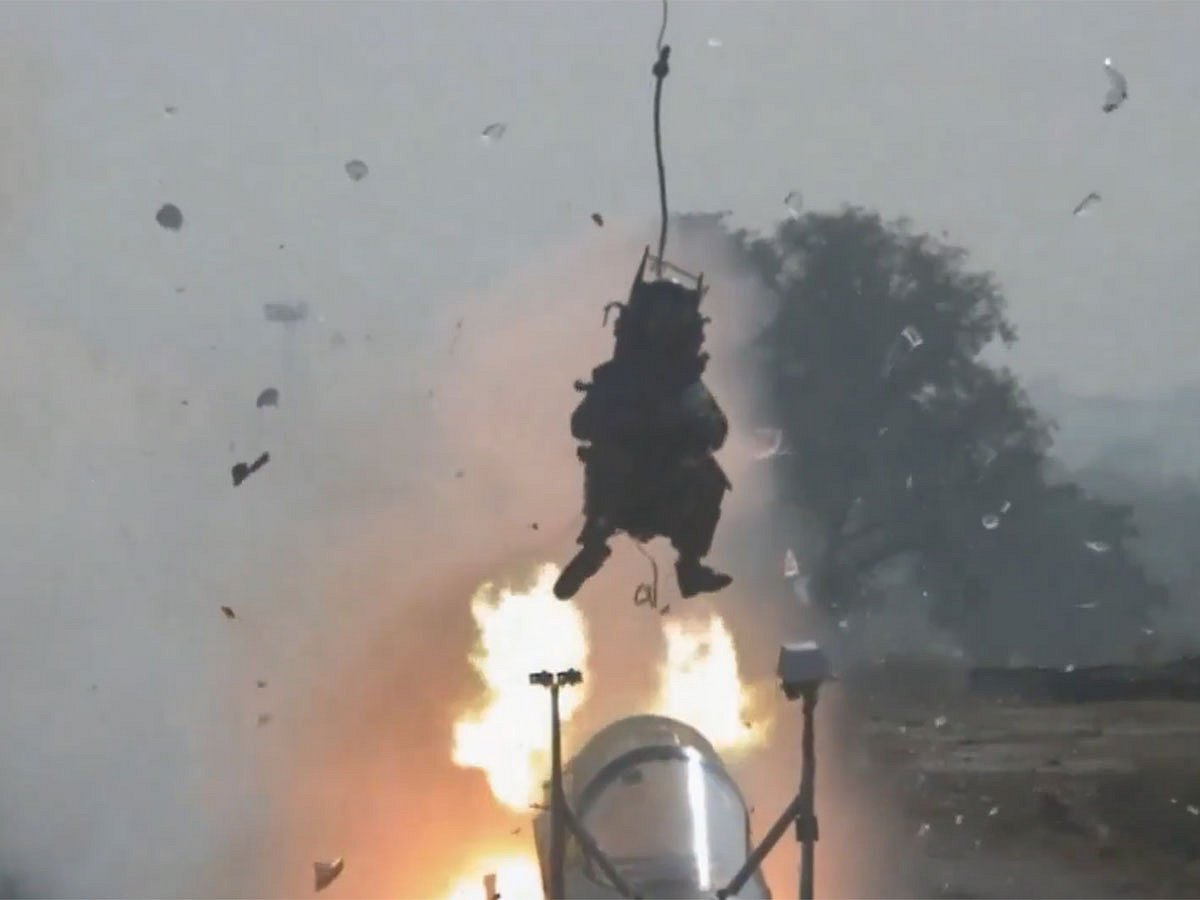
Dubai: India’s Defence Research and Development Organisation (DRDO) successfully conducted a complex, high-speed rocket-sled test of a fighter aircraft escape system at its facility in Chandigarh, validating the complete aircrew-recovery sequence.
The test, performed at the Rail Track Rocket Sled (RTRS) facility of the Terminal Ballistics Research Laboratory (TBRL), saw a Light Combat Aircraft (LCA) forebody propelled to a precisely controlled velocity of 800km/h, achieving a significant technological milestone for the nation's indigenous defence capability.
“This complex dynamic test places India in an elite club of nations with advanced in-house escape system testing capability,” the DRDO confirmed in a statement following the procedure. Defence Minister Shri Rajnath Singh complimented the agencies involved, describing the event as a “significant milestone for India’s indigenous defence capability towards self-reliance.”
The trial used a dual-sled system and phased firing of multiple solid propellant rocket motors to simulate a real-world high-speed ejection. It specifically validated the critical functions of canopy severance, the precise ejection sequencing, and the subsequent aircrew recovery process.
Dynamic ejection tests, which are considerably more complex than static assessments like the ‘Net test’ or ‘Zero-Zero test’, serve as the true measure for evaluating an ejection seat’s performance and the efficacy of the canopy severance system.
During the test, an instrumented Anthropomorphic Test Dummy was used to simulate the pilot, recording critical data including loads, moments, and accelerations that a crew member would experience during a live ejection. The entire sequence, including the canopy fragilisation pattern, was meticulously captured using both onboard and ground-based imaging systems.
The successful demonstration was a collaborative effort involving the DRDO, the Aeronautical Development Agency (ADA), and Hindustan Aeronautics Limited (HAL). Officials from the Indian Air Force (IAF), the Institute of Aerospace Medicine, and certification authorities were present to witness the trial.
Secretary, Department of Defence R&D and Chairman DRDO Dr Samir V Kamat also congratulated the team associated with the successful demonstration. The development underscores India's push towards greater self-sufficiency and technological mastery in critical aerospace safety systems.

Sign up for the Daily Briefing
Get the latest news and updates straight to your inbox
Network Links
GN StoreDownload our app
© Al Nisr Publishing LLC 2026. All rights reserved.