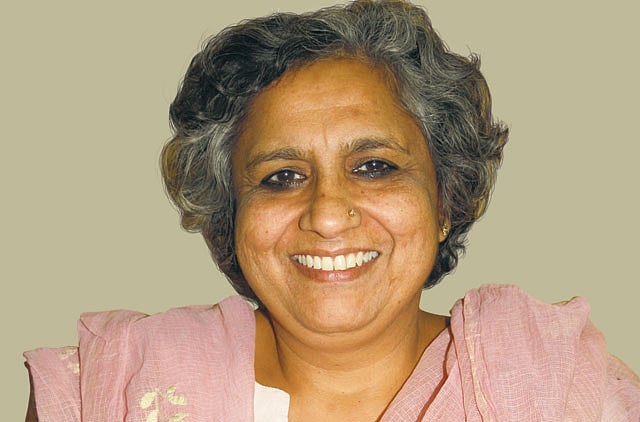
New Delhi: Anjali Gopalan, founder and executive director of New Delhi-based NGO, Naz Foundation, has made it to Time magazine’s list of 100 most influential people in the world. Naz (Pride) is dedicated to the fight against the HIV/Aids epidemic and also runs an orphanage for HIV-positive children.
At a time when family members and doctors in hospitals would refuse to touch people infected with HIV, Anjali opened her doors for them.
Seeing her dedication, Hollywood star Richard Gere funded Naz for few years. Anjali says, “He is one of the nicest persons I have met. He is very caring, generous and good-hearted.”
Anjali is herself all of that and more. Her strength of character, indomitable spirit and sensitive approach has touched thousands of lives. She believes that raising awareness on any issue is the first step to solving it.
She spoke to Gulf News in an exclusive interview.
GULF NEWS: Having worked relentlessly in the field for nearly two decades, did you expect to make it to the list anytime?
ANJALI GOPALAN: Absolutely not. It came as a surprise or rather as a shock. That’s because worldwide only 100 people are chosen. And I suppose, when one works on something, one does not regard it as something phenomenal. Time magazine sent me an email saying I was on the list, but I thought someone had hacked into my mail, and ignored it. Two days later, an overtly excited friend in the US called up to inform I was on the list and then it sunk in.
Apart from boosting your morale, in what way has the recognition benefited NAZ?
A lot more people have approached us for help. Even though I think it’s too early to say how it will benefit, it sure is likely to open doors. It will allow us to take the advocacy component of our work further. That runs through all our programmes and advocacy is always difficult — whether you want to meet people in position or try to bring about changes in the system.
How was the experience of working in the US on issues related to HIV/Aids?
I started working in the US in 1986. It was a huge learning process. My stay there gave me a lot of skills and since HIV/AIDS is all to do with human nature, attitudes and values, it helped me make that transition very easily. When I came to India in 1994, I could transfer all that easily.
Was there any particular reason for choosing to work in this particular field?
My first job in the US was with a community-based group in Brooklyn, New York. I was working with migrant Asians and undocumented migrant labourers on issues of health, including HIV. One day, my boss said that I was good at counselling and should get formal training. This is how it all began. So, it was by chance that I stepped into this area of work.
What made you return to India to set up NAZ?
I came back for a very selfish reason — to be with my parents, who were getting older. I didn’t have any lofty ideas, but I soon realised that I could actually use the skills I had acquired, to good use. It gave me a purpose to do something that was really needed.
What challenges did you face initially?
Since I had been out of the country for many years, it was difficult understanding the system. Except for Mumbai, there was no institution in any part of the country for HIV/AIDS patients. I had seen what the epidemic had done to people in the US and knew it would not be long before something similar happened here.
I realised that men, who had physical relations with other men, were married and had children. It was clear how it would impact the lives of women and children too. When I spoke on the issue, there was strong resistance from women’s groups. And, in fact, the government agencies were worse. It was very challenging and kept me engaged, as I had to fight at every level. And when something like this happens, you become more focused.
Since then, several NGO’s and government organisations have been working in this field. Have the number of HIV/AIDS cases come down?
According to the government data, the numbers have reduced. And yes, in some states, it has, but about many other states, we do not really know. Most of the resources have gone into states in the west, south and the northeast, but in the northern belt there hasn’t been much focus. And indications of the epidemic are all there, as there is lot of migration within the country. Many people are migrating to what we call — high prevalence states. So, even if the government feels we have been able to reverse the epidemic, I don’t think we can sit back and be complacent. For, it won’t be long that we again see an upsurge of infection.
How did you come across the HIV-positive orphans for whom you run a home?
The children were referred to us from orphanages, because HIV positive children cannot be put up for adoption. Others came from government institutions, hospitals and child welfare committees. Sometimes extended families bring them saying they cannot take care of them. Our criterion though is to keep those HIV-positive children who have lost both parents and have no extended family support. It’s unfortunate that a lot of kids die without getting any kind of care. We have 29 children in our home. The youngest, who is now 5-years-old, came to us when he was just 6-months-old and the eldest is 20 years.
What is lacking in the government’s approach as far as improving the quality of life for children is concerned?
Overall, the quality services for children are very limited. And the approach is not right if you look at children’s homes and talk about numbers. Institutions are not the answer, but they have to be part of the answer. The government needs to find a place for children who do not have any kind of community support or those who are physically and mentally challenged and are also HIV positive. Whether it is taking care of their medication, nutrition or education, we need to get serious. Another important aspect is the safety of children, as they are the most commonly abused. But sadly, the government is not even trying to do anything. We do not have a law yet against trans-sexual abuse. While the old law is not enough, the new one is taking so long to be introduced and implemented.
Do you think endorsements by celebrities can help a cause?
Yes, it does focus on the cause. But it can also have a negative impact to some extent, as it becomes the flavour of the month. And when the celebrity moves on to endorsing something else, the focus also moves away. A good example is that of female foeticide. We have been talking about it for years. But after Bollywood actor Aamir Khan did one show, the subject became a matter of discussion.
Sign up for the Daily Briefing
Get the latest news and updates straight to your inbox
Network Links
GN StoreDownload our app
© Al Nisr Publishing LLC 2026. All rights reserved.