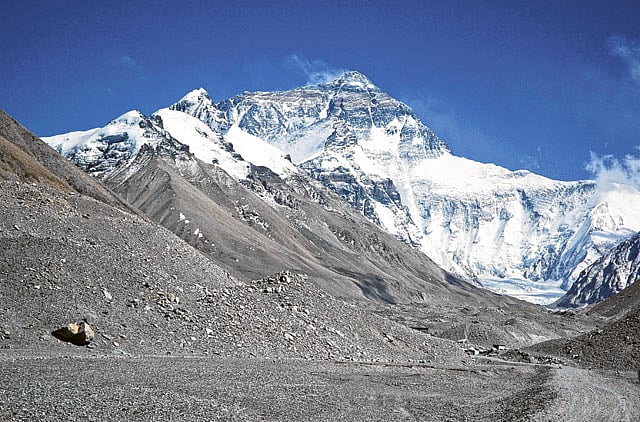
The climb to Everest base camp is a journey into a monochrome world, a landscape of rock, ice and grey sky. The only spots of colour are the bright, domed tents of the few climbing teams willing to attempt the summit in the off-season.
There are no birds, no trees, just the occasional chunks of glacier splashing into pools of pale green meltwater like ice cubes in some giant exotic drink. The stillness suggests nothing has changed for decades, but Tshering Tenzing Sherpa, who has been in charge of rubbish collection at base camp for the past few years, remains uneasy. "Everything is changing with the glaciers. All these crevasses have appeared in the ice. Before, base camp was flat and it was easy to walk," he said.
Climbers had reported that they barely needed crampons for the climb, there was so much bare rock, Tenzing said. That is not how it was in Edmund Hillary's day. Tenzing pointed towards the Khumbu ice fall — the start of the climb, and part of a 16-kilometre stretch of ice that forms the largest glacier in Nepal. "Before, it was totally blue ice, and now it is black rock on top," he said. He is convinced the changes have occurred in months — not years, or even decades, but during the brief interval of the summer monsoon. "This year it has totally changed," he said.
This much is known: Climate change exists, it is man-made, and it is causing many glaciers to melt across the Himalayas. Beyond that, however, much is unclear or downright confusing. For that, scientists blame a blunder in a United Nations report that was presented as the final word on climate change. The 2007 report which included the false claim that the Himalayan glaciers would disappear by 2035 did more to set back science, and delay government action on climate change, than any other event. The scandal, known as Glaciergate or Himalayagate, was a gift to climate-change deniers when it came to light early last year and a deep embarrassment to glaciologists. Now they are desperately trying to recover.
Mention melting and Himalayas to almost any glacier expert working in the region, and they will instantly plead for caution: Please do not repeat the mistake of thinking all the ice will be gone in the next few decades. "It was just nonsense," said Alton Byers, the scientific director of the Mountain Institute. "It's absolutely staggering when you look at some of those high mountains. They are frozen solid, at minus 15 or minus 20 degrees, and they are going to remain that way."
But at lower elevations, it is a different scenario, Byers said. Low-lying glaciers are melting, and far more rapidly in the past 10 or 15 years than in previous decades, scouring out new landscapes and creating a whole new realm of natural disasters.
I accompanied the Mountain Institute and 32 scientists and engineers from more than 13 countries on an expedition looking into some of the new hazards.
After flying to the Nepalese town of Lukla — landing in an airport partly built by Edmund Hillary — the 18-day trek took us to Everest base camp and to Imja lake to look at a prime potential danger of climate change in the mountains: catastrophic, high-altitude floods. Melting ice turns to glacial lakes which grow in size until — one day — they risk rupturing their banks, spewing out rocks and debris. Such outbursts can kill, and they almost always invariably destroy infrastructure and land, burying fields in several metres of rubble.
That is seen as the biggest potential hazard. There are more than 1,600 glacial lakes in Nepal alone, of which about a half-dozen are considered very dangerous. But glacier loss could also destabilise mountainsides or devastate water supplies. Some of Asia's mightiest rivers — the Indus, the Ganges, the Brahmaputra — depend to some extent on seasonal glacier melt. In Pakistan, the Indus river system derives between 60 per cent and 80 per cent of its flow from summer melt, according to Amjad Masoud of Islamabad's Global Change Impact Studies Centre. In Uzbekistan, half of the rivers in the Tashkent area rely on water from glaciers, said Maxim Petrov, head of glaciology at the Academy of Sciences.
The problem is people who live with the mountains are already convinced their landscape is changing and have given up on waiting for scientists to confirm it. Local people say they can see evidence of climate change everywhere: Trees growing higher up mountain slopes, houseflies buzzing at almost 16,500 feet, monsoon rains arriving at inconvenient times.
Some see the hand of divine retribution. Kancha Sherpa, the sole surviving member of Hillary's expedition, believes the melting glaciers are a punishment for defiling nature. Now 79, he spends his time in the main town of Namche Bazaar in a room painted pale pink and lined with pictures of past expeditions. "I believe the gods reside in the mountain, and now with all the mountains being climbed, they have been polluted. I believe God is not happy with all the people climbing in the hundreds."
Birendra Kandel, a conservation officer at the Sagamartha National Park, which includes Everest, argues that animals are already roaming beyond their typical ranges. A few years ago, on a field trip, he spotted a common leopard prowling well into snow leopard heights.
Others are also convinced familiar landscapes are changing before their eyes and that the cause is global warming. Not far from the Everest, tucked into the mountains at 16,600 feet, near the village of Lobuche, there is a three-storey glass pyramid that looks like it belongs on the sets of an Austin Powers film. It is a high-altitude research station run by an Italian organisation dedicated to research on the Himalayas. Earlier this year, crews from the pyramid, as it is usually known, strapped on crampons and installed a weather station on the south col of Everest at about 26,250 feet. There are plans to go even higher next spring, placing a weather station on the summit itself.
The data from the south col, on temperature, air quality and ozone levels, has just started coming in. Ka Bista, a Nepalese staffer who mans the pyramid when the Italians are in Europe, says the changes are evident now. "Since the past five or ten years before and now, there are many differences in the glaciers. Before, you could see ice," Bista said, pointing to the bare black rock visible through the pyramid. "Yearly the snow is melting and going further up the mountain, and the temperature is also going up." Winters have also grown milder, he said. In 2006, February temperatures were minus 23 or 24 Celsius. This past February it was almost balmy in comparison, Bista said, at minus 17 or 18 degrees. The changes are disorienting for local people, Bista said. "Ten years ago a trekking guide could tell you the names of every mountain, but now they are all completely black and the guides can't recognise their names."
But what became clear on the Mountain Institute expedition was the disconnection between such personal experiences and the scientific process. People living in the mountains say they can see signs of climate change. Climbers who have scaled Everest say they can see evidence of climate change. But the problem is that it is immeasurably harder to produce conclusive scientific documentation of those changes — which glaciers are melting and how fast? — and Himalayagate has made scientists especially cautious.
Put simply, the region is just too big, and too remote. Between them the mountains of the Himalayas, the Hindu Kush, the Kar-akorams, the Pamirs and the Tien Shan store more ice than anywhere outside the North Pole and the South Pole. There are believed to be about 15,000 glaciers across the Himalayas.
But even that number should not be taken as gospel, according to Dorothea Stumm, of Icimod. Scientists can't even agree on which mountain ranges should be included in the count. "At present it is safer to talk about several tens of thousands of glaciers instead of a specific number," Stumm wrote in an e-mail. Then, there is the question of size. "How big does an ice patch need to be to be called a glacier?" Stumm said. Smaller ones might not even show up on low-resolution satellite images. And how do you count a bigger glacier that has split into two smaller blocks of ice? And it is not as if scientists can just pop out for an afternoon and measure some of the large glaciers in the Himalayas. The Khumbu glacier, which runs alongside the Everest, is a good eight or nine days' walk from the nearest airport at Lukla. The glaciers of Bhutan are even further removed, and the Siachen glacier is an actual battlefield, with India and Pakistan maintaining troops there at 19,685 feet.
The result, according to Byers, is a big knowledge gap. Scientists have access to satellite images of the Himalayas but, compared with other regions, such as the Andes or the Alps, there is relatively little on-the-ground research. Satellite imagery only gives a partial picture; it can reveal a glacier shrinking in length, but it gives little indication of whether the ice is thinning.
"It's pretty much a vacuum, the Himalayas," Byers said. "The Alps and the Andes are well studied. In the Himalayas, for reasons of logistics, hardship and altitude, there still hasn't been a whole lot of detailed field work done."
Nevertheless, some definitive patterns are emerging. In Nepal, south-facing glaciers, especially at lower elevations below about 16,500 feet, are thinning and growing shorter at a rapid rate. Some — especially the glaciers that are relatively clear of debris — have already disappeared. Those glaciers covered in a sufficiently thick mask of grit and rock have a better chance. If the covering is thick enough, say greater than a metre, the layer of rocks and debris acts like an insulation blanket, preserving the glacier from more rapid warming.
But even the greatest glaciers, such as Khumbu, are in retreat. On the way up to base camp, the signs seem evident in the small ponds now forming on the surface. "It is a sign of degradation," Petrov said. "Of course, this glacier is not degrading so intensely as smaller glaciers, but if you compare the old glacier 40 or 50 years ago with the glaciers of today, it is retreating."
So where does that leave the Himalayan glaciers? Will there still be glaciers in the big ice repository a generation from now? Probably, but don't count on it for much longer than that, Byers said.
Sign up for the Daily Briefing
Get the latest news and updates straight to your inbox
Network Links
GN StoreDownload our app
© Al Nisr Publishing LLC 2026. All rights reserved.