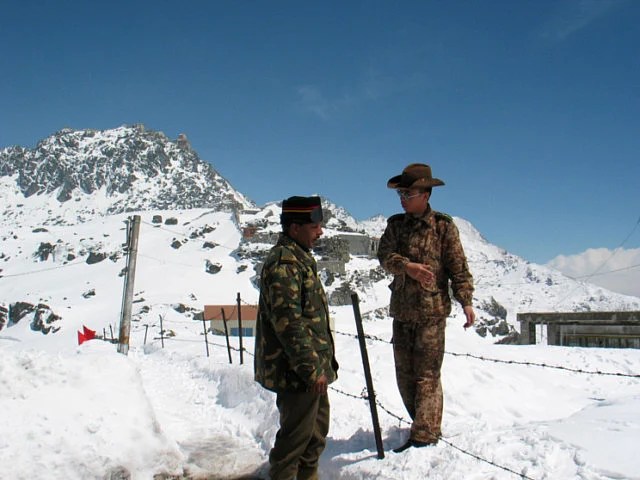
New Delhi: A standoff between Indian and Chinese soldiers overshadowed a visit to New Delhi by China’s President Xi Jinping on Thursday, with a $20 billion (Dh73.47 billion) investment pledge eclipsed by robust comments from India’s new Prime Minister Narendra Modi about the dispute.
Modi and Xi emerged from a long meeting to address a news conference shortly after officials confirmed that the soldiers had pulled back from their positions in a barren area of the Ladakh plateau in the western Himalayas claimed by both nations.
“I raised our serious concern over repeated incidents along the border,” said a stern-sounding Modi, a nationalist who was elected in May partly on promises to build a more assertive India. “There should be peace in our relations and in the borders. If this happens we can realise true potential of our relations,” he said, with Xi sitting to his right.
Dozens of soldiers from both sides had faced off on the Ladakh plateau for over a week in a dispute about infrastructure works near the de facto border, where the two countries fought a brief war in 1962.
Raising hopes for a renewed push to resolve their territorial differences, Modi called for an early border settlement with China. The two sides have held 17 rounds of border talks since the early 1990s without making significant progress. Modi has not assigned a special envoy to restart the talks since he took office in May.
“We have to address the boundary question very soon,” Modi said, urging “clarification” of the Line of Actual Control — the front line where fighting ended in the 1962 war.
In his speech at the same event, Xi played down the tensions and agreed with Modi that they should work to settle the border question at an early date, reiterating language China has used in the past.
“Sometimes there might be certain incidents, but the two sides are fully capable of acting promptly to effectively manage the situation,” he said.
The lack of a clearly demarcated boundary in the barren Himalayan region has in the past led to incidents in which New Delhi said Chinese troops crossed into its land, while Beijing said Indian troops were occupying Chinese territory.
While analysts believe there is little danger of a conventional war breaking out between the two countries, the frequent border skirmishes make it difficult to achieve a lasting resolution. The two sides have held several rounds of talks on their boundary dispute, but have made little progress.
China claims about 90,000 square kilometres of land in India’s northeastern state of Arunachal Pradesh, while India says China is occupying 38,000 square kilometres of territory on the Aksai Chin plateau in the western Himalayas.
Another cause for bitterness is China’s deep ties with Pakistan, India’s archrival.
M.D. Nalapat, who heads the department of geopolitics at India’s Manipal University, said India’s new government saw that working with China was 90 per cent upside, and should not be undermined by the two countries’ differences.
“Modi is looking at an opportunity, and will not sacrifice it because of the 10 per cent threat,” Nalapat said in an article written for the Gateway House think tank.
“China needs India — as a market, as a source of trained manpower, and as a friendly neighbour. I believe that Xi has the ability to break through the negativism about India.”
Another irritant for China is the presence in India of exiled Tibetan spiritual leader the Dalai Lama, who has lived in the north of the country since fleeing a failed uprising against Chinese rule of his homeland in 1959. A government of exiled Tibetans and tens of thousands of refugees are also based in India.
In one sign that India wanted the Xi visit to be a success, New Delhi asked the Dalai Lama, whom Beijing labels a dangerous separatist seeking an independent Tibet, to reschedule an event in the capital so that it would not clash with the Chinese president’s trip.
About 20 supporters of a free Tibet, mainly women, protested within a few metres of the building in New Delhi where Modi and Xi were holding talks, waving Tibetan flags and shouting “We want justice.” Police detained them after a few minutes. Several other small pro-Tibet protests broke out across the city.
Sign up for the Daily Briefing
Get the latest news and updates straight to your inbox
Network Links
GN StoreDownload our app
© Al Nisr Publishing LLC 2026. All rights reserved.