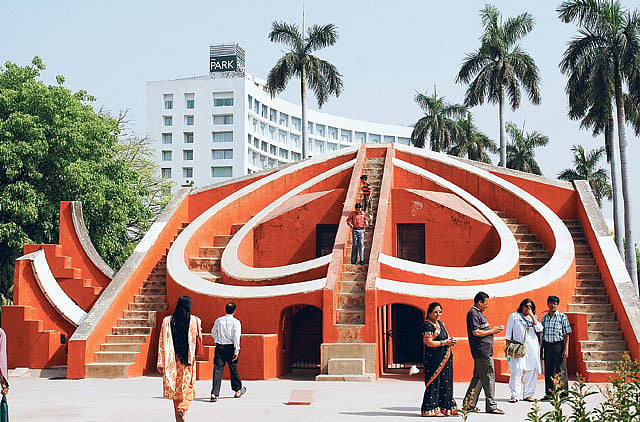
New Delhi: When Sawai Jai Singh of Rajasthan built the Jantar Mantar, the 18th century astronomical monument, he wanted to facilitate naked eye observation to make science of astronomy accessible to as many people as possible, says veteran architect and conservationist Anisha Shekhar Mukherji.
"When Jai Singh built the first Jantar Mantar in New Delhi around 1710, he was aware of the existence of the early telescopes that concentrated on specific objects. But he wanted astronomers to look at the expanse of the sky. He wanted to facilitate naked eye observation and to make science of astronomy accessible to as many people as possible," Mukherji, the woman behind the restoration of the Jantar Mantar in the capital for the last 10 years, told IANS in an interview.
First laboratory
Mukherji, also the author of a comprehensive book on the history and the conservation of the historic Red Fort, has turned the spotlight on the country's first astronomical laboratory in a new book, "Jantar Mantar: Maharaja Sawai Jaisingh", published by Ambi.
The Jantar Mantar is back in the reckoning after the Unesco added the Jantar Mantar in Jaipur on the Maharaja's native turf to the list of World Heritage Sites in India this year.
India has five Jantar Mantar at Delhi, Jaipur, Ujjain, Mathura and Varanasi.
"The Jantar Mantar in the capital is significant because it was the first in the series of five built by Jai Singh in the country. It is of great cultural significance because the new astronomical tables [that forms the basis of native almanacs] was made on the readings taken from the Jantar Mantar — coinciding largely on the observations made by astronomers at the Delhi Jantar Mantar between 1728 and 1732," Mukherji said.
The Jantar Mantar is also important for astrologers because "astronomy is closely linked to astrology that requires to take into account the positions of the sun and the moon for predictions," Mukherji said. It was used for forecasting changes of seasons, she said.
Calendar
The Maharaja was deeply spiritual and "wanted to devise a common calendar with the help of observations from the Jantar Mantar," Mukherji said.
"Recognition of Jantar Mantar as a world heritage site was necessary to highlight its importance."
"I think the reason why the Unesco preferred the Jantar Mantar in Jaipur over the one in the Delhi in its decision to grant it the status was its strategic location next to the City Palace in the heart of Jaipur," she said.
Sign up for the Daily Briefing
Get the latest news and updates straight to your inbox
Network Links
GN StoreDownload our app
© Al Nisr Publishing LLC 2026. All rights reserved.