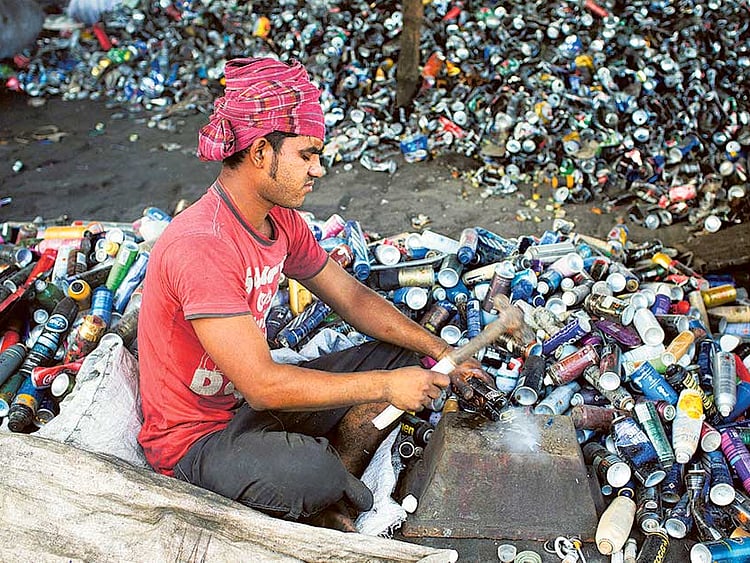
Keraniganj, Bangladesh: Mohammad Jamal last saw his now four-month-old daughter when she was two days old. He doesn’t know when he will see her next.
For most of his adult life, the 33-year-old has worked menial and risky jobs far from his home and family. He is among millions of impoverished Bangladeshis forced to eke out livelihoods as migrant workers.
“I have no land to cultivate and I’m the only working hand in my family. It’s hard to stay far from home, but I’m working hard for a better future for my child,” he says, showing pictures of the cherubic little girl on his cell phone.
Jamal works at a small aluminium recycling factory in Keraniganj, on the outskirts of the capital, Dhaka. A large swath of land not far from the Buriganga River is dotted with makeshift tents that are home to men and women who work 12 hours a day recycling cans, industrial ash and medicine blister packets into raw aluminium. Those aluminium blocks are then sold to companies that make machine parts.
The work is difficult and dangerous. The workers have no safety equipment or masks to protect themselves from the fumes and aluminium dust.
The toil earns the men and women an average of $10 a day. Why do so many people leave their hometowns for such a small sum? Because more than 40 million of Bangladesh’s 166 million people survive on less than $2 a day.
Sign up for the Daily Briefing
Get the latest news and updates straight to your inbox
Network Links
GN StoreDownload our app
© Al Nisr Publishing LLC 2026. All rights reserved.