HOW A HEAT PUMP WORKS: In "Heating Mode", it extracts heat energy from outdoor air, ground, or water sources (even in freezing temperatures) and transfers it indoors. In "Cooling Mode", it reverses direction, operating exactly like an air conditioner by pulling heat out of your home and venting it outside.
Why the US is falling behind on renewables as China ‘eats our lunch’: America ceding global leadership — by prioritising fossil fuels, warns lawmaker
National security threat: US pushback on renewables in favour of costly, aging alternative
Last updated:
6 MIN READ
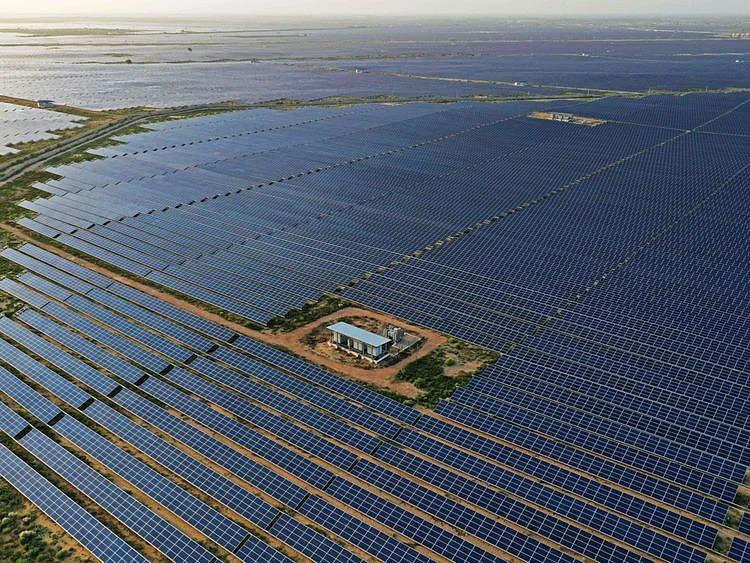
Countries are taking steps towards developing renewable sources of energy, including wind, solar, nuclear, geothermal and hydropower, following more than 200-years-long use of fossil fuels as the primary source of energy, heating and cooling. Photo shows solar panels at the site of solar energy projects developer Saurya Urja Company of Rajasthan Limited, at the Bhadla Solar Park, in the northern Indian state of Rajasthan. File photo taken on October 6, 2021.
AFP
WASHINGTON: US Rep. Dave Min (D‑California) used a House oversight hearing recently to argue that the United States should be “leading” the global renewable‑energy drive, instead of deliberately losing out to China.
Then he gave a stark warning: China is “eating our lunch” by exporting out-of-the-box cheaper and cleaner energy technology and gaining influence across Asia, the Americas and Africa.
During the hearing titled “No Flame, More Pain: How State and Local Bans on Natural Gas Increase Costs,” Rep. Min, an economist and lawyer who is a US Representative for California's 47th Congressional District (also a former California State Senator), pressed witnesses on whether the US was "falling behind" in the energy transition, even as Republicans defended natural gas as a lower‑cost option for households.
Energy expert Dr. Pete Wyckoff, who testified as a resource person, reinforced Min’s point that battery storage and other technologies are making renewables increasingly cost‑competitive.
Get it: Fast, verified news for FREE ... download the Gulf News app — simply click here
'China is eating our lunch': Influence via renewables
Rep. Min, 50, said over 80% of China’s new energy capacity added last year came from renewable sources, contrasting that with far slower US additions.
He argued that Beijing is using clean‑energy exports to build long‑term economic and diplomatic leverage in developing regions.
Up to $52 billion
Amount of direct subsidies + tax breaks given by the US government to the fossil fuel industry annually (Sources: Oil Change International and Earth Track)
"In many areas (in the US), replacing the natural gas infrastructure was so much more expensive than moving to all-electric that they (utilities) could literally replace all the gas-burning appliances — home heating, ranges, stoves, etc — they could replace that for free, the consumer would actually have a lower cost. So free appliances, lower cost of utilities: that sounds like a great deal, right?"
To which Dr. Pete Wyckoff replied: "That sounds good to me."
Rep Dave Min said: "This is crazy."
"I would just note that what these witnesses on the Republican side are proposing is reinvesting in aging technology that is becoming more expensive day by day. And as we move forward it is clear that renewable energy is the future. It would be cheaper. In many place, it already is cheaper."
America ceding global influence by prioritising fossil fuels?
Then he press on the national security issue: Rep. Min said America risks ceding global influence if it continues to prioritise fossil fuels while China dominates solar, wind and battery supply chains.
As we move forward, it is clear that renewable energy is the future. It is going to be cheaper, and in many places it already is cheaper. And doubling down on aging oil and gas infrastructure is like doubling down on the horse and buggy or wood-burning stoves. I’m sure that if this hearing were taking place in 1926 instead of 2026, these witnesses would probably be testifying in favour of wood-burning stoves right now.US Rep. Dave Min (D‑California)
Why natural gas — and why replace it with electric?
Republicans at the hearing cited data that homes using electric heating paid more than $1,200 in seasonal bills versus about $700 for gas‑heated homes, and that the American Gas Association estimates average monthly savings of more than $66 for gas over electric appliances.
Min, however, argued that the picture changes when utilities face the cost of maintaining or replacing aging gas distribution systems, which need regular or preventive maintenance.
He said that in parts of California, utilities found it so expensive to replace old gas pipes that it would be cheaper to retire local gas lines entirely and provide free electrification upgrades — swapping gas stoves, water heaters and furnaces for induction cooktops, "heat pumps" and other electric appliances.
Under California’s SB 1221, authored by Min as a state senator, up to 30 neighborhood‑scale pilots can use avoided pipeline costs to fund those appliance swaps, with replacing a single mile of pipe estimated at $3 million to $5 million or more.
WHAT ARE HEAT PUMPS? A heat pump is an electrical heating and cooling system that transfers thermal energy between the indoors and outdoors. Unlike traditional heating systems that generate heat through combustion or electrical resistance, heat pumps move existing heat from one location to another using a continuous refrigeration cycle.
Aging pipes, expensive infrastructure
Min and supporters of electrification argue the US gas industry relies on an aging, leak‑prone network of distribution pipes that is increasingly costly to maintain and upgrade, especially as decarbonisation policies reduce long‑term demand for gas.
They contend that continuing to invest heavily in new or replacement gas infrastructure risks locking ratepayers into expensive assets that could become underused as buildings shift to electric heating and cooking.
What is 'Duty to Serve'?
In the United States, the “duty to serve” is a legal obligation requiring regulated public utilities to provide essential services to customers in their designated service areas, subject to applicable rules and conditions.
In the electricity industry, it generally means that a utility cannot simply refuse to connect a qualifying customer because serving that customer is less profitable than serving others. It must provide adequate, reasonably reliable service and treat customers fairly, within the limits of its legal obligations.
How does it work?
Electricity: A regulated utility generally must connect eligible customers within its service territory, maintain its network and provide adequate service.
Natural gas: Regulated gas utilities may have similar obligations to serve customers in their designated areas, subject to safety, infrastructure and state-specific rules.
Oil: The same principle does not automatically apply to every oil company. Oil producers, refiners and fuel retailers generally do not have a universal obligation to sell to every customer. Specific pipeline operators or other regulated entities may have separate duties under applicable laws or tariffs.
Does 'Duty to Serve' apply in all 50 US states?
Yes, in some form. A 2022 law-review analysis says all 50 states recognise a form of the utility duty to serve, although the details and scope vary by state. The obligation generally applies within a utility's service territory; it does not mean that every company must supply every customer everywhere.
For example, Alabama law requires utilities to provide adequate service and make reasonable improvements to meet the needs of the territory they serve.
There's a key distinction: The "duty to serve" is not a blanket requirement for all oil and electricity businesses to sell energy to everyone. It is primarily a public-utility obligation, with the precise rules depending on the service, company and jurisdiction.
Why are heat pumps more efficient than fossil fuels?
The primary reason heat pumps outperform fossil fuels comes down to heat transfer versus heat creation:
Efficiency ratios exceeding 100%: Burning fossil fuels (natural gas, oil, propane) can convert up to 95–98% of the fuel's potential energy into usable heat. Heat pumps do not create heat; they transfer it. For every 1 unit of electricity used, a heat pump delivers 3 to 4 units of heat energy, resulting in an efficiency of 300% to 400%.
Lower energy usage: Moving thermal energy takes significantly less electrical power than burning fuel to create it, drastically reducing baseline primary energy consumption.
Decarbonisation potential: Fossil fuel furnaces emit greenhouse gases at the point of combustion. Heat pumps run entirely on electricity, meaning their carbon footprint decreases automatically as power grids transition to renewable sources like solar and wind.
China's dominant position in heat pump manufacturing
Yes, China currently holds a dominant lead over the US in heat pump manufacturing, global market share, and supply chain control.
Market share, volume: The Asia-Pacific region accounts for nearly 50% of global heat pump market demand, led by China.
Major domestic manufacturers like Gree, Midea, and Haier produce the vast majority of air-source heat pumps and compressors supplied globally.
Supply chain dependency: China controls critical upstream supply chains for heat pump manufacturing, including compressor production, heat exchangers, rare earth magnets for motors, and electronic expansion valves.
US positioning: While heat pump adoption in the US has expanded significantly (passing annual gas furnace sales and supported by tax incentives under federal policy), the US relies heavily on imported heat pump components and sub-assemblies from Asian manufacturing hubs.
China, with 120 nuclear reactors generating up to 135 GW, is also among the world's top generators of nuclear power vs America's 94 commercial nuclear reactors generating 470 GW on average.
Network Links
GN StoreAbout Gulf NewsTerms & ConditionsReach by GNSitemapContact usPrivacy PolicyGN FocusHave your sayWork with usAdvertise with usGulf News epaperPrinting Services
Download our app
© Al Nisr Publishing LLC 2026. All rights reserved.