Trump can't stop America's clean-energy boom: Here's why — and how
AI-era electricity demand fuels record US solar and storage buildout
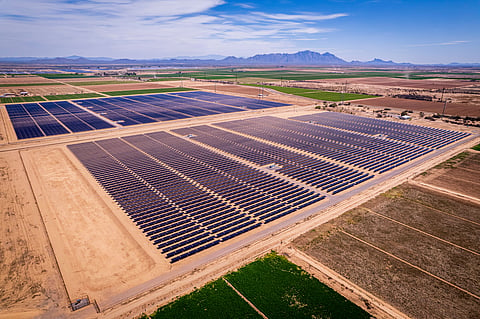
It's a disruption from above.
Despite a sharp shift in US energy policy under President Donald Trump, solar power continues to dominate the country's electricity expansion, official government data shows.
This underscores one reality: economics.
New data from the Federal Energy Regulatory Commission (FERC) shows solar was the single-largest source of new US power-generation capacity for 28 consecutive months through the end of 2025.
Utility-scale solar alone accounted for 72.6% of all new electricity capacity added last year, while renewable energy sources collectively represented 88% of total new additions.
The figures highlight a growing disconnect between political rhetoric and market realities.


Since returning to office in January 2025, Trump has sought to roll back many of the clean-energy incentives introduced under former President Joe Biden, arguing that the United States should prioritize fossil fuels, including oil, natural gas and coal.
The first solar-powered satellite was Vanguard 1, launched by the United States on March 17, 1958. It was the first spacecraft to successfully use photovoltaic technology in space.
His administration has moved to weaken support for renewable-energy projects and unveiled plans aimed at reviving domestic coal production.
Yet the nation's energy developers continue to build solar farms, battery-storage facilities and other renewable-energy projects at a rapid pace.
Ember, an industry tracker, reported that solar met 61% of US electricity demand growth in 2025. Electrons generated by the Sun proved "invaluable" in meeting fast-growing electricity demand in a way that no other power source could have provided more affordably and efficiently.
Industry analysts say the reason is simple: renewable energy is increasingly the cheapest — and fastest — source of new electricity.
"The economics of renewable energy are overwhelming," argues environmentalist and author Bill McKibben.
And despite political friction, the financial superiority of renewable energy (such as solar) over fossil fuels is so massive that it is driving rapid adoption.
The sentiment has also been echoed by other energy analysts including Stanford University's Tony Seba, citing the undeniable cost-competitiveness of green power.
In recent RethinkX updates, Seba has doubled down on his core thesis that the combination of solar, wind and batteries (SWB) is becoming the dominant energy system.
Cost curve
The reason: it is following exponential cost declines similar to those seen in computing and telecommunications.
Renewable systems can operate reliably with battery support, are commercially viable rather than hypothetical.
Seba also pointed out the large amounts of low-cost surplus energy, claiming 2026 as a potential "breakout year" for grid-scale battery storage, a process that's already more than a decade underway.
Whether that happens as quickly as Seba predicts remains a subject of debate among energy analysts.
Tony Seba of Stanford University studies "cost reduction curves" following Wright's Law. If the rate of cost reduction with the default being a 15% per-unit cost reduction per doubling of total production, it is easy to predict outcomes. For example, a machine costs $1 million to make the first model, the second iteration costs $850,000 (as production doubles), the fourth costs $722,500, etc.
Rapid, sustained growth
But falling solar-panel costs, surging demand from data centres and artificial-intelligence infrastructure, and shortages of equipment needed to build new gas-fired power plants are helping sustain renewable-energy growth despite policy uncertainty.
The growth has already reshaped the US energy landscape.
Solar now represents a larger share of installed electricity-generating capacity than hydropower, nuclear power and wind power individually.
According to FERC projections, solar installations are expected to increase by another 86 gigawatts over the next three years, allowing the sector to surpass coal before the end of the decade.
If current trends continue, solar could become America's second-largest source of electricity-generating capacity by 2029, trailing only natural gas.
Why solar keeps growing
One of the biggest drivers is a bottleneck affecting natural gas expansion.
Utilities seeking to meet rapidly rising electricity demand — particularly from artificial intelligence, cloud computing and advanced manufacturing — have encountered a shortage of gas-fired turbines, delaying construction of new natural-gas power plants.
As a result, many utilities are turning to solar power and battery storage because they can be deployed much faster.
China controls over 80% of the entire global photovoltaic (PV) supply chain, spanning from raw polysilicon to fully assembled panels. Backed by heavy state support, cheap materials, and massive manufacturing scale, China’s production dominance has driven down global solar installation costs while triggering intense market competition.
"Renewables and storage continue to be the fastest way to get new electrons on the grid until additional gas-fired generation can be built," NextEra Energy CEO John Ketchum told Reuters.
The surge in power demand is being fueled by an unprecedented wave of investment in data centres, semiconductor manufacturing and AI infrastructure.
Tech companies are increasingly seeking large volumes of electricity, prompting utilities and investors to pursue virtually every available source of generation.
Nuclear, fusion energy, geothermal power
Alongside solar and batteries, investors are also pouring money into advanced nuclear reactors, fusion-energy research, enhanced geothermal systems and other emerging technologies.
A surprising global contrast
The rapid expansion of US renewables comes at a time when Europe — long regarded as the global leader in climate policy — is facing slower growth.
European energy markets continue to grapple with high costs and regulatory hurdles following the energy shock triggered by Russia's invasion of Ukraine. Additional volatility in global energy markets stemming from tensions in the Middle East has added further pressure.
Miguel Stilwell d'Andrade, chief executive of Portuguese utility EDP, recently argued that the United States has become one of the world's most attractive destinations for renewable-energy investment despite the Trump administration's political stance.
EDP plans to direct more than half of its planned capital expenditures—about $5.3 billion—toward U.S. renewable-energy projects over the next three years.
The trend illustrates a broader reality confronting policymakers worldwide: while government incentives can accelerate clean-energy adoption, declining technology costs and growing electricity demand are increasingly driving the transition on their own.
For now, America's clean-energy boom appears set to continue, even as Washington debates the future of climate policy.
Fact File: America's 'Solar Boom'
Solar was the largest source of new U.S. power capacity for 28 consecutive months through December 2025.
Utility-scale solar accounted for 72.6% of all new electricity-generating capacity added in 2025.
Renewables represented 88% of total new U.S. power additions last year.
FERC projects another 86 gigawatts of solar capacity will be installed by 2028.
Solar is expected to surpass coal in installed generating capacity within three years.
• By 2029, solar could become the second-largest source of U.S. generating capacity behind natural gas.
• Shortages of gas-fired turbines are slowing new natural-gas power projects and increasing reliance on renewable energy and battery storage.
• The rapid growth of artificial intelligence and data centers is driving a historic increase in electricity demand across the United States.
Why it matters
Scientists from the Intergovernmental Panel on Climate Change (IPCC) have repeatedly warned that global greenhouse-gas emissions must decline sharply this decade to limit warming to internationally agreed targets.
The energy sector remains the largest source of human-caused carbon emissions.
The continued expansion of solar power, batteries, energy efficiency, electric vehicles and other low-carbon technologies is therefore viewed by climate experts as essential to slowing the pace of global warming while meeting rising energy demand.


