US Senate advances bid to curb Trump’s Iran war authority: Showdown looms
Veto threat hangs over US Senate push to rein in Trump on Iran
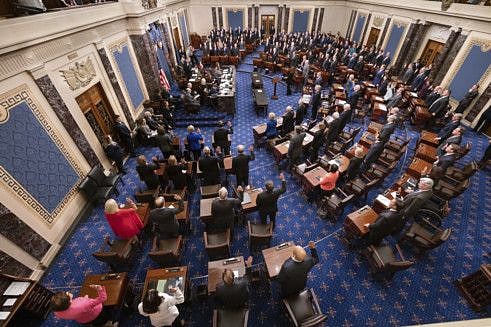
The Senate on Tuesday (May 19) took a first step toward debating limits on President Donald Trump’s authority to launch future military action against Iran, advancing a war powers measure in a 50–47 procedural vote that exposed rare bipartisan divisions over the role of Congress in matters of war.
The vote, however, does not necessarily mean the resolution will pass and Trump will be legally handicapped.
Instead, it opens the door to formal debate on the Senate floor, where lawmakers will test whether there is enough support to overcome the chamber’s 60-vote threshold required to end debate and move to a final vote.
The reason why it passsed was that while Democratic Sen. John Fetterman broke with his party to oppose the motion to proceed, four Republicans — Rand Paul, Susan Collins, Lisa Murkowski and Bill Cassidy — joined Democrats in allowing the measure to move forward.
Main obstacle
Several Republicans were absent Tuesday while campaigning in their home states, and GOP leaders have signaled little appetite for a binding vote on war authorisation.
But without 60 votes to close debate, the measure would stall.
That "cloture" vote is expected to be the central obstacle.
If senators do clear that hurdle, the resolution would then face a simple majority vote for final passage.
From there, it would move to the House, where its prospects are uncertain, before landing on Trump’s desk.
Symbolically important vote
Steps to be taken after the US Senate's 50–47 procedural vote to advance the Iran war-powers measure:
Step 1: The bill moves to formal debate on the Senate floor
Because the Senate agreed to proceed, the chamber now enters a period of structured debate on the resolution. Senators can speak for or against limiting the president’s authority to conduct future military action against Iran without Congress.
This is where party leaders try to shape the narrative and test whether there are 60 votes to move toward a final decision.
Step 2: Vote on cloture, 60 votes needed
Before the Senate can reach a final vote, it must first vote on cloture — the motion to end debate.
60 senators must agree.
If cloture fails, the measure stalls and effectively dies.
Given absences and Republican resistance, this is the biggest hurdle.
This is why Tuesday’s 50–47 vote is symbolically important, but not yet decisive.
Step 3: Final passage vote (simple majority)
If cloture succeeds, the Senate proceeds to a final vote, which requires only a simple majority (51 votes).
At this stage, the coalition that advanced the bill could, in theory, pass it — if the same senators hold and attendance improves.
Cloture is the only procedure by which the US Senate can vote to end a debate and limit further discussion on a bill or motion. It is primarily used to overcome a filibuster, allowing the Senate to move to a final vote.
How cloture works
The Threshold: Invoking cloture requires the affirmative vote of three-fifths of all sworn Senators, which is typically 60 votes.
Rule XXII: Under Senate Rule XXII, a cloture motion must be filed by 16 senators and voted on two days of session later.
Additional Time: If cloture is achieved, debate is limited to a maximum of 30 additional hours before a final vote is taken on the underlying
Trump expected to veto measure
The president would be expected to veto the measure, setting up a near-impossible attempt by Congress to override the veto with a two-thirds majority.
It revives a long-running debate in Congress over presidential war powers and forces senators to go on record as tensions with Iran remain high.
For now, the Senate's action only marks the beginning of that debate.
Still, beyond its legislative odds, the Senate's vote carries some political weight, though the end game is far from conclusive.
Sign up for the Daily Briefing
Get the latest news and updates straight to your inbox
Network Links
GN StoreDownload our app
© Al Nisr Publishing LLC 2026. All rights reserved.