The radar system of a Boeing E-3A AWAC (Airborne Warning and Control System) airplane
US loses key ‘eyes in the sky’ in Iran strike at Saudi base: Why it matters in war
Strike signals shift as Iran targets high-value American war assets
Last updated:
4 MIN READ
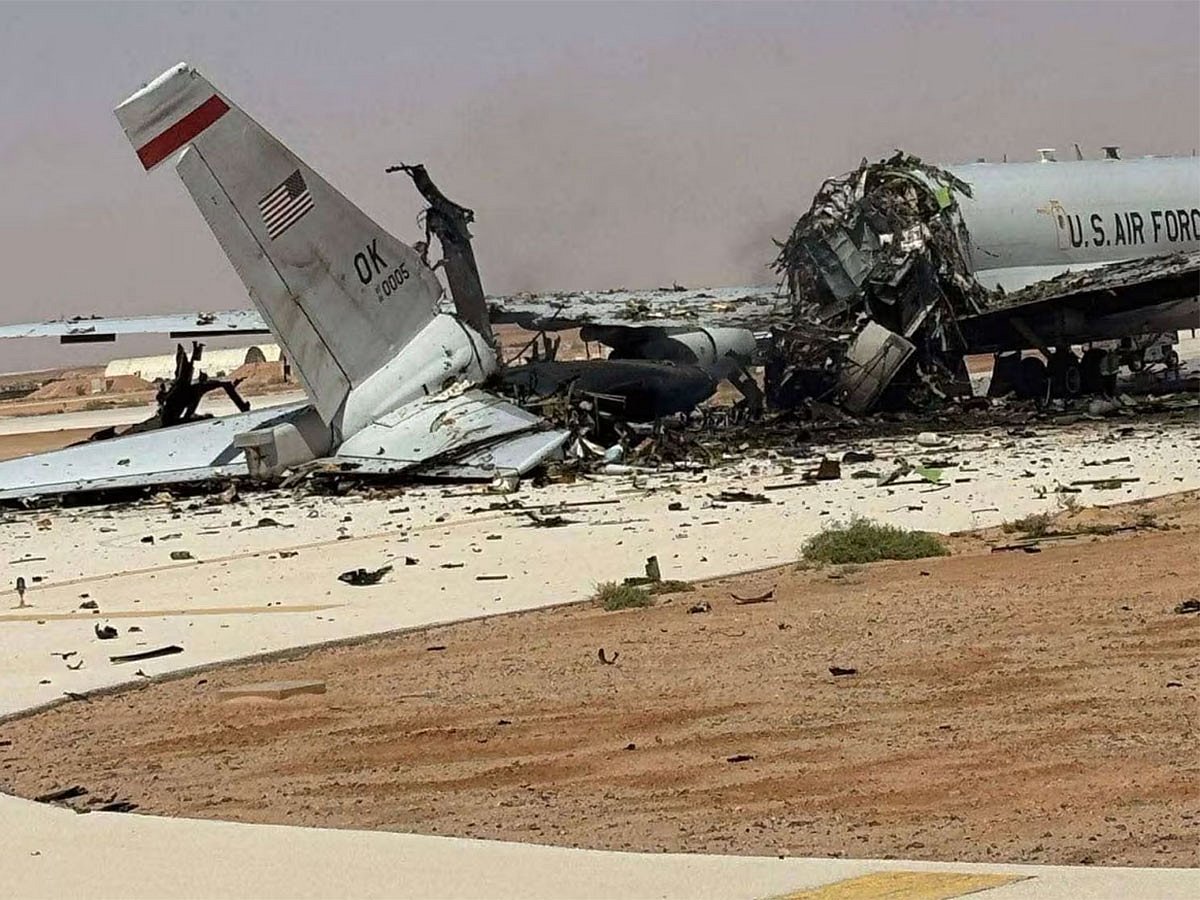
The wreckage of a US Air Force E-3 Sentry airborne warning and control aircraft sits on the tarmac at an air base in Saudi Arabia.
Source: Air Force amn/nco/snco/Facebook
Dubai: The destruction of a key US airborne radar aircraft in an Iranian strike is being seen as a significant setback to Washington’s battlefield awareness and command capabilities, with analysts warning it could weaken the ability to detect and respond to threats across the region.
Dramatic images of the wreckage — geolocated by CNN — show a US Air Force E-3 Sentry aircraft with its tail severed and its distinctive radar dome lying on the ground at Prince Sultan Air Base in Saudi Arabia. The aircraft is part of the Airborne Warning and Control System (AWACS), long considered a cornerstone of US military operations.
The loss of the platform is “a serious blow to (US) surveillance capabilities,” said CNN military analyst Cedric Leighton, a former US Air Force colonel who has flown on the aircraft.
“It can potentially impact (US) ability to control combat aircraft and vector them to their targets or protect them from engagements of hostile aircraft and missile systems,” he said.
The E-3 is far more than a radar plane. Often described as a flying command post, it can monitor vast areas of airspace — up to 120,000 square miles — tracking hundreds of targets simultaneously, including aircraft, missiles, drones and even ground movements. Its onboard personnel relay real-time intelligence to commanders, ships and ground forces, while also directing fighter jets and coordinating strikes.
A recent report by the Center for a New American Security described AWACS as the “quarterback” of the battlefield, highlighting its role in turning individual missions into a coordinated and dominant force.
This UGC image posted on social media on March 29, 2026 and verified by AFP staff appears to show a destroyed US Air Force Airborne Warning and Control System (AWACS) aircraft, primarily used for air traffic control, in the aftermath of a projectile strike at Prince Sultan Airbase in Saudi Arabia.
The strike, which reportedly injured at least 10 US service members and also damaged a tanker aircraft, underscores a worrying shift in Iran’s targeting strategy. Analysts say Tehran appears to be focusing on high-value assets that underpin US operational effectiveness.
What is AWACS? The ‘eyes in the sky’
Full form: Airborne Warning and Control System (AWACS)
Role: Flying radar and command centre that monitors battlespace in real time
Coverage: Can scan up to 120,000 sq miles of airspace
Tracking power: Detects and tracks hundreds of targets — aircraft, missiles, drones, even ground movement
Battle control: Directs fighter jets, guides intercepts, coordinates strikes
Real-time link: Sends live data to commanders, ships and ground forces
Why it matters: Often called the “quarterback” of modern warfare — turns separate missions into coordinated operations
Key advantage: Spots threats far earlier than ground radar, giving critical reaction time
US fleet: About 17 aircraft, many dating back to the 1970s
Vulnerability: High-value but limited asset — loss significantly impacts surveillance and coordination
Kelly Grieco, a fellow at the Stimson Center, said the attack reflects a broader pattern. “Iran’s going after the radars that detect threats, the tankers that keep jets flying, and the AWACS that direct the battle. That’s a counter-air campaign. Adapted to what Iran can actually do. And the damage is real,” she wrote.
This UGC image posted on social media on March 29, 2026 and verified by AFP staff appears to show a destroyed US Air Force Airborne Warning and Control System (AWACS) aircraft, primarily used for air traffic control, in the aftermath of a projectile strike at Prince Sultan Airbase in Saudi Arabia.
Experts note that airborne radar systems like the E-3 significantly extend detection time. Peter Layton, a former Royal Australian Air Force officer, said an AWACS aircraft could spot an incoming Iranian drone up to 85 minutes earlier than ground-based radar — a critical advantage in modern warfare.
The circumstances of the strike have also raised serious questions about force protection. Leighton described the loss of the aircraft on the ground as “a serious breach of our Force Protection efforts,” noting that such assets are typically heavily guarded and often escorted when airborne.
He added that external assistance may have played a role in the targeting. “Russia most likely gave Iran geographic coordinates and satellite imagery that provided the precise location,” he said.
Beyond the immediate impact, the incident highlights a deeper structural concern: the limited and aging nature of the US AWACS fleet. The US operates just 17 E-3 aircraft, down from 32 in 2015, with some dating back to the late 1970s. Despite their importance, replacements have yet to be fully finalised, leaving a critical capability under strain.
Why losing one AWACS matters — even if the US has 17
At first glance, losing one aircraft from a fleet of 17 may not seem critical. But AWACS platforms are not ordinary assets — they are rare, high-value systems that underpin the entire air war.
Not all 17 are available: A significant number are under maintenance, upgrades or rotation, meaning only a fraction are mission-ready at any time
Global commitments: These aircraft are deployed across multiple regions, from Europe to the Indo-Pacific — not just the Middle East
High operational demand: In conflict, AWACS aircraft are flown continuously, putting heavy strain on a small fleet
Force multiplier effect: One AWACS doesn’t just replace one aircraft — it supports dozens of fighters, intercepts and missions simultaneously
Coverage gaps: Losing even one reduces early warning range and coordination capacity, especially in a fast-moving missile and drone war
Each aircraft carries a crew of up to 23 personnel and represents a major investment — costing roughly $540 million in today’s terms.
While alternatives such as the US Navy’s E-2 Hawkeye exist, analysts say they cannot fully replace the E-3’s capabilities due to limitations in altitude, range and onboard personnel.
As the conflict intensifies, the loss of even a single AWACS aircraft could have outsized consequences — reducing situational awareness, slowing response times and complicating coordination across an increasingly contested battlespace.
In modern warfare, losing one AWACS is not losing one aircraft — it’s losing the battlefield’s central nervous system.

A Senior Associate Editor with more than 30 years in the media, Stephen N.R. curates, edits and publishes impactful stories for Gulf News — both in print and online — focusing on Middle East politics, student issues and explainers on global topics. Stephen has spent most of his career in journalism, working behind the scenes — shaping headlines, editing copy and putting together newspaper pages with precision. For the past many years, he has brought that same dedication to the Gulf News digital team, where he curates stories, crafts explainers and helps keep both the web and print editions sharp and engaging.
Sign up for the Daily Briefing
Get the latest news and updates straight to your inbox
Network Links
GN StoreAbout Gulf NewsTerms & ConditionsReach by GNSitemapContact usPrivacy PolicyGN FocusHave your sayWork with usAdvertise with usGulf News epaperPrinting Services
Download our app
© Al Nisr Publishing LLC 2026. All rights reserved.