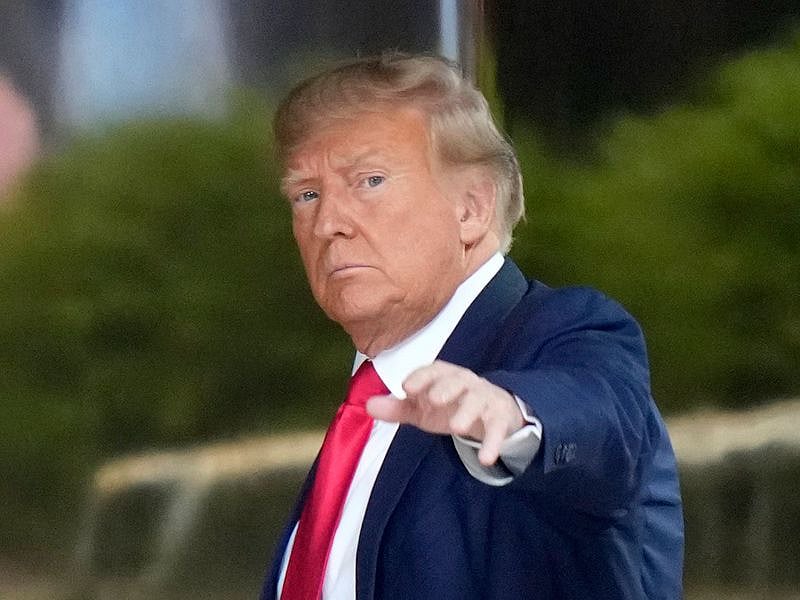
US President Donald Trump is reportedly considering the creation of a new elite global forum — dubbed the “C5” or “Core Five” — that would bring together the United States, China, Russia, India and Japan, potentially sidelining traditional Western-led groupings such as the G7.
The proposal was first reported by Politico, which said the idea appears in a longer, unpublished version of the National Security Strategy (NSS) reportedly circulating in Washington. While the White House last week released a 33-page public NSS document, Defense One claimed a more expansive version exists, containing the C5 concept.
The White House has denied the existence of any alternate plan. Press secretary Hannah Kelly told Politico there is “no alternative, private, or secret version” of the official strategy.
What the reported plan proposes
According to Politico, the alleged draft describes the C5 as a small club of major powers with populations over 100 million, designed to meet regularly — much like the G7 — to discuss global security and strategic issues.
The first proposed agenda item, according to the report, would be Middle East security, including efforts to normalise relations between Israel and Saudi Arabia.
The key difference from the G7, analysts note, lies in the criteria: the C5 would be defined not by wealth or democratic norms but by “hard power” — population size, military capability and global influence.
Analysts: ‘A very Trumpian idea’
National security experts quoted by Politico say the idea reflects Trump’s worldview: transactional, personality-driven and focused on strong states, regardless of political system.
“This is consistent with how we believe President Trump views the world — non-ideological, sympathy for strong players, cooperation among great powers with spheres of influence,” said Torrey Taussig, former director for European affairs at the US National Security Council under the Biden administration.
Taussig added that Europe’s exclusion from the theoretical C5 would reinforce concerns that the Trump administration sees Russia—not the EU—as the dominant power in Europe.
Michael Sobolik, a former aide to Republican Senator Ted Cruz, said the idea marks a break from Trump’s first-term approach to China. “The first Trump administration adhered to great-power competition… this is a huge departure from that,” he told Politico.
Concerns among US allies
The reports come as Washington debates how far the second Trump administration will reshape the global order. The C5 idea, if pursued, would reframe forums like the G7 and G20 as outdated for a multipolar world and elevate major military-economic players over traditional alliances.
US allies fear the move could:
elevate Russia and China into a privileged circle,
sideline Europe, weakening trans-Atlantic unity, and
undermine NATO cohesion by granting Russia de facto recognition of its sphere of influence.
India, meanwhile, has not commented on the reports. Indian outlets including The Week and Times Now highlighted the geopolitical implications for New Delhi, noting the C5 would place India alongside the world’s largest powers in a grouping with no ideological pre-conditions.
As of now, all details remain unconfirmed, and the White House maintains no such plan exists.

Sign up for the Daily Briefing
Get the latest news and updates straight to your inbox
Network Links
GN StoreDownload our app
© Al Nisr Publishing LLC 2026. All rights reserved.