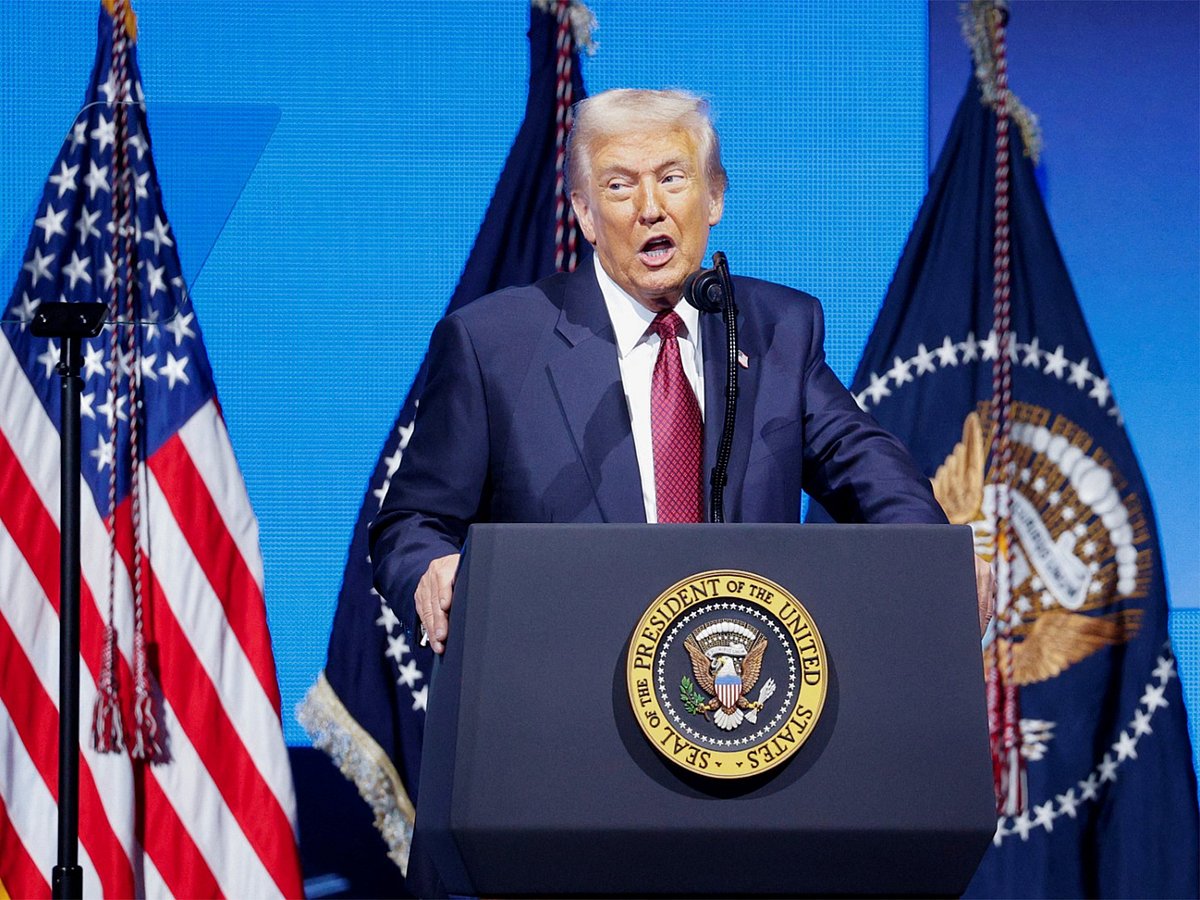
US President Donald Trump sparked global confusion after posting a cryptic image on Truth Social showing his official portrait labelled “Acting President of Venezuela”.
The post offered no caption or explanation, prompting speculation over whether it was symbolic, satirical or a deliberate political signal amid the deepening US-Venezuela crisis. The image appeared designed to resemble a Wikipedia entry, adding to the ambiguity.
There has been no formal announcement or legal declaration recognising Trump as Venezuela’s acting president.
Why did Trump post the image?
Earlier the same day, Trump told reporters aboard Air Force One that relations with Caracas were progressing smoothly.
“Venezuela is really working out well. We’re working along really well with their leadership,” he said.
Trump also confirmed direct talks with Venezuela’s interim president, Delcy Rodríguez, highlighting cooperation on oil shipments to the US.
“She asked us if we could take 50 million barrels of oil… it’s worth $4.2 billion, and it’s on its way right now to the United States,” he said.
The comments fuelled speculation that the social media post was linked to Washington’s growing influence over Venezuela’s energy sector rather than an actual transfer of political power.
Executive order protects Venezuelan oil funds
The post followed Trump’s decision on Friday to sign an Executive Order declaring a national emergency to protect Venezuelan oil revenues held in US Treasury accounts.
According to the White House, the order blocks courts and creditors from seizing or attaching Venezuelan oil and diluent sales deposited in US custody. These funds — termed “Foreign Government Deposit Funds” — remain frozen unless explicitly authorised.
The order states the revenues are the sovereign property of Venezuela, held by the US for governmental and diplomatic purposes, and cannot be claimed by private parties. It also overrides previous directives regulating how the funds may be handled.
On the same day, Trump met senior oil and gas executives at the White House, promoting investment in Venezuela’s energy sector and saying “a lot of money is going to be made”.
What happened after Maduro’s arrest?
After Nicolás Maduro was captured by US forces on January 3, Venezuela’s Supreme Tribunal of Justice appointed Vice‑President Delcy Rodríguez as acting president to maintain administrative continuity and safeguard state institutions. Rodríguez was formally sworn in on January5, by the country’s legislature under constitutional succession rules.
Former US President Donald Trump initially declared that the United States would “run” Venezuela during a transition to “get the oil flowing,” but Secretary of State Marco Rubio clarified that Washington does not intend to directly govern the country, even as it pursues an “oil quarantine” to influence policy outcomes.
Who is venezuela’s acting president?
Delcy Eloína Rodríguez Gómez, a lawyer and long‑time chavista leader, assumed the presidency in Maduro’s absence. She has held senior posts including vice‑president, foreign minister, communications minister and oil minister, and remains under sanctions from the US, EU and other governments for her role in Venezuela’s political crisis.
Rodríguez has voiced both strong condemnation of the US military operation that ousted Maduro and cautious engagement with Washington, particularly on energy issues, reflecting Venezuela’s sharply divided political landscape.
Maduro’s capture and legal status
Maduro and his wife, Cilia Flores, were taken to the United States to face federal charges including drug trafficking and narco‑terrorism, to which he has pleaded not guilty, while insisting he remains Venezuela’s legitimate president. His removal has intensified political tensions at home and abroad, highlighting controversies over Venezuela’s electoral legitimacy and governance record.
Network Links
GN StoreDownload our app
© Al Nisr Publishing LLC 2026. All rights reserved.