Why has Trump attacked Venezuela and captured Maduro? What happens next?
How sanctions, oil and security claims pushed the US–Venezuela standoff to the brink
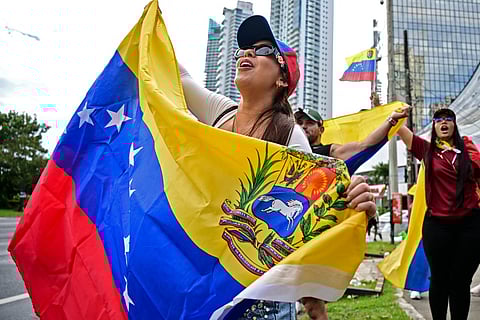
Dubai: The confrontation between the United States and Venezuela has exploded into a major international crisis after US President Donald Trump announced a “large-scale strike” on Venezuelan targets and said Venezuelan President Nicolás Maduro and his wife had been captured and flown out of the country.
Reports from Caracas described loud blasts, aircraft overhead, smoke near military facilities and power outages, while Venezuela’s government denounced the operation as “military aggression,” declared a national emergency and called for nationwide mobilisation.
The arrest marked one of the most dramatic US actions against a foreign head of state in decades, immediately raising questions about legality, regional fallout and the risk of escalation.
Trump later posted a photo of Maduro in custody on a US naval ship and wearing both a blindfold and handcuffs.
"Nicolas Maduro on board the USS Iwo Jima," Trump wrote on his Truth Social platform, along with a picture showing Maduro hours after he was snatched by US forces.
The White House also posted video on X of Maduro, handcuffed and in sandals, escorted by federal agents through a US Drug Enforcement Administration facility in New York.
“Good night, happy new year,” the 63-year-old leftist is heard saying in English
The US military operation to extract Maduro in a nighttime raid in Caracas took "months of planning and rehearsal," and more than 150 US aircraft were used, top US General Dan Caine told reporters Saturday.
"The word integration does not explain the sheer complexity of such a mission, an extraction so precise - it involved more than 150 aircraft launching across the Western Hemisphere," Caine told a joint press conference with Trump.
At a glance
The US struck Venezuela and captured President Nicolás Maduro
Venezuela calls it illegal military aggression
Oil, sanctions and Iran form a key backdrop
The legality and fallout are still hotly disputed
The Maduros were later transported to New York to face narcotrafficking and weapons charges.
Maduro was in a New York jail late Saturday.
What happened on January 3, 2026?
In the early hours of Saturday, explosions were reported in and around Caracas and other areas. Venezuela’s government said attacks hit multiple locations including the capital and surrounding states, and it declared a state of emergency while urging citizens and political forces to mobilise.
Trump then posted that the US had carried out a “large scale strike” and that Maduro and his wife were captured and flown out of Venezuela, describing it as an operation done “in conjunction with US law enforcement.”
The Associated Press reported US strikes on targets in Caracas and that US officials said Maduro was captured and removed, but also noted that details such as his exact whereabouts were not publicly confirmed in the initial aftermath.
Why is the US involved in Venezuela?
There are four big drivers behind Washington’s involvement:
Drug trafficking and 'narco-terrorism' allegations
US authorities have long accused elements of Venezuela’s leadership and allied networks of facilitating cocaine trafficking routes that feed US markets. This is central to the way Trump’s camp frames the operation — not as a “war,” but as a security-and-law-enforcement mission.
Long-running political and legitimacy conflict
US–Venezuela relations have been hostile for years, especially after Washington refused to recognise Maduro’s legitimacy at various points and supported opposition figures. That broader legitimacy fight sits underneath Saturday’s military escalation — a dispute over who has the right to govern Venezuela.
Sanctions and oil pressure
Venezuela’s oil wealth makes it strategically important. Washington has used sanctions and restrictions aimed at limiting state revenue, while Caracas has repeatedly accused the US of pursuing an “oil grab.” Reuters reported that accusation featured again in the latest exchange.
Regional security narrative
The Trump administration’s line is that Venezuela is not only a domestic dictatorship problem but a regional security threat — tied to criminal networks, migration pressures and instability affecting neighbouring states.
So why does Iran matter here?
A lesser-known but significant backdrop to the crisis is Venezuela’s oil relationship with Iran, which has drawn increasing US scrutiny. Over the past few years, Iran has helped Venezuela keep its energy sector afloat by supplying fuel, refining support and oil shipments, as both countries faced heavy US sanctions.
This cooperation created a network of oil movements that Washington says was designed to evade sanctions, using tankers that obscured their origin, changed flags or operated through intermediary routes.
In late 2025, that oil trail moved into sharper focus after the US pursued and seized tankers in the Caribbean that officials said were linked to Venezuelan and Iranian oil trade.
One high-profile pursuit involved a vessel accused of carrying sanction-hit oil that allegedly tried to disguise its identity while evading US forces. Venezuela condemned the actions as “piracy,” while Washington argued the oil trade was funding illicit networks and regional instability. The tanker episode marked a turning point, signalling that oil enforcement — not just diplomacy — had become central to U.S. pressure on Caracas.
What does Venezuela say?
Venezuela’s government rejects the US justification and describes the strikes as a violation of sovereignty and international law. In its official messaging, Caracas has portrayed the events as an “imperialist attack,” called citizens to the streets, and urged “mobilisation plans” across society and politics.
This matters because Venezuela’s response will shape whether the crisis stays politically contained or shifts toward broader military retaliation, internal unrest or a prolonged conflict dynamic.
Is this 'legal' under international law?
This is where the story becomes globally explosive.
Under the UN Charter, the use of force against another state is generally prohibited except in narrow cases — most notably self-defence or when authorised by the UN Security Council.
The US argument appears to lean on a blend of self-defence and a law-enforcement/security framing tied to narcotics and alleged transnational criminal activity. Critics argue that criminal allegations do not automatically justify cross-border military strikes or seizing a sitting head of state on foreign soil.
Even in US domestic politics, legal questions surfaced quickly: AP reported lawmakers raised concerns about the lack of congressional authorisation for major military action.
Bottom line: There is no instant global consensus here. Expect emergency diplomacy at the UN and sharp divides between US allies and governments that view this as aggression.
Has the US done anything like this before?
In Venezuela, US pressure historically leaned on sanctions, diplomacy and covert-style political support — not an overt strike aimed at physically removing the head of state.
But in the wider region, the closest historical parallel is Panama (1989), where the US invaded and captured Manuel Noriega, citing drug trafficking and security threats. The difference is that Venezuela is larger, geopolitically more entangled, and today’s information ecosystem makes legitimacy battles immediate and global.
What happens next?
Despite the success of the risky operation, what happens next is highly uncertain.
1. The US must decide how deep it goes in Venezuela
Trump has claimed victory but signalled the US will remain “very involved.” The key choice now is whether Washington limits itself to removing Maduro — or actively shapes Venezuela’s next government, a far riskier commitment.
2. A looming power vacuum in Caracas
With Maduro gone, no successor has been named. Analysts warn that Maduro’s allies may resist or fight to retain power, raising the risk of instability rather than a clean transition.
3. Who leads Venezuela is still unresolved
The US faces a decision between backing the exiled opposition figure Edmundo González, negotiating with Vice President Delcy Rodríguez, or pursuing another transitional arrangement. Trump has refused to commit to any option so far.
4. Rising legal and diplomatic pressure
European allies, Democrats in Congress, Russia and China have all raised concerns about international law and sovereignty, suggesting diplomatic friction and legal scrutiny will intensify even as Washington claims success.
5. A defining test of Trump’s foreign policy doctrine
The operation reinforces Trump’s readiness to use force in the Western Hemisphere. How long the US stays, and whether it stabilises Venezuela or deepens turmoil, will shape how rivals such as China and Russia read America’s global posture.
-- With AP & Reuters inputs


