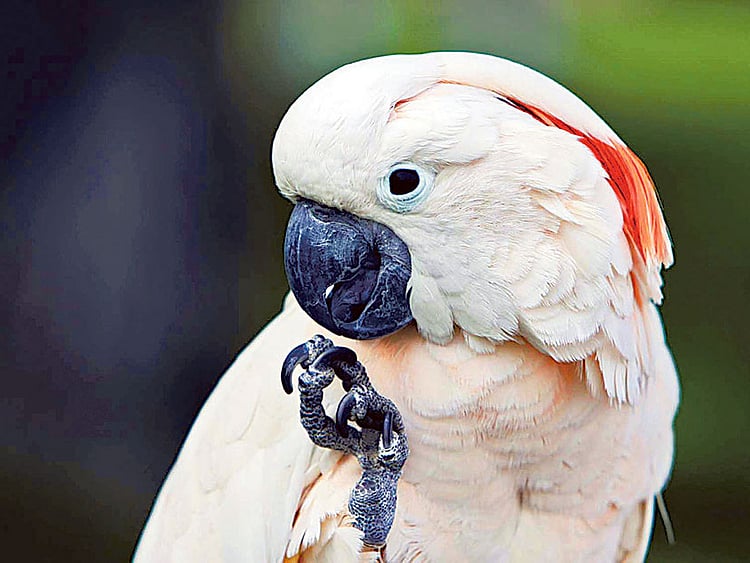
The Moluccan cockatoo does not sound pleased, no sir. Peaches is its name, and owner Elaine Sigmon told the Huffington Post that the bird busts out into these arguments with itself nearly every day.
Sigmon said she believes the bird was previously owned by a bickering couple.
“We had Peaches for several days when one afternoon she began ranting and raving as if blessing someone out,” Sigmon told the outlet. “My husband, Don, was sitting in the chair near her perch and she began to aggressively point her head toward him just like someone pointing their finger while arguing ... We’re not sure what she is saying, but she is really giving her opinion.”
OK, we’re left with many questions, namely: How common is it for humans to turn their birds into screaming machines?
Chris Davis, a bird behavioural consultant who has worked with birds and their owners for decades, said it’s hard to say how often this happens, but parrots can mimic humans at their worst. Davis recalled years ago when she encountered a parrot that had been abandoned by its owner at a movie studio lot. The bird would scream and beg for “daddy” to leave it alone.
“The guys would laugh, and I’d say, ‘You’re hearing a child being beaten. You’re hearing a child being abused.’ This was not something this bird had been taught intentionally,” Davis said.
As for Peaches, Davis said this bird was likely in an environment “where it was hearing a person being emotionally and verbally abusive to another person,” and it’s not all that surprising that Peaches picked up on the words.
Why? Irene Pepperberg, a Harvard lecturer and scientist who has extensively researched animal cognition and parrots, said there are certain sounds that birds latch onto more than others.
“In general, parrots will pick up what they hear, and vocalisation with a strong emotional content are more likely to be acquired than other vocalisations (think about how quickly a young child will pick up a curse word without knowing its meaning; parrots are not that different),” Pepperberg wrote in an email. “The bird will also pick up whatever will get attention (for example, birds often acquire sounds like telephone rings and microwave beeps, because humans immediately respond by going over to those objects).”
And a sound doesn’t have to be made all that often for a bird to pick up on it, Davis said. “Birds like emotion. They like a lot of emphatic movement, they like drama,” Davis said. “Birds are drama kings and queens; they love that kind of thing. This is just right up their alley.” Head bobbing is not uncommon for these particular kind of birds, even in the wild, and their vocalisations aren’t usually clearly pronounced words.
Watching the video, you may feel like it’s kind of hilarious to hear the way us humans argue, back at us, in bird form. But then, it seems like it wouldn’t be a pleasant thing for the bird to have to repeat over and over again. Pepperberg said it’s difficult to say what the bird is going through as it’s making these noises. Davis said it may be experiencing the same kind of fear and anxiety such sounds inflicted the first time it heard them.
These kinds of parrots live among flocks in the wild; they come to treat their human owners as members of their flock, and a bird like Peaches “would be quite disturbed to have its flock members constantly squabbling,” Pepperberg said.
Peaches is probably repeating the behaviour because it gets attention each time it does. For this, Davis recommends giving Peaches “very focused, short periods” of repetitive play.
Cockatoos can get grouchy; take the bird in a video, who Davis said, is “arguing back” at its owner.
“What you will notice are similar emphatic vocalisations and body movement; however, the bird is actually interacting with the woman, and it’s a humorous bantering back and forth between an obviously beloved bird and his favourite human,” Davis said. She then recalled the video with Peaches: “If you watch each one a few times, you will get an entirely different feel about the two birds and about how actually different they are in what they are conveying behaviourally.”
So, yes, you can get sassy with your pet, but be careful with what you say around these birds; they can soak up your worst, most dramatic moments like a sponge.
Sign up for the Daily Briefing
Get the latest news and updates straight to your inbox
Network Links
GN StoreDownload our app
© Al Nisr Publishing LLC 2026. All rights reserved.