At an organising breakfast for National Rifle Association (NRA) grassroots activists, Samuel Richardson, a man with whom I have not exchanged a word, passes me a note. "Please read the book Injustice by Adams," it reads. "He was [sic] lawyer for US Justice Department who prosecuted Black Panther Case."
Quite why Richardson thinks this book is for me is not clear. There are six other people at the table, a couple of them journalists. The fact I am the only black person in a room of about 200 may have something to do with it.
J. Christian Adams, a former Department of Justice lawyer, resigned after the department decided not to prosecute members of the New Black Panther party who brandished guns and intimidated poll watchers outside a voting station in Philadelphia in 2008. Several attorneys, including Republicans, have argued that while the case was serious it did not warrant the department's resources. Adams believed there were darker forces at play, claiming the case "gave the public a glimpse of the racially discriminatory worldview" of the department under Obama.
Richardson goes further. The press and the government are in cahoots, he explains, to oppress white people. "It's fascistic," he explains. "It's just like Hitler did. Discriminating against one ethnic group and claiming that they're the cause of everything that's wrong. It's what happened in Rwanda," intimating that white Americans, like Tutsis, could one day find themselves systematically slaughtered in their own land.
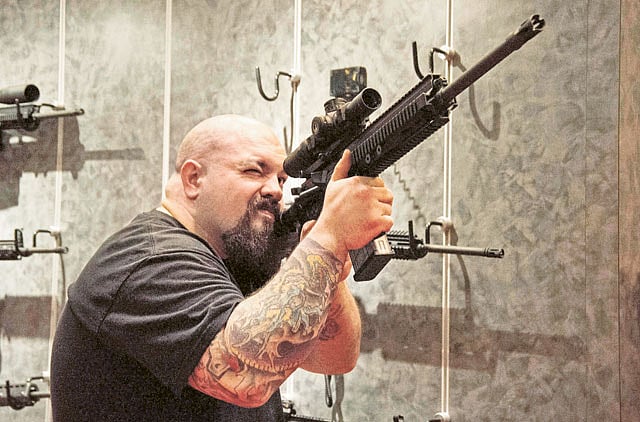
It would be easy to ridicule the NRA. Billboards for its national convention all around St Louis promise "acres of guns and gear". In the exhibition hall they are giving two free guns, twice a day, to anyone wearing a sticker that says "Ambush", and they are selling semi-automatics in pink camouflage. One of the most powerful lobbying organisations in the country and deeply embedded in the Republican party, the NRA still calls itself the country's oldest civil rights organisation.
But America's relationship with guns is as deep and complex at home as it is perplexing abroad. And even though the nation is evenly split on whether there should be more gun control, every time there is a gun-related tragedy, whether it is the shootings in Arizona, Virgina Tech or any number of schools, the issue has been effectively removed from the electoral conversation. And at the centre of these apparent contradictions stands the NRA, once an organisation that represented the rights of hunters and sportsmen and now a major political player closely linked to the gun industry.
"All the domestic controversies of the Americans at first appear to a stranger to be incomprehensible or puerile," suggested the 19th-century French chronicler Alexis de Tocqueville in Democracy in America. "And he is at a loss whether to pity a people who take such arrant trifles in good earnest or to envy that happiness which enables a community to discuss them."
But guns in America are no trifling matter. There are approximately 90 guns for every 100 people in the United States (a rate almost 15 times higher than England and Wales). More than 85 people a day are killed with guns and more than twice that number are injured with them. Gun murders are the leading cause of death among African Americans under the age of 44.
And the NRA is no joke. Claiming gun ownership as a civil liberty protected by the Second Amendment, it opposes virtually all gun-control legislation. It claims more than 4 million members, has a budget of more than $300 (Dh1,101) million and spent almost $3 million last year — when there were no nationwide elections — on lobbying.
The Second Amendment to the US Constitution reads: "A well-regulated militia, being necessary to the security of a free State, the right of the people to keep and bear arms, shall not be infringed." There has long been a dispute about whether "the people" described refers to individuals or the individual states. But there is no disagreement about its broader intent, which is to provide the constitutional means to mount a military defence against a tyrannical government.
"It's about independence and freedom," explains David Britt. "When you have a democratic system and an honourable people then you trust the citizens."
Britt, an affable man in his 60s, does not lend himself easily to caricature. Elsewhere in the room, a T-shirt quotes Thessalonians 3:10 ("If any would not work neither should he eat") on the back and "I hate welfare" on the front. Another T-shirt announces: "Christian, American, Heterosexual, Pro-Gun, Conservative. Any Questions?"
Britt is more understated, conservative but more likely to water at the mouth talking about barbecue in his native Memphis than foam at the mouth over a Fox News talking point. He doesn't fetishise guns but fondly recalls his grandfather giving him his first rifle when he was 7. "He said it's not a toy and he showed me how to use it properly."
Britt believes individual gun ownership is a guarantor of democracy. "In Europe they cede their rights and freedoms to their governments. But we think the government should be subservient to us." For all the right-wing demagoguery associated with the NRA, this is quite a radical notion. The trouble is that, left in the hands of individuals, each gets to define their own version of tyranny and potentially undermine democracy with their firearms. Some believe the health-care law enacted by a democratically elected Congress is tyrannical.
In the hardscrabble town of Pahrump, Nevada, in 2010, I witnessed a conversation between conservatives about the most propitious moment to militarily challenge this government. "The last thing we want to see is to break out our arms," said one. "But we need to have 'em in hand, and the government needs to know that we will use [our arms] if they continue down the path they're on."
But the Second Amendment is not the only factor that embeds guns in America's culture. As a settler nation that had to both impose and maintain its domination over indigenous people to acquire and defend land and feed itself in a frontier state, the gun made America, as we understand it today, possible. "None of us in the free world would have what we have if it were not for guns," says Britt. "It's about freedom, it's not about violence."
Missouri representative Jeanette Oxford, who represents a district in St Louis, disagrees. "From the outset violence was enforced with weapons of various kinds in North America," she says. "I think the ability to enforce your right through might is ingrained in us."
It is also an important component of something else that is central to American society: capitalism. Guns make money. A lot of it. Since 1990 the sale of legal guns alone has come to, on average, about $3.5 billion every year. And it is recession-proof, rising and falling less with the economic tide than the electoral one.
When Democrats are elected the sales go up. And when a black Democrat is elected, they skyrocket. The week Barack Obama was elected, gun sales leapt 50 per cent against the previous year. And they have continued to rise sharply.
Back at the grassroots breakfast the organisers are gearing up the activists for this election year. "Bad people get sent to Washington because good people don't vote," they say. When it comes to engaging potential allies they are told to "hunt where the ducks are" — gun clubs, hunting groups and so on. Each electoral district has an assigned Election Volunteer Coordinator (EVC) who acts as a go-between among candidates, members and gun owners. Few domestic organisations can rival the NRA in lobby power.
Liberal legislators recognise and respect its influence precisely because it is so effective. "They don't have shoot-ins and rifle marches," Massachusetts Democrat Barney Frank explains. "They write and call. The NRA — person for person — they are extremely influential because they lobby that way."
In 2000, Democrats credited the NRA with swinging the election for George Bush by costing Al Gore his home state of Tennessee. It was around that time that Democrats, as a party, effectively gave up on gun control. Obama, during his first two years, signed laws allowing guns in national parks and on checked baggage on trains. In 2010 he was graded "F" by gun-control group Brady Campaign. The NRA has not won the argument — only a tiny percentage believe, such as the NRA, that controls are too strict and a plurality want to make them stricter — but they do keep on winning the votes.
Halfway through the session a slide displays the four people they consider the most important obstacles to their cause. Obama, Hillary Clinton (sitting in front of a United Nations flag), Eric Holder (Obama's black attorney general) and Sonia Sotomayor, the Latina supreme court judge. All, by their titles, are legitimate targets for the NRA. And yet one could not help sense the symbolic significance. Two women and three people of colour in positions of authority, in a country where women are becoming more politically assertive and white people will be in a minority in 30 years, looking down on a room of overwhelmingly ageing white men defending their right to bear arms.
The NRA is not entirely certain what to do with its partial success. Partly it keeps pushing for laws that would expand the places where guns might be carried, including churches, bars and college campuses (it supports a group called Students for Concealed Carry). Partly, it opposes even the most basic controls, such as legislation to ban gun sales to people on the government's terrorist watchlist, meaning a suspected terrorist can be denied the right to board a plane but not to buy a gun.
This has left the NRA with a problem. Now the Democrats have caved and the Supreme Court has a pro-gun majority, it simply has no worthy enemy. No one at the convention can point to a single concrete piece of legislation from the White House that they didn't like. Instead, they simply raise the spectre of an Obama second term. Unfettered by the need to stand again, he will come for your guns. There is absolutely nothing, beyond his right to appoint people to the Supreme Court and beyond, to suggest this is true. But there is nothing to prove it couldn't be either.
In Missouri, Oxford says, one representative attempted to add gun ownership to the list of protected categories alongside race, gender and disability so that no gun owner could be discriminated against in employment. "We asked her if she knew anyone that had ever happened to," Oxford says. "She didn't."
It is this fear, of the unknown and the known, both manufactured, exploited and real, that hangs over the convention. Time and again people paint scenarios in which I or my family might be attacked, threatened or in some way violated as a rationale for arming myself. In this atmosphere, Richardson's evocation of Rwanda, while extreme, is not entirely ludicrous.
"Ultimately it comes down to whether you trust other people or not," one gun control activist says. "We do, they don't." The ideas that the government might protect you, that the police might come, that if nobody had guns then nobody would need to worry about being shot, are laughed away. "By the time you call the police it could be too late," says Britt, who has never had to pull a gun on anyone but has had to make it clear he might a few times. "All they can do is write the report."
When the breakfast is over I tell Britt that I am heading into town to see some people. "Be careful," he says. "St Louis is a very dangerous place."
—Guardian News & Media Ltd
Sign up for the Daily Briefing
Get the latest news and updates straight to your inbox
Network Links
GN StoreDownload our app
© Al Nisr Publishing LLC 2026. All rights reserved.