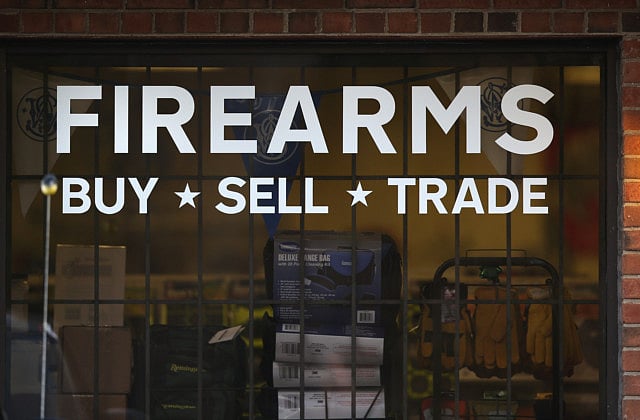
Why can’t the US just ban guns?
The US Constitution prohibits Federal government and States from completely banning gun ownership. Despite the popularity of this statement, gun ownership was actually a grey area until 2008, when the US Supreme Court ruled that gun ownership was actually an individual right.
However, this ruling doesn’t mean the US government or the States can’t ban ANY gun. The federal government has passed laws prohibiting the sale or ownership of assault weapons, which generally include many semi- and fully-automatic rifles. States can also pass their own laws, which vary significantly. However, the last major federal ban on assault rifle ended in 1996, due mainly to influence from the National Rifle Association (NRA).
Other laws have also been passed, such as the Brady Bill, which governs who can’t own a gun, such as felons, anyone judged to be a mental defective, or a drug addict.
What would it take to get a total federal gun ban?
Two things would be needed.
First, you would need a general turnaround in the mindset of most Americans. In a 2011 Gallup poll, only 43 percent of American thought there was a need for stricter gun laws. That’s a dramatic shift from 20 years ago, when 78 percent of Americans supported stricter laws.
Second, you would need an amendment to the US Constitution. To even start that process, you need either the approval of two-third of both the US House of Representatives and the Senate or for two-third of the states to call for a national convention. Getting the amendment passed is even harder. The result has been that only 17 Amendments have passed over the last 220 years. Given today’s polarized political environment, an amendment would be practically impossible.
What is the NRA?
The National Rifle Association is a not-for-profit lobbyist group in the US, with estimated assets of $280 million. They are routinely listed at the most influential lobby in the US. It was established in 1871 and has an estimated 4.2 million members.
Why is the NRA so controversial?
They are known for opposing any law that would limit or restrict gun ownership. Notably, the NRA successfully opposed a 5-day waiting period for gun-ownership in the Brady Bill, a US law which governs who can be stopped from owning a gun. They also successfully opposed a federal law requiring local enforcement to conduct background checks on anyone seeking to purchase a gun.
The NRA is also known for arguing that Americans should be allowed to have guns to protect themselves from crime - a position many anti-gun advocates argue only increases the likelihood of violence and would be better left to police - and to protect people from governmental oppression. In 1996, Former President George H.W. Bush resigned his membership in the NRA when the group issued a fundraising letter that described federal law enforcement agents as “jack-booted thugs.” NRA Executive Vice President Wayne LaPierre later apologized for the letter, saying the statement didn’t apply to “all federal law-enforcement officials.”
Are the NRA members generally responsible for gun crime?
No. Actually, NRA members are usually viewed as being responsible gun owners who take gun safety quite seriously. It is the organization’s active resistance to laws that seek to govern guns that often lead it into controversy.
Was the NRA serious in its suggestions that more armed police officers in school would stop assaults?
Probably not, but they were certainly aware of the unfeasibility of their own suggestions. Due to the financial situation in the US and its impact on federal and state budgets, 53 percent on countries in the US had fewer staff members in 2011 than in 2010. Twelve-thousand officers across the country were laid off. 2012 is also looking bad for local law enforcement budgets. Putting aside for a second the desirability of armed guards in school, police forces are struggling to keep the staff they do have, let along add staff.
Wouldn’t a ban on assault rifles cut down on the number of murders?
That’s hard to say. Certainly a ban on assault rifles would make it more difficult for gunmen to commit mass slaughter, but the main culprit in most US gun crimes is handguns, not assault rifles. While FBI statistics don’t specially address assault rifles, in 2011, handguns were responsible for at least 72 percent of gun-related homicides. Twenty percent of firearms homicide was listed as “type not stated.”
How easy is it to get a gun in the US?
Laws governing gun ownership vary tremendously from state to state.
Anyone purchasing a gun from a federally licensed gun dealer must have a background check. Unless a check finds some reason the person should not own a gun, such as a mental disability or prior criminal record, the sale will be permitted. However, an estimated 40 percent of all gun sales in the US are conducted between private parties, which do not require a background check. As of 2012, 156 million background checks have been performed.
It seems like everyone in the US owns a gun. Is that right?
No, 45 percent of homes in the US have a gun, and even that number is often taken out of context. In California, the largest state by population, only 21.3 percent of households own a gun, according to USACarry.com. In New York, gun ownership is only 18 percent. Even in Texas, a state often associated with a pro-gun population, only 35.9 percent of household own a gun. According to the Pew Research Center, 49 percent of Americans in 2011 believes it is important to protect the right of Americans to own guns.
What can be done to prevent further tragedies?
A rush of gun-control laws are expected to be proposed over the next few months. California Senator Dianne Feinstein said she plans to introduce a ban on assault rifles on the first days of the next congressional session. Anti-gun advocates are also focusing on laws to require trigger locks, additional background checks, and locked gun cabinets. Many of these proposal are expected to receive stiff opposition from the NRA.
Scott Shuey
Sign up for the Daily Briefing
Get the latest news and updates straight to your inbox
Network Links
GN StoreDownload our app
© Al Nisr Publishing LLC 2026. All rights reserved.