Watch: Mohammed bin Rashid inaugurates tunnelling work for Dubai Metro Blue Line
30km route, 14 stations on Blue Line to serve 1 million residents, ease congestion by 20%
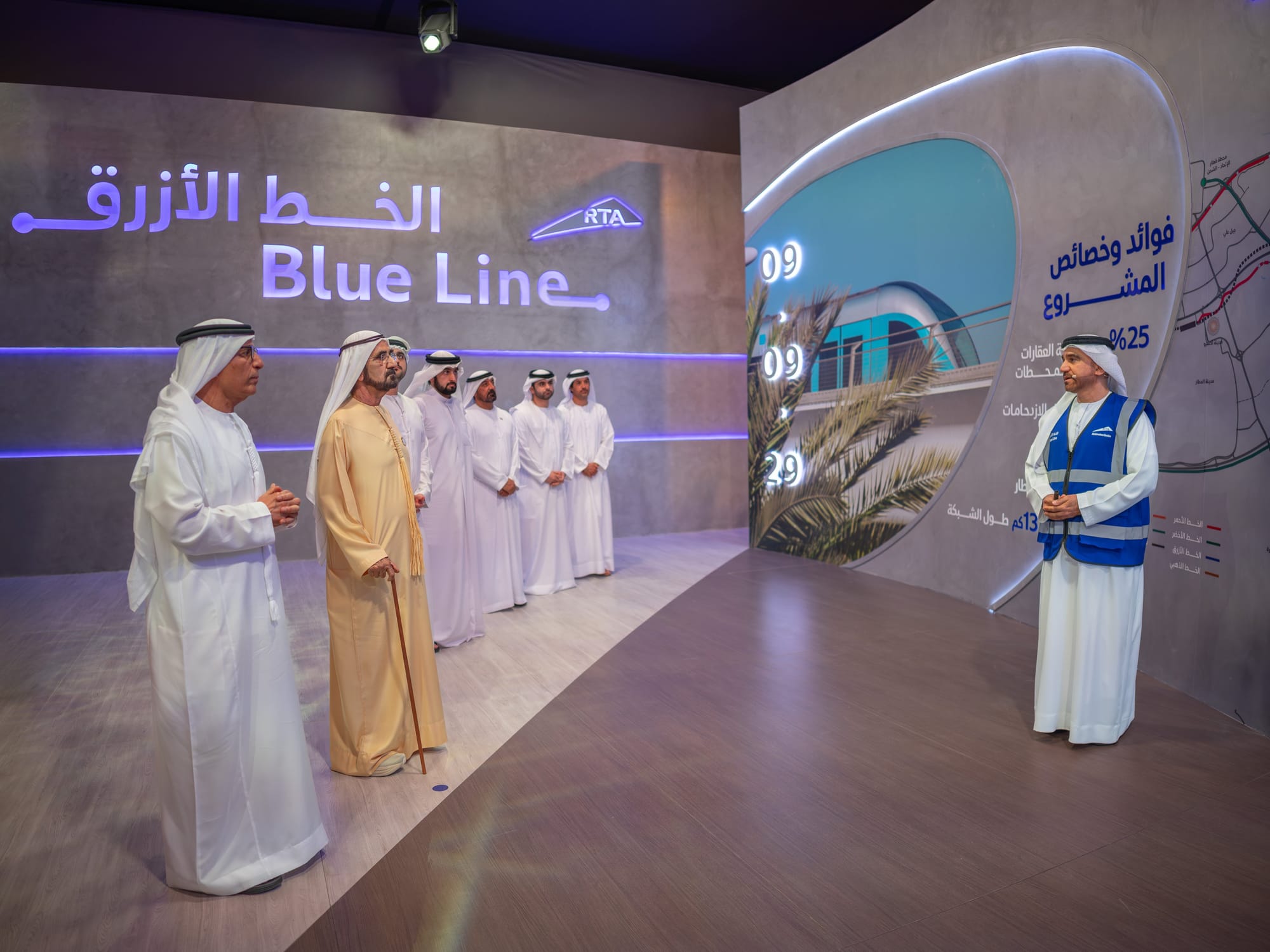
Dubai: His Highness Sheikh Mohammed bin Rashid Al Maktoum, Vice President and Prime Minister of the UAE and Ruler of Dubai, has inaugurated tunnelling work for the Dubai Metro Blue Line, reinforcing the emirate’s commitment to future-ready infrastructure and sustainable urban growth.
The 30-kilometre route, valued at Dh20.5 billion, will feature 14 stations and serve nine key districts with a combined population of around one million residents, in line with the Dubai 2040 Urban Master Plan. Once operational, the line is expected to ease traffic congestion across the city by up to 20 per cent.
During the visit, Sheikh Mohammed reviewed the architectural designs of the interchange station at Dubai International City 1, along with interior concepts for the metro stations. He also gave the signal to launch the Tunnel Boring Machine (TBM), named “Al Wugeisha”, marking the official start of excavation works.
The massive machine, measuring 163 metres in length and weighing over 2,000 tonnes, will operate around the clock, advancing at an average rate of 13 to 17 metres per day.
Sheikh Mohammed was briefed by Mattar Al Tayer, Director General, Chairman of the Board of Executive Directors of the Roads and Transport Authority.
Major projects
Sheikh Mohammad said: “Investing in the transport sector is an investment in the future and a key pillar of enhancing Dubai’s global competitiveness. The Dubai Metro Blue Line represents an extension of an integrated vision aimed at building a more connected, efficient and sustainable city. Our projects in Dubai are delivered to the highest international standards, guided by clear plans and precise timelines, and driven by national talent capable of turning vision into tangible achievements on the ground. Their delivery is overseen by 180 rail experts and engineers.”
Taking to his X account, Sheikh Mohammed highlighted that the Blue Line will feature 14 “iconic” stations and serve around one million people.
10,000 workers
The project is being delivered by a workforce of approximately 10,000 engineers and employees, with completion targeted for September 9, 2029. It forms part of a wider transport expansion strategy that also includes a planned Dh34 billion investment in the upcoming Dubai Metro Gold Line.
Highlighting the broader vision, Sheikh Mohammed pointed to several major initiatives reshaping the emirate, including a new global airport, advanced transport systems, the continued evolution of the Dubai International Financial Centre, and the expansion of digital infrastructure powered by autonomous and artificial intelligence technologies.
“Our major projects to reshape the new Dubai are ongoing,” Sheikh Mohammed said.
He added: “We are the world’s most future-ready city. Whoever bets on Dubai, bets on the future.”
Setting new benchmarks
The Dubai Metro Blue Line offers a range of distinctive features. In addition to the iconic Emaar Properties Station, it includes the first Dubai Metro bridge crossing Dubai Creek, stretching 1,300 metres. The line is also home to the largest underground interchange station in the network, spanning over 44,000 square metres with a projected capacity of 350,000 passengers per day. Notably, the Blue Line is the first transport project in Dubai to fully comply with green building standards, achieving Platinum Category certification.
50,000 university students
The Dubai Metro Blue Line was meticulously planned with sustainability in mind, ensuring it connects existing and future high population densities, estimated to reach around one million residents by 2040. Key areas served by the Blue Line include Dubai Creek Harbour and Dubai Festival City, noted for their immense development potential, as well as International City, home to Dragon Mart and large residential complexes visited by over 200,000 residents and visitors. It also serves residential neighbourhoods like Al Rashidiya, Al Warqaa, and Mirdif. It also extends to Dubai Silicon Oasis, recognised as one of the Dubai 2040 Urban Master Plan’s Urban Centres, and Academic City, which is projected to accommodate over 50,000 university students by 2029.
The construction of the Blue Line project will utilise cutting-edge international technologies in rail systems. Station designs have been planned to maximise space efficiency, thereby reducing construction, operation and maintenance costs. Additionally, these designs aim for seamless integration with various transportation modes, including public buses and taxis.
Economic return
Initial studies by RTA indicate that infrastructure investment is a key driver of economic growth in cities worldwide. The Dubai Metro Blue Line project aligns with the objectives of the Dubai Economic Agenda D33, offering economic, social and environmental returns. By 2040, the project is projected to yield a benefit-cost ratio of 2.60 (AED2.60 in benefits for every AED1 spent). The total anticipated benefits will exceed AED56.5 billion by 2040. These benefits include substantial savings in time and fuel, reduced accident-related fatalities, and lower carbon emissions.
The Blue Line is also expected to decrease traffic congestion on its served routes by 20% and appreciate the value of land and properties near stations by up to 25%. The Blue Line also provides a direct connection between Dubai International Airport and nine key areas situated along its route. It connects with the fifth urban centre, Dubai Silicon Oasis Centre, ensuring that all major urban centres in Dubai are seamlessly connected by metro lines.
Backbone of transportation system
The endorsement of the Dubai Metro Blue Line signifies a major milestone, building upon the huge success the Dubai Metro has achieved since its inauguration on 9/9/2009. The Metro has emerged as the backbone of Dubai’s transportation network, becoming the preferred mode of travel for both residents and visitors. It represents nearly 60% of total usage across all public transportation modes in Dubai, which include buses, the Dubai Tram, and marine transport.
From the start of operations until the end of 2024, the Dubai Metro has transported 2.527 billion passengers. In 2024, the Metro averaged over 900,000 passengers daily. The Dubai Metro has also recorded great success in upholding the highest international safety standards and operational efficiency, boasting a 99.7% punctuality rate.
The Dubai Metro played a pivotal role in boosting Dubai’s competitiveness for hosting major international events, including the hosting of Expo 2020 Dubai. This event coincided with the launch of the Dubai Metro Route 2020, a 15km extension featuring seven new stations. It has also contributed to stimulating economic growth, boosting tourism, and appreciating the value of properties located near metro stations.
Global standing
Dubai Metro maintains its global position with a current total length of 90km. This network includes around 52km for the Red Line, 23km for the Green Line, and 15km for Route 2020. The network comprises 53 stations, with 29 on the Red Line, 18 on the Green Line, and seven on Route 2020, including an interchange station. Additionally, the fleet consists of 129 trains. The facilities and services offered at the Dubai Metro stations are recognised as some of the best globally.

Sign up for the Daily Briefing
Get the latest news and updates straight to your inbox
Network Links
GN StoreDownload our app
© Al Nisr Publishing LLC 2026. All rights reserved.