Tailors working on kandouras on the loft of Jairam Dayalal Tailors in Satwa.
EXCLUSIVE
Watch: 54-year-old who has been making kandouras in Dubai since he was 13
A stitch-by-stitch success story ahead of Ramadan in the UAE
Last updated:
5 MIN READ
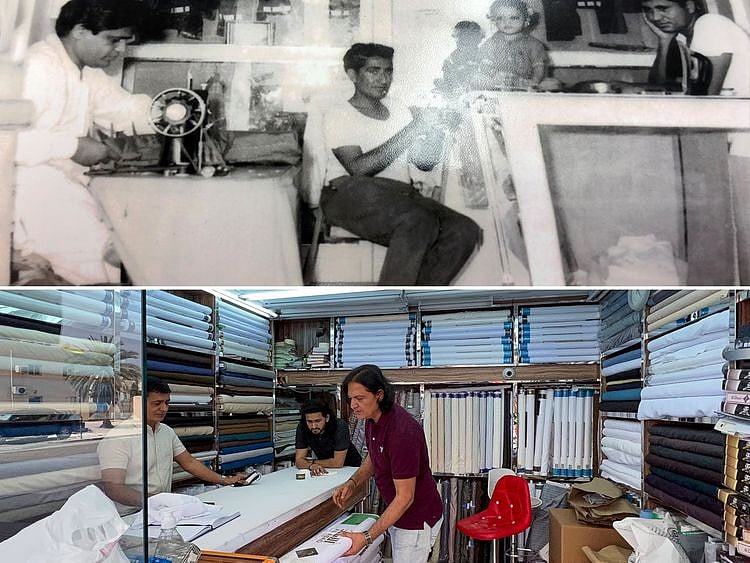
Manoj Kumar Jethwa dropped out of school at the age of 13 to run his father's tailoring business (top) following his death in Dubai in 1982.
Supplied and Ahmed Ramzan/Gulf News
Dubai: It’s 11 am on a mid-week morning and a group of 22 tailors across the lofts of three shops in Satwa are busy on their heavy duty Juki sewing machines. It’s a throwback to yesteryear Dubai as you scale an almost perpendicular wooden ladder to reach the low-roofed attic to meet them. They barely indulge you as they are in a race against time. All, without exception, are catering to the rush of orders for kanduras ahead of Ramadan, which is just round the corner.
Downstairs, their boss Manoj Kumar Jethwa, proprietor of Jairam Dayalal Tailors , picks up a couple of finished kanduras kept between reams of fabric on the shelves. He places them carefully in a crisp brown paper packet and hands it over to an Emirati customer with whom he talks in fluent Arabic.
Quiet confidence
Jethwa is a soft-spoken man. But there is quiet confidence about him. The kind that comes with being schooled by life’s circumstances, rather than lessons in the confines of a classroom.
Manoj Kumar Jethwa's father (second from left) came to Dubai in 1957-58 and by 1960, set up the Jairam Dayalal Jethwa Tailoring Shop on Al Fahidi Street.
“My father died young and I was only 13 at the time, a Grade 8 student at the Indian High School. As the eldest of his three children, I had to choose between continuing to study or run the business and earn for the family. I took the second option,” the Dubai-born Jethwa, now 54, says.
In a validation almost of the revelation, another Emirati customer, Amir Moosa, who has just walked in, tells us he has known Jethwa since he was a child. “I know him from those days. His family has been making clothes for our family for many, years.”
Amir Moosa, right, with Manoj Kumar Jethwa: A long association
As we begin to walk down the memory lane, Jethwa says his grandfather Dayalal Jethwa first came to Dubai from Junagad district in India’s Gujarat in the early 1950s and set up a small tailoring shop on the Abra Lane in Bur Dubai.
Demand for readymades
“He brought my father in 1957-58 and by 1960, he had set up the Jairam Dayalal Jethwa Tailoring Shop on Al Fahidi Street. They were a men’s tailoring shop all along, but initially stitched only pants and shirts for merchants. My father moved to Satwa in 1980 and since people started going in for readymade pants and shirts, he focused on kanduras as well as they had to be made to measure and there was a large local community to cater to.”
The Jethwa family initially catered to orders for shirts and pants. But when readymades picked up, they ventured into making kanduras.
Jethwa says the demand for the local attire was so high, especially during Ramadan, that when he took over the reins of the shop after his father’s death in 1982, he only did kanduras.
Back in time: Manoj Kumar Jethwa (centre) at his father's shop in the 1980s.
“I had many Emirati friends and was encouraged to become a kandoura specialist. There has been no looking back since.”
Types of kanduras
From two tailors at the time to 22 today, Jethwa along with his younger brother Jaiprakash Jairam Jethwa manage three shops in Satwa, all equipped to make kanduras of different kinds.
Manoj Kumar Jethwa with his brother Jaiprakash Jairam Jethwa at one of their three shops in Satwa.
He says the most popular are the Emirati, Abadi, Kuwaiti, Saudi, Omani and Qatari style kanduras.
“My Emirati customers in Dubai typically wear kanduras with a tarboush or tassle in front. What distinguishes these kanduras are their stitches in the front and back. Others come with a band in the neck, a collar or a single cuff. The Emirati style of kandoura requires a good skillset as the stitches must be perfectly aligned,” he explains, pointing to a board with samples of the various styles of kanduras.
A board with samples of different kandoura styles at Jairam Dayalal Tailors, Satwa.
Whether it is the Qatari style marked by its cuffs, shirt collar and hidden buttons; the Bahraini style which usually has no collar but is embellished with embroidery; the Saudi style dishdash with two buttons on the upper neck region; the Kuwait style thoub which has a rounded collar and cuffs; or the Abadi style which has a concealed zipper but without buttons on the neck – Jethwa can wax eloquent on the unique features of any type of kandura.
The fabric that is used for kandouras also comes in different kinds – soft, medium and hard – and I sourced from different countries like Japan, Thailand and Indonesia. “The fabric is available in rolls of either 58 or 36 inch width and they could be of pure cotton, polyester or a mix of both which is preferred to avoid wrinkles and remain cool during summers,” says Jethwa, adding that an average kandura requires 3.5 metres of the fabric.
The fabric that is used for kandouras also comes in different kinds – soft, medium and hard – and I sourced from different countries like Japan, Thailand and Indonesia.
The cost
The cost depends on the material used and the prices could range from Dh150 to Dh300 a piece, he adds.
The days leading up to Ramadan are extremely busy as families place orders en masse for the festivities. “We procure the required fabric in advance and are well prepared for the rush. It takes around four-and-a-half hours to make one kandura and our tailors work extended hours sometimes to be able to deliver orders on time.”
Ramadan rush: Tailors put in extra hours too in order to deliver orders on time.
Jethwa counts his loyal customer base over three generations as a measure of his success in the UAE.
“Many of our customers have moved from old Dubai to areas in the south. Or even overseas. But they still make it a point to come here. Ramadan is a truly blessed time for us,” he says.
Sign up for the Daily Briefing
Get the latest news and updates straight to your inbox
Network Links
GN StoreAbout Gulf NewsTerms & ConditionsReach by GNSitemapContact usPrivacy PolicyGN FocusHave your sayWork with usAdvertise with usGulf News epaperPrinting Services
Download our app
© Al Nisr Publishing LLC 2026. All rights reserved.