Residents enjoying the rain in Manama, near Fujairah, on August 4.
Why is it raining in the UAE when it's nearly 50°C? The answer starts near Madagascar
From Madagascar to the Hajar Mountains, here's why summer storms hit parts of the UAE
Last updated:
4 MIN READ
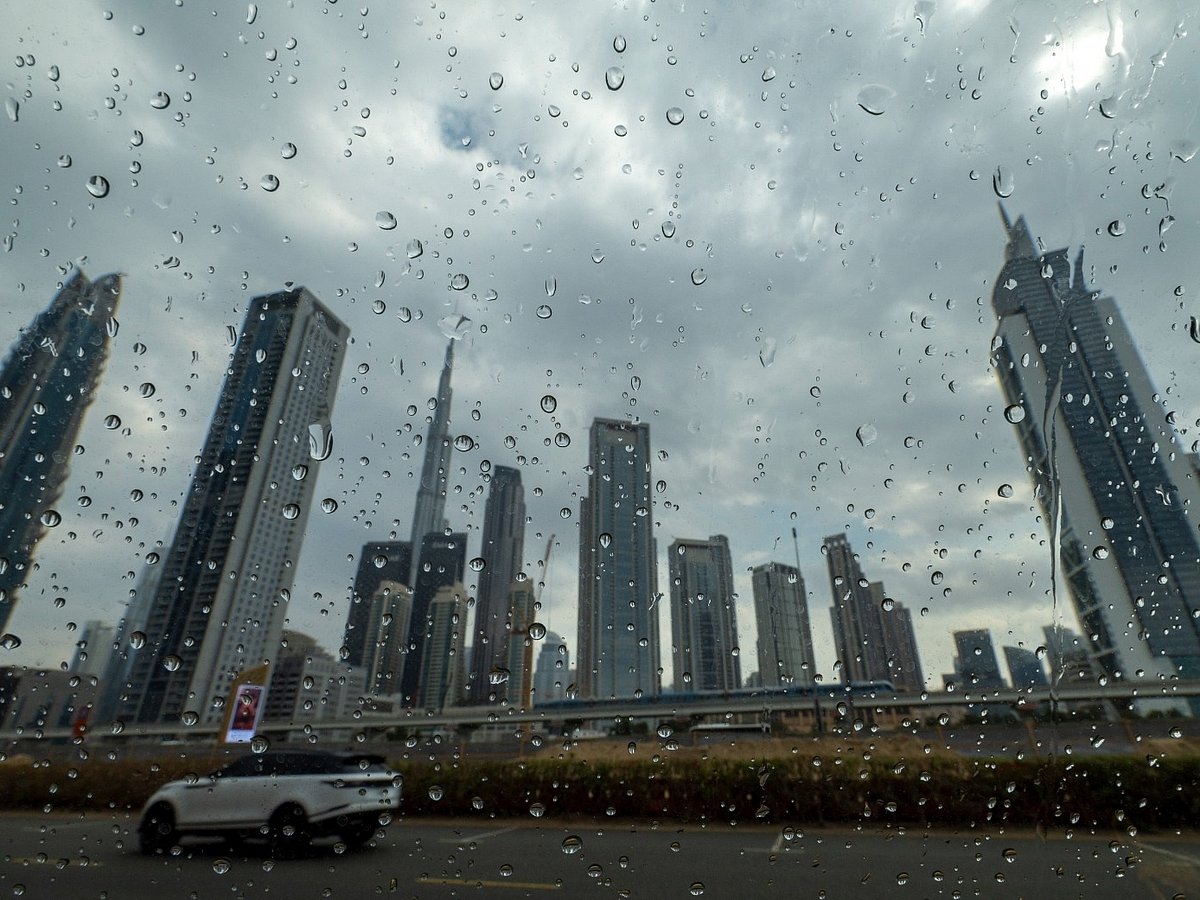
UAE summer rains
Supplied
Dubai: You have seen the videos this past week. Rain, in August, in a country running near 50°C inland. The obvious question is how, and the better one is why there and not where you are standing.
The answer starts about six thousand kilometres away, in the ocean off Madagascar, where the southwest monsoon forms.
Summer rain surprises most residents every year, and it should not. It happens more often than people expect, and none of it is random. Muhammed Sajjad KP, the civil engineer behind the UAE Weatherman account and a self-taught forecaster followed by around 280,000 people, explains that several systems have to line up before a drop falls.
The journey north
The monsoon wind tracks north past Somalia, gathering moisture as it goes. By the time it reaches Yemen and Salalah it is heavy enough to turn those mountains green every summer, which is why one corner of Oman spends three months looking nothing like the rest of the Gulf.
One arm swings east towards Kerala. The rest sits over the Arabian Sea, within reach of us.
"Rainfall bands can develop near Madagascar, move toward Somalia, then Yemen and Salalah, and at times extend toward Kerala," Sajjad says. "Some of this moisture also reaches Oman, particularly its mountainous regions, and parts of it can extend into Al Ain and the eastern Emirates."
A 2025 study in the Quarterly Journal of the Royal Meteorological Society, by a team at Khalifa University and NYU Abu Dhabi, found that convection in the drier central and western parts of the country is fed by exactly this: moisture drawn off the Arabian Sea by the southerly monsoon flow.
Naseem al bahar
Here is the part most explanations get wrong.
The clouds do not make that journey. The moisture does. The clouds are built here, on the day, and it takes two winds to build them.
Every afternoon, sea breezes push inland from both coasts. One off the Arabian Gulf, running from Abu Dhabi up to Ras Al Khaimah. The other off the Sea of Oman, in through Fujairah and Dibba. Naseem al bahar, the sea breeze. Both arrive humid, and somewhere over the interior they meet.
What drives them is the temperature gap between water and land, which the same research team measured at over 10C in places.
"During summer afternoons, these breezes can converge over certain areas, leading to cloud formation when supported by low-pressure systems, high temperatures, and sufficient humidity throughout the atmosphere," Sajjad says.
Why the rain lands in the east
That collision forces air upward and cloud starts to form. The Al Hajar mountains push it higher still.
The Khalifa University team tested this by removing the Arabian Gulf sea breeze from their simulation, replacing the water with flat desert. The convection weakened. NCM bulletins point the same way, listing the eastern mountains alongside rising temperatures and incoming moisture.
Which explains the geography of a UAE summer shower. Fujairah, Khor Fakkan and Al Ain get soaked. The coastal cities watch it happen on Instagram.
Everything else that has to agree
Cloud is not rain. Pressure has to be low, because under high pressure the cloud goes nowhere. Temperature has to behave through every layer of the atmosphere, not just at the surface. When it does, the cloud keeps climbing into cumulonimbus, the towering formations that actually deliver.
This particular spell has a specific cause. NCM attributes it to the northward advance of the Intertropical Convergence Zone, a belt of low pressure near the equator, combined with an upper-level trough from the east, a surface low arriving from the south, and moisture drawn in from the Sea of Oman.
Low-pressure systems from India and Pakistan feed into it too. August is the month the UAE is affected by the Indian monsoon low, alongside thermal lows from the southwest that push inland temperatures higher.
And no, it is not all cloud seeding
The question follows every summer downpour, so it is worth settling.
Seeding works on clouds that already exist. It cannot create them and it cannot pull rain from a clear sky. Aircraft release natural salt particles into suitable convective clouds, helping small droplets merge into drops heavy enough to fall, which approved studies put at a 10 to 25 per cent increase in rainfall.
As of the start of August, the UAE had flown 110 seeding missions since the beginning of 2026. Every one needed nature to build the cloud first.
Which is the shape of the whole thing. A wind forms off Madagascar, runs the length of the Somali coast, drops its load over Salalah and leaves the rest hanging over the Arabian Sea. Two sea breezes carry it inland. A mountain range lifts it. And on the right afternoon, with the pressure and the temperature agreeing, it finally reaches us.
Network Links
GN StoreAbout Gulf NewsTerms & ConditionsReach by GNSitemapContact usPrivacy PolicyGN FocusHave your sayWork with usAdvertise with usGulf News epaperPrinting Services
Download our app
© Al Nisr Publishing LLC 2026. All rights reserved.