Want to become an astronaut? Lessons from Emirati astronaut Nora Al Matrooshi
From engineering to NASA training, what it actually takes to qualify for space
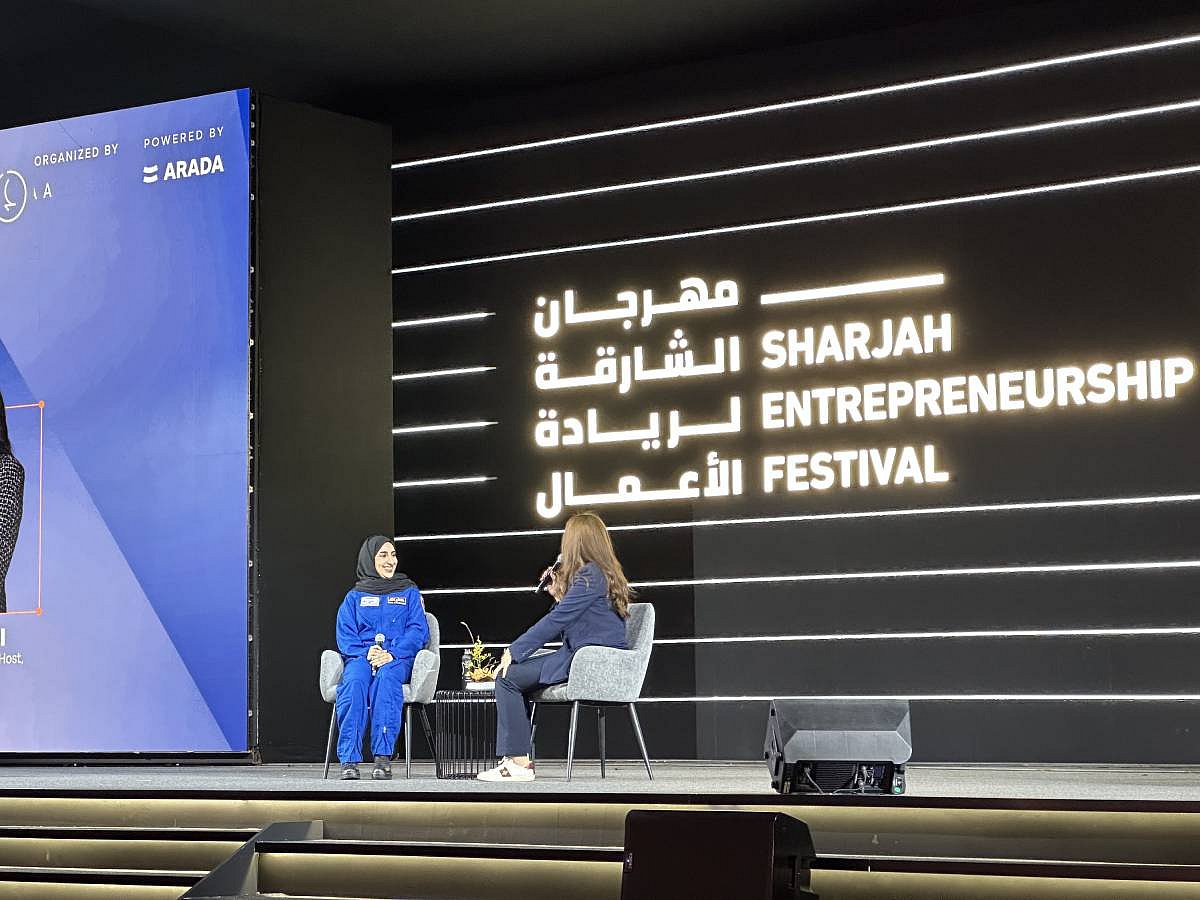
Dubai: Becoming an astronaut has little to do with a single defining moment and far more to do with preparation that stretches across years, according to Nora Al Matrooshi, who said her journey into space began long before formal training ever started.
Speaking at a fireside chat during the Sharjah Entrepreneurship Festival 2026, Al Matrooshi traced her interest in space back to early childhood, when a classroom exercise sparked a fascination that never faded. At five years old, her teacher recreated a moon landing inside the classroom, complete with makeshift spacecraft and exploration tasks. What stayed with her was the feeling it created. “That feeling of excitement and exploration stuck with me,” she said, explaining that it shaped how she approached learning from that point on.
That curiosity later translated into an academic choice. Mechanical engineering, she said, offered a way to understand systems and solve problems in a structured way, while staying close to the technical backbone of spaceflight. A documentary on a Soyuz mission during high school reinforced that decision, after she noticed that many of the engineers behind the spacecraft shared the same background. Mechanical engineering, she said, became a deliberate pathway rather than a placeholder.
Rejection is part of the process
When the UAE Astronaut Programme opened, thousands applied. Al Matrooshi applied in the first round and was not selected. She continued developing her skills and followed the programme closely, supported by family and friends who kept pushing her to reapply when the next opportunity came. “I didn’t stop working on myself,” she said, describing rejection as part of the process rather than an endpoint. She was selected in the second intake in 2021 at the age of 27 and sent to NASA’s Johnson Space Center in Houston for astronaut training.
What the training demands
Training, she explained, is designed to test far more than technical knowledge. Astronaut candidates are taught how to operate and maintain the International Space Station, respond to emergencies, work with robotics and function in a multilingual environment, including mandatory Russian language training. Equal weight is placed on leadership and teamwork, reflecting the reality of living and working in confined spaces with international crews for extended periods.
Much of the pressure comes from simulations that are intentionally overwhelming. Systems fail, problems stack up and candidates are required to respond without losing focus. Al Matrooshi said those sessions revealed gaps she did not know existed. Procedures and repetition build muscle memory, allowing astronauts to stay calm and act logically when stress peaks. “You learn to follow what you’ve trained for, even when everything is going wrong,” she said.
Spacewalk training proved the most demanding. Hours spent underwater in the Neutral Buoyancy Lab, wearing a heavy suit with limited vision, require constant coordination, stamina and mental clarity. Engineers also adapted the training environment to accommodate her hijab, ensuring safety standards were met without compromising comfort, a step she said reflected the programme’s professionalism.
Lessons beyond space
Asked what astronaut training teaches beyond spaceflight, she answered that learning never stops. “If you think what you know is enough, it never is,” she said, adding that progress depends on stepping outside comfort zones and learning from others. Fear, she noted, plays a role too, sharpening awareness rather than blocking action. “Don’t let it stop you from taking the next step,” she said.
Looking ahead, Al Matrooshi pointed to the UAE’s expanding role in space exploration, from lunar missions to satellite programmes, as a sign that opportunities are widening beyond astronauts to engineers, researchers and technology companies. Space, she said, is becoming an economic sector as much as a scientific pursuit.
Sign up for the Daily Briefing
Get the latest news and updates straight to your inbox
Network Links
GN StoreDownload our app
© Al Nisr Publishing LLC 2026. All rights reserved.