An example of a US-sanctioned crude oil tanker, the RAMONA I, due to its Iran links. Tracking databases list the same IMO number, 9233222, for both Triathlon and RAMONA I. It has the former names Shadi (until 2022), Seagull 21 (2021) and Triathlon (2021). The Triathlon record shows a crude oil tanker with the same IMO number, built in 2002 and sailing under the Liberian flag. The Ramona I record shows the same IMO, the same 84,586 gross tonnage and 164,445 deadweight tonnage, and a Panama flag. Why '"Monrovia" appears: Monrovia is Liberia’s capital and the port of registry for Liberian-flagged ships. So “Triathlon, registered in Monrovia” means it was Liberian-flagged at that point. It later appears under the Panama flag, which is consistent with the Panama-flagged vessels Treasury described in this action.
US-Israel-Iran war: Blasts near Hormuz, oil prices rise, Trump declares no talks with Iran, 'something will happen soon'
UAE residents face travel disruptions as Iran conflict intensifies near Hormuz
Last updated:
4 MIN READ
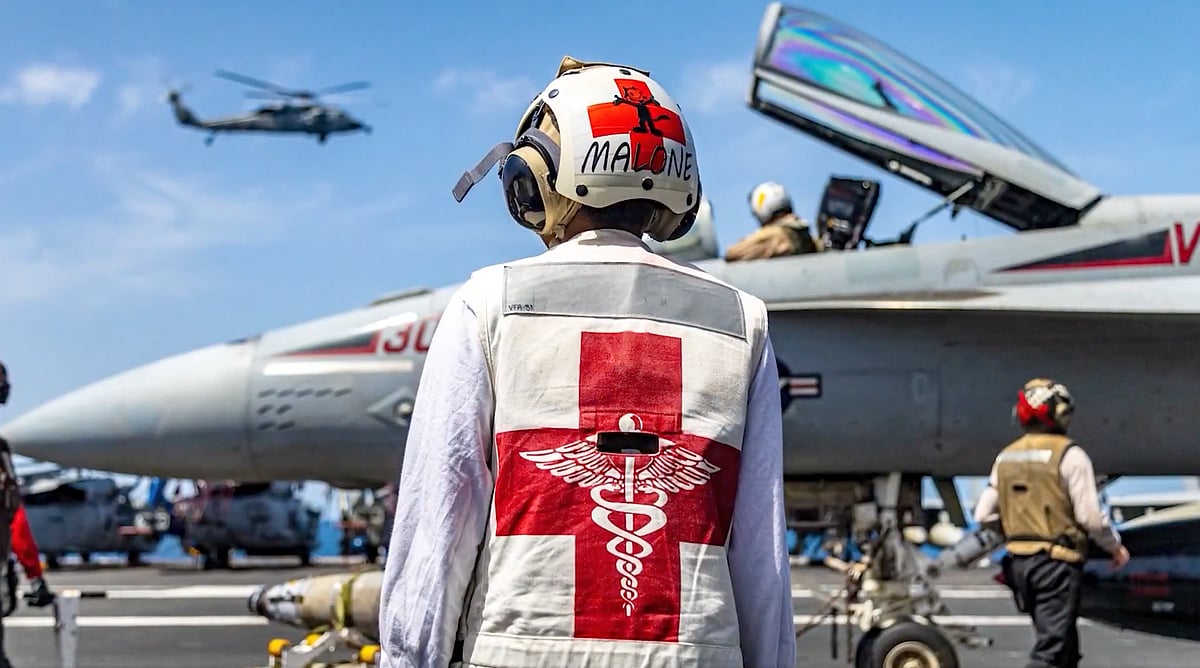
US sailors preparing to launch an fighter jet from an aircraft carrier. On Wednesday IRGC accused the US of encouraging ships to cross mined waters and warned that continued activity could lead to retaliation against US bases across the region.
CentCom | X
The US-Israel-Iran conflict entered a more volatile phase on Thursday (Oct. 22, 2026), with explosions reported near the Strait of Hormuz, Iranian officials warning of a possible “zero hour” with Israel, Gulf air defences responding to drone and missile threats, and US President Donald Trump declaring no talks are happening with Iran.
For UAE residents, the immediate effects are disrupted Saudi flights, higher fuel-price risk, and continued official advice to avoid unnecessary travel — though no new UAE-wide guidance requires changes to daily routines.
The US, meanwhile, ordered some diplomats to leave Saudi Arabia as fears of escalating Houthi attacks rise.
US President Donald Trump, who wrote on October 8 that the US will not attack Iran before the November 3 midterm elections, has declared on late Wednesday that the US is not negotiating with Iran, adding that "something" will happen "soon".
Get it: Fast, verified news for FREE ... download the Gulf News app — simply click here
Following are the latest developments:
'Zero hour': Blast near Hormuz
Iranian state media reported explosions in southern Hormozgan province, overlooking the Strait of Hormuz — the first reported in the area this month after a relative lull.
Meanwhile, Iranian Parliament Speaker Mohammad Bagher Ghalibaf’s adviser, Mehdi Mohammadi, said signs of military confrontation between Iran and Israel had “noticeably intensified” and warned the two sides were nearing a “zero hour.”
US and Israeli officials confirmed that dozens of Israeli fighter jets and refuelling aircraft reportedly flew more than 800 miles along a route consistent with a potential strike on Iran, passing through Syrian and Iraqi airspace.
Iranian Foreign Minister Abbas Araghchi said on X that Iran remains open to diplomacy if the US demonstrates a willingness to build trust and reach a resolution.
Araghchi warn: if the US "chooses war over diplomacy, it'll certainly result in an even greater strategic failure," he added.
US Secretary of State Marco Rubio told reporters on Wednesday that mediation efforts are welcomed, though the final decision on terms rests with Trump.
Asymmetrical defence
Iran’s IRGC said it was shifting to an “offensive and asymmetrical” defence doctrine and threatened to invade any country that attacks it.
The rhetoric signals a higher risk of escalation, although it does not by itself confirm an imminent attack on other Gulf states.
On Thursday, the IRGC claimed it struck seven vessels in a single night. The Guards said 4 vessels were struck simultaneously and caught fire while transferring oil between ships in the north-central Gulf.
IRGC also reported that 3 other vessels hit mines west of the Strait of Hormuz last night and caught fire. IRGC accused the US of encouraging ships to cross mined waters and warned that continued activity could lead to retaliation against US bases across the region.
Travel and flights
The most direct impact for UAE residents remains air travel to Saudi Arabia.
Several flights to Saudi Arabia have been cancelled. Emirates and flydubai have cancelled services to three Saudi cities – Riyadh, Dammam and Abha – though Dubai-Medina flights were still listed as operating.
Etihad has cancelled Abu Dhabi flights to Riyadh, Jeddah and Dammam through Saturday, October 24.
AP reported that Riyadh’s King Khalid International Airport was open for domestic flights on Wednesday following multiple Houthi strikes on the Saudi capital this month.
Later Wednesday, an attack on King Fahd International Airport in eastern Saudi Arabia left one Saudi resident, the Saudi Civil Aviation Authority said.
Global flight-tracking service Flightradar24 said flights have been diverted away from the airport in Damman.
Airlines continue to adjust services. Flight cancellations also disrupted travel plans for Indian expatriates: Air India, Air India Express and IndiGo have suspended Saudi flights until October 24.
US Treasury sanctions Iran-linked shipping network
The US Treasury Department has sanctioned Panama- and Greece-based law firm Karnakis and Karnakis, shipping agents and vessels over their alleged support for illicit Iranian shipping activity, the department said in a post on X.
The Treasury said the activity indirectly helped Tehran generate revenue to fund its military, weapons and nuclear programmes.
The measures were announced under Operation Economic Outcast, which Washington said involves coordination with partners in Europe and around the world to cut off Iran’s remaining economic lifelines.
Security and daily life
Regional security activity remains a concern.
There is no new official UAE guidance telling residents to alter daily routines. However, foreign advisories remain in place.
Saudi air defences intercepted a drone targeting Aramco’s Shaybah oilfield near the UAE border, with falling debris killing two people and injuring two others.
While these incidents are in Saudi Arabia, not the UAE, but they underscore why residents should follow official UAE alerts and avoid spreading unverified claims.
Oil, prices and economy
Oil markets remain sensitive to Hormuz disruptions.
Middle East producers have kept crude moving by expanding pipelines, offshore transfers and tanker shuttles that bypass the strait; regional exports reached more than 24 million barrels per day, up from 23.3 million before the war.
Still, supply risks are pushing prices higher.
As of 2.02pm Beijing (10.02am Gulf, Oct. 22, 2026) Brent jumped 2.25% to $111.3 per barrel, and WTI at $99.11, up 2.02%; Murban crude oil futures held steady at $110 per barrel (up $0.15, or 0.14%).
For UAE residents, the practical effect may be higher petrol, transport and imported-goods costs over time, depending on how long shipping and insurance disruptions persist.
What to watch next
Four developments are worth watching: any confirmed strike or major escalation near Hormuz; the status of Saudi airport operations and UAE-Saudi flight schedules; official UAE emergency or civil-defence advisories, and oil-price movements.
Iran’s foreign minister had said the strait would remain shut until Washington accepted a seven-day deal, while Tehran rejected US-backed talks in Pakistan and set seven conditions — making diplomacy the key variable for de-escalation.
Flight schedules can change at short notice.
Travellers are advised to confirm their flight status, departure time and any rebooking arrangements before setting off and must check directly with their airlines before leaving for the airport.
Network Links
GN StoreAbout Gulf NewsTerms & ConditionsReach by GNSitemapContact usPrivacy PolicyGN FocusHave your sayWork with usAdvertise with usGulf News epaperPrinting Services
Download our app
© Al Nisr Publishing LLC 2026. All rights reserved.