What a Pomegranate Asks
UAE teen artist Abibi turns everyday objects into powerful stories of culture, memory and belonging
From butter cookie tins to Rooh Afza, everyday items become shared memories
Last updated:
4 MIN READ
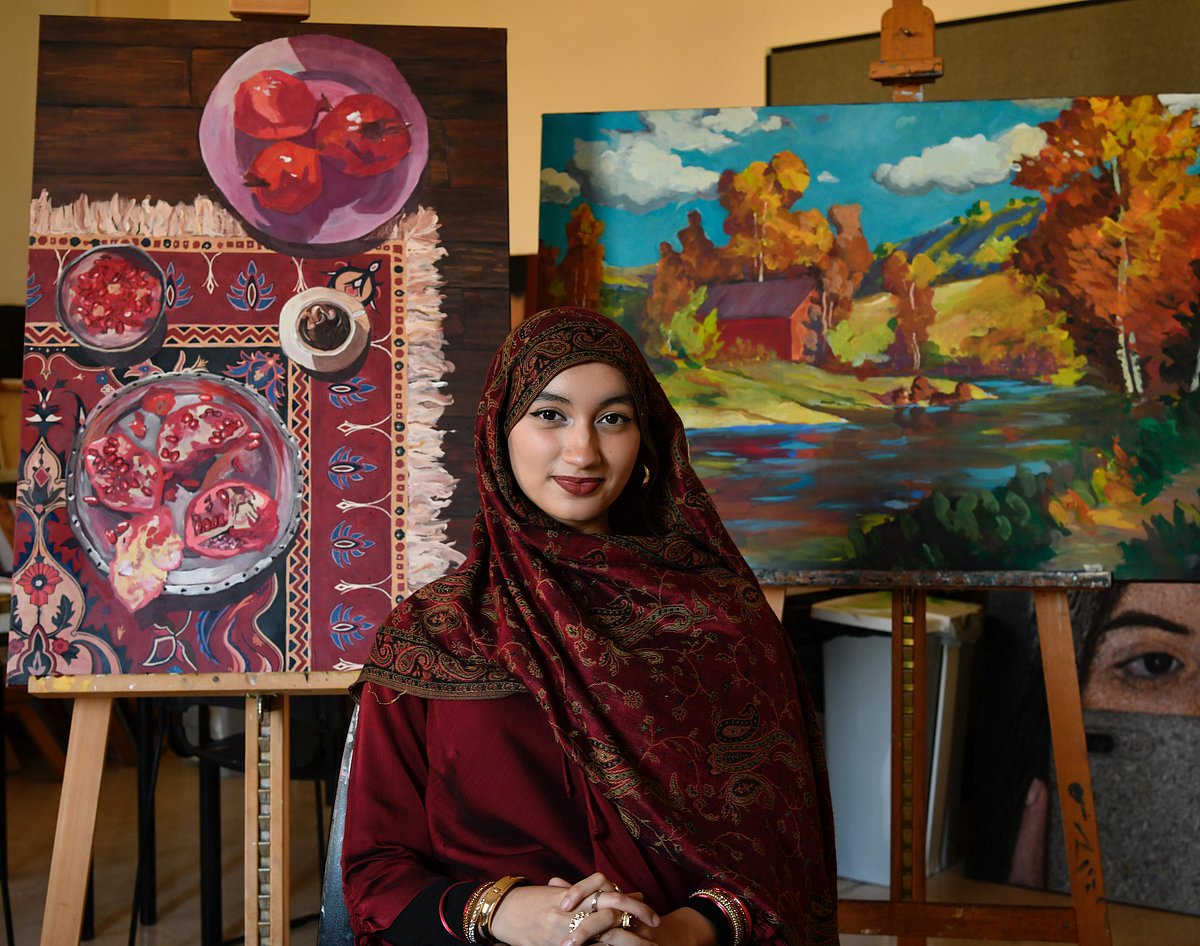
19-year-old Abibi uses painting to highlight everyday moments and cultural stories
Supplied
Dubai: At just 19, Aabidah better known as Abibi, is already building a body of work that resonates far beyond her years. Working primarily with gouache, the UAE-based artist captures cultural moments and everyday objects, turning them into something deeply personal yet widely recognisable.
“I’ve been painting and drawing since I was a little kid, like I think everyone.” she explains. Her path into art wasn’t entirely linear. Abibi initially began studying architecture before realising it wasn’t the right fit.
Around the same time, a university exhibition in Dubai became a turning point. “That’s what really pushed me to make original work on canvases,” she says. “And I guess the rest is history.”
Get updated faster and for FREE: Download the Gulf News app now - simply click here.
Today, her work has reached more than 8 million people online, but for Abibi it’s the stories behind those numbers that matter most.
“One story that really sticks with me is when a woman told me my painting What a Pomegranate Asks reminded her of her grandmother,” she says. “She said her grandmother would come every weekend, peel her pomegranates and ask her questions. It’s those kinds of emotional connections that stay with me.”
Living in the UAE has played a central role in shaping her artistic voice.
“There are so many people from different cultures around me, and that obviously inspires my work,” she explains. “I try to find specific, niche moments that are actually common across all these cultures.”
“The UAE is a remarkable example of being united” she says. “Through creative spaces, people from different backgrounds come together, inspire each other, and share their work. It’s really amazing to be part of that.”
She also finds herself reflected in the country’s large community of third culture kids. “We’re originally from somewhere else, but we call the UAE home,” she says. “It’s really nice to be able to represent that experience through my art.”
That idea of shared experience often shows up in the most unexpected ways, like her current work-in-progress centered around butter cookie tins.
Get updated faster and for FREE: Download the Gulf News app now - simply click here.
Abibi's current project on butter cookie tins
“It’s such a specific but universal thing,” she says. “Almost every household has a butter cookie tin that doesn’t actually have cookies in it, it’s usually filled with sewing supplies. It’s such a small, silly moment, but so many people relate to it.”
This focus on the everyday extends across her work, including pieces inspired by familiar cultural items like the Rooh Afza bottle or the Maang Tikka objects that quietly carry memory, identity and belonging.
Maang Tikka painting (left) and Roohafza (right)
Get updated faster and for FREE: Download the Gulf News app now - simply click here.
During the recent period of uncertainty, she found herself reflecting on the role of creativity. “It’s times like this when people turn to art,” she says. “Whether it’s movies, music or fine art, these are the mediums that give you answers when there aren’t many.”
Despite her growing audience, her proudest moments remain grounded in her own impact. “Every time someone says, ‘I’m not really interested in art, but your painting is something I’d want in my house,’ that means a lot,” she says. “Or when someone tells me I inspired them to start painting again, even my own mom got back into it after seeing my work.”
At the heart of her practice is a clear intention: representation.
“I want people to feel seen through my art,” she says. “There are so many misconceptions about Asian and Arab communities in global media. Through my work, I want to romanticise these cultures and show their complexity.”
It’s also why she feels strongly about how art is perceived as a career, particularly within South Asian contexts.
“It’s ironic because these cultures are historically known for their art and craftsmanship,” she says. “But today, pursuing art is sometimes seen as less intelligent or less stable.”
Abibi alongside her painting 'Yaqeen'
For Abibi, that mindset needs to change. “It really hurts to see people being pushed into careers they’re not passionate about in the name of a ‘stable future’ especially when nothing is truly certain.”
Instead, she advocates for choosing fulfilment in the present. “The idea that art is something you can do later or on the side is something I don’t agree with,” she says. “Why wait for a hypothetical future when you can spend your time now doing what you love?”
Abibi’s work proves that even the smallest, most familiar objects can carry big stories. By capturing experiences that are both personal and widely relatable, she creates art that makes people feel seen and represented. All while showing that passion pursued today will always be meaningful.
Sign up for the Daily Briefing
Get the latest news and updates straight to your inbox
Network Links
GN StoreAbout Gulf NewsTerms & ConditionsReach by GNSitemapContact usPrivacy PolicyGN FocusHave your sayWork with usAdvertise with usGulf News epaperPrinting Services
Download our app
© Al Nisr Publishing LLC 2026. All rights reserved.