Etihad Rail station in Fujairah.
Dubai: Getting to Fujairah was already an adventure before we even stepped foot inside the station. As our convoy got closer to the port, GPS glitches knocked out our navigation completely, and we found ourselves reading the map manually, spotting landmarks, piecing the route together the old-fashioned way. Then, in the distance, we saw it.
Two massive UAE flags draped over the facade of a grey and glass building, with several more hoisted outside. The Etihad Rail Fujairah Passenger Station looked like something out of a science fiction film. I immediately reached for my camera.
A station unlike anything I expected
I expected it to feel like the Dubai Metro, the only reference point I had from commuting during my university years. But the moment those doors opened, I forgot everything I thought I knew.
The station was enormous and airy, with massive digital information boards at its centre displaying train times and route details. The kind you see in airports, or in films set in London or Tokyo. Navigation panels hung from above, pointing you in every direction. There was a quiet efficiency to the whole space that I genuinely was not expecting.
Information panels at the station displaying train timings.
To my left was the ticketing gate section, where you tap your ticket and pass through waist-high glass barriers that open around you. Then, like a scene from a film, an escalator carried us up to the platform. I had never been on a train platform in my life.
The train: Better than anything I imagined
I spotted the train before I had even fully taken in the platform.
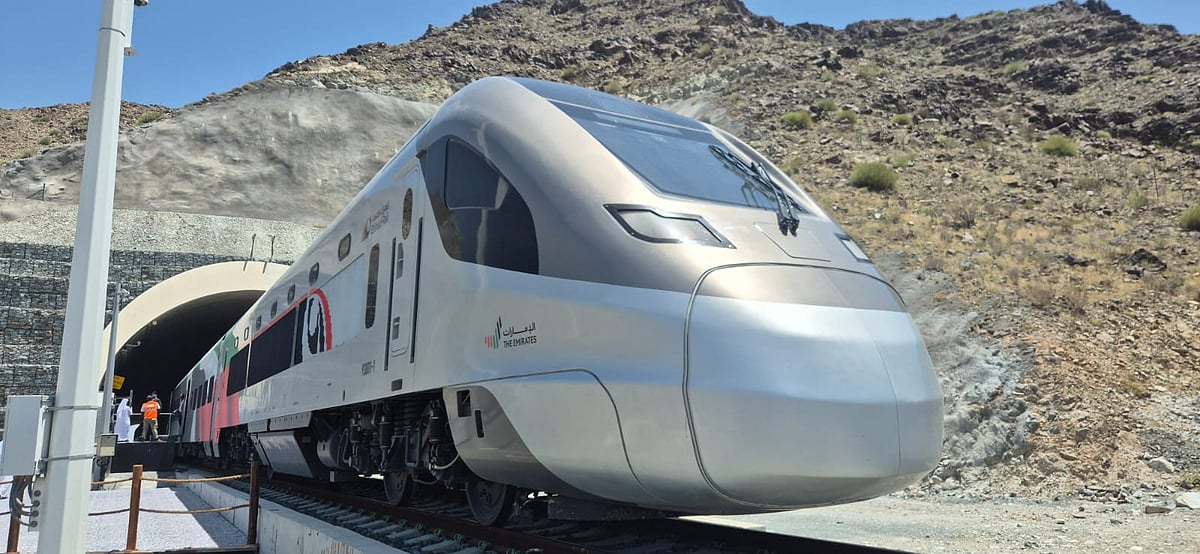
Its aerodynamic body shimmered under the sun, the grey metal catching the light and turning it silver. The UAE flag painted along its side looked almost alive. If I moved, it seemed to ripple. The nose was angled upward toward the sky, as if it was just as eager to get going as I was. On the side, a UAE map in the colours of the flag bore the words "The Emirates", a quiet nod to what this whole project is really about. Connecting every emirate.
The Emirates logo on the side of the rail.
Speaking to Gulf News, Adhraa Almansoori, Executive Director of Commercial at Etihad Rail Mobility, mentioned that school children are expected to use the train as part of the UAE's wider public transport vision. That made the whole thing feel even bigger.
Stepping inside
To my right, the premium coaches. To my left, comfort class.
Premium seating with tables.
The interior had dark charcoal seats with padded neck rests, tray tables, underseat charging ports and sockets, pull-down window shades, and a leg rest you nudge open forward with your foot. The panoramic windows, similar to the ones on the Dubai Tram, give you a full unobstructed view of everything passing outside.
Overhead luggage spaces, a large rack near the entrance, and dedicated priority seating for pregnant women rounded things out nicely. The walls were warm beige, and the whole palette felt quietly luxurious in that very UAE way.
We found four-seater family facing seats around a shared table, settled in, and then the train began to move.
Etihad rail Fujairah passenger station and the train ride during a media preview.
The view from the window
Fujairah unfolded below us. Date palm trees, residential streets, farmland, the ocean sitting far on the horizon, all of it gradually blurring as the train picked up speed. People were walking the coaches, standing, chatting, and nobody lost their footing. The ride was that smooth. Not a single jolt.
The UAE flag on a fort beside Al Bithnah Bridge
We stopped near Al Bithnah Bridge, where the conductor gave us five minutes to step off and take in the view. A fort with a UAE flag stood in the distance, framed by date palms and mountains. I stood there wishing my phone could do it justice.
On the way back, the train passed through several tunnels, the outside world disappearing into darkness and turning the windows into mirrors. I took a few selfies. I needed proof this was real.
On the way back, the train passed through several tunnels.
I never expected my very first train ride to be on the Etihad Rail. But honestly, I could not have asked for a better one. When services launch later this year, I'll be among the first in line.
Network Links
GN StoreAbout Gulf NewsTerms & ConditionsReach by GNSitemapContact usPrivacy PolicyGN FocusHave your sayWork with usAdvertise with usGulf News epaperPrinting Services
Download our app
© Al Nisr Publishing LLC 2026. All rights reserved.