E-scooter safety under spotlight after UAE records 97% crash surge
Study finds widespread reckless riding, helmet violations and underage use
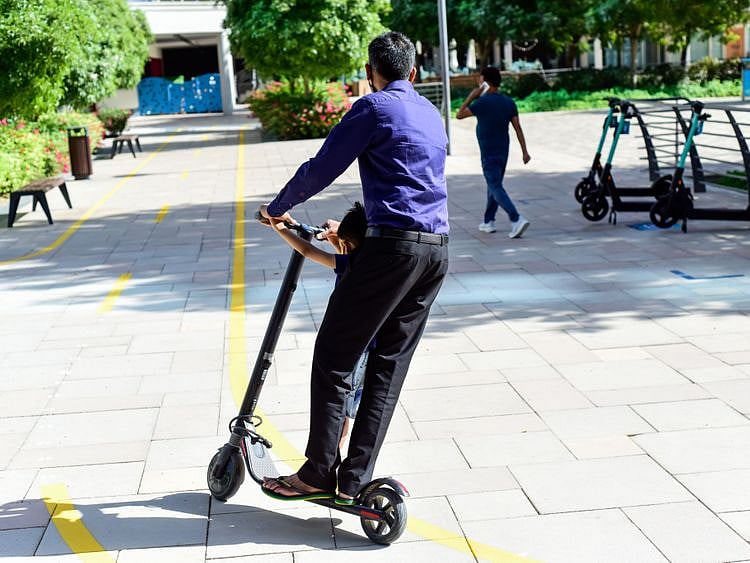
Dubai: The rapid rise of e-scooters across the UAE is being accompanied by an alarming increase in serious accidents, with new data showing that major e-scooter crashes nearly doubled in 2025, raising urgent concerns about rider behaviour, safety awareness and infrastructure.
An analysis of UAE Ministry of Interior (MOI) traffic data by RoadSafetyUAE revealed that major accidents involving e-scooters increased by 97 per cent in 2025 compared with 2024. The broader micro-mobility segment including e-scooters, motorcycles, bicycles and electric bikes recorded a 45 per cent rise in major accidents, significantly outpacing the overall increase of 23 per cent across all vehicle categories.
The findings come alongside a nationwide perception study commissioned by Al Wathba Insurance and RoadSafetyUAE, which surveyed 1,010 UAE residents and uncovered widespread public concern over unsafe e-scooter use.
Reckless
According to the survey, 93 per cent of respondents said they regularly witness e-scooter riders behaving recklessly or unsafely, while 90 per cent said they personally feel unsafe because of rider behaviour. Helmet compliance emerged as one of the biggest concerns, with 90 per cent reporting that they frequently see riders without helmets.
The study also highlighted other common safety violations. Nearly 89 per cent of respondents said they often observe e-scooter riders using areas where they are prohibited, such as sidewalks or roads against traffic flow. Another 88 per cent reported seeing riders who appear to be younger than the legal minimum age of 16, while 81 per cent said riders often travel without lights at night, significantly increasing accident risks.
Important mode of transport
Despite these concerns, e-scooters remain an important mode of transport for many residents. Six in ten respondents said e-scooters fulfil an important transportation need in their communities, reflecting the growing role of micro-mobility in urban travel.
Thomas Edelmann, Founder and Managing Director of RoadSafetyUAE, said the combination of soaring accident figures and widespread reports of unsafe behaviour points to an urgent need for action.
“The 2025 accident statistics paint a picture that calls for immediate attention. While e-scooters provide valuable mobility options, the data clearly shows that rider behaviour and compliance with regulations remain major challenges,” he said.
Safety measures
The research also suggests that current safety measures may not be sufficient. Although 70 per cent of respondents reported seeing traffic officers enforcing e-scooter regulations, many believe additional steps are needed to improve safety outcomes.
One of the strongest recommendations from the study is the expansion of dedicated e-scooter infrastructure. Nearly 88 per cent of respondents supported the creation of more designated lanes, crossings and safe riding zones to separate e-scooters from pedestrians and other road users.
Al Wathba Insurance Chief Financial Officer Muralikrishnan Raman said the findings underscore the need to balance mobility benefits with public safety.
“There is a clear demand for e-scooters as a transport solution, but the high levels of perceived reckless riding cannot be ignored. Research like this helps identify where interventions are needed to better protect riders and the wider community,” he said.
Awareness
RoadSafetyUAE said the findings point to the need for a broader, multi-stakeholder approach involving authorities, schools, parents, residential communities and employers. The organisation called for enhanced rider education, greater awareness of existing regulations, improved helmet use and more responsible riding practices.
Experts believe that combining stronger enforcement with education campaigns and better infrastructure could help reverse the sharp rise in serious accidents while ensuring e-scooters remain a safe and sustainable transport option in the UAE.
Where are e-scooters prohibited?
To avoid heavy fines and ensure pedestrian safety, do not ride your e-scooter in the following locations:
Major highways: Strictly forbidden.
High-speed roads: any road with a speed limit exceeding 60 km/h.
Pedestrian-only areas: non-designated pavements, sidewalks, or tracks specifically for running and jogging.
Public transport hubs: you cannot ride inside Metro stations or on platforms.
Essential rules and safety regulations
Speed limits - The maximum allowed speed for e-scooters in Dubai is 20 km/h. Riders must adhere to this limit and follow all local speed restrictions posted on tracks.
Key conduct Rules
Age requirement: Riders must be at least 16 years old.
Safety gear: It is mandatory to wear a helmet and a reflective jacket.
No passengers: E-scooters are designed for one person. Carrying a passenger is a violation.
Balance: Do not carry heavy items that could cause an imbalance.
Pedestrian crossings: You must dismount your e-scooter when crossing the road at pedestrian points.
Safe distancing: Maintain a safe gap between yourself, other cyclists, and pedestrians.
Do you need an e-scooter permit?
Yes, a e-scooter permit is mandatory for anyone riding an electric scooter in Dubai.
How to apply: You can obtain a permit for free via the RTA website - rta.ae or the Dubai Now app.
Exemptions: You do not need to apply for a permit if you already hold a valid UAE driving licence or a valid international driving licence.
Common e-scooter violations and fines
Under Executive Council Resolution No. (13) of 2022, authorities can issue fines for failing to follow regulations. Here are the most common penalties:
Riding without a valid RTA permit - Dh200
Carrying a passenger on an e-scooter - Dh300
Riding on roads with speed limits of 60 km/h and above-Dh300
Riding in non-designated lanes - Dh200
Parking in a way that obstructs traffic/pedestrians - Dh200
Network Links
GN StoreDownload our app
© Al Nisr Publishing LLC 2026. All rights reserved.