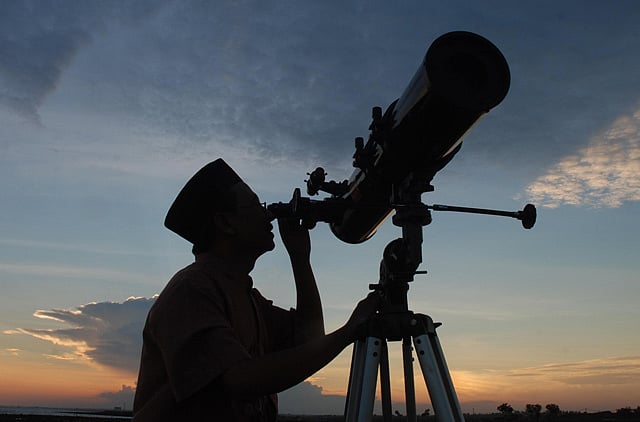
Dubai: Most Islamic countries are expected to observe the crescent moon marking the start of Rajab 1447 AH on Saturday, according to the International Astronomical Centre.
Rajab is the seventh month of the Hijri calendar and one of Islam’s four sacred months. It holds special importance as it signals the final phase leading up to Ramadan, which traditionally begins after Rajab and Sha’ban.
When could Ramadan begin?
If Rajab starts on Sunday, December 21, and both Rajab and Sha’ban run their usual 29 or 30 days, Ramadan is expected to begin in about 60 to 61 days. However, the exact date will depend on official moon sightings closer to the time.
Engineer Mohammed Shawkat Odeh, Director of the International Astronomical Center, said the moon’s central conjunction will occur at 01:43 GMT on Saturday. He added that the visibility of the crescent after sunset will vary widely by region.
Where the crescent may be seen
According to Odeh, the crescent may be visible with telescopes from parts of southern and south-western Africa, as well as South America. Naked-eye visibility is expected only from western South America and the Pacific Ocean.
Because the crescent can be seen from some parts of the Islamic world, many official calendars have already listed Sunday, December 21, as the first day of Rajab.
Despite astronomical predictions, Odeh stressed that the official start of Rajab remains subject to confirmation by religious authorities in each country, based on verified crescent sighting reports.
Visibility ruled out in many Arab capitals
Astronomical calculations show that crescent visibility will be impossible on Saturday evening in several Arab and Islamic capitals, whether by telescope or with the naked eye.
In Jakarta, the moon will set 18 minutes after sunset, at an age of 11 hours and 16 minutes. In Abu Dhabi, moonset will occur 10 minutes after sunset, with the moon aged 13 hours and 30 minutes. In Riyadh, it will set after 11 minutes, at 13 hours and 55 minutes old.
In Amman, the moon will set 8 minutes after sunset, aged 14 hours and 9 minutes. In Cairo, it will set after 10 minutes, at 14 hours and 24 minutes. In Rabat, moonset will occur 12 minutes after sunset, with the moon aged 16 hours and 3 minutes.
In all these locations, Odeh said, crescent sighting will not be possible by any conventional means.
Better chances in Southern Africa
More favourable conditions are expected in Maputo, Mozambique, where the moon will set 39 minutes after sunset at an age of 16 hours and 8 minutes, making telescope observation possible.
Odeh noted that advanced astronomical imaging techniques could, in theory, detect the crescent across much of the Islamic world. However, such methods remain religiously disputed and are not accepted by many countries for declaring the start of lunar months.
He added that the shortest moonset interval ever observed by the naked eye was 29 minutes, while the youngest visible crescent was recorded at 15 hours and 33 minutes.
Even then, he said, visibility is not guaranteed and also depends on factors such as the moon’s angular distance from the sun and its height above the horizon.
Sign up for the Daily Briefing
Get the latest news and updates straight to your inbox
Network Links
GN StoreDownload our app
© Al Nisr Publishing LLC 2026. All rights reserved.