How the UAE determines the first day of Ramadan each year
Astronomers and scholars work together to confirm the Ramadan crescent
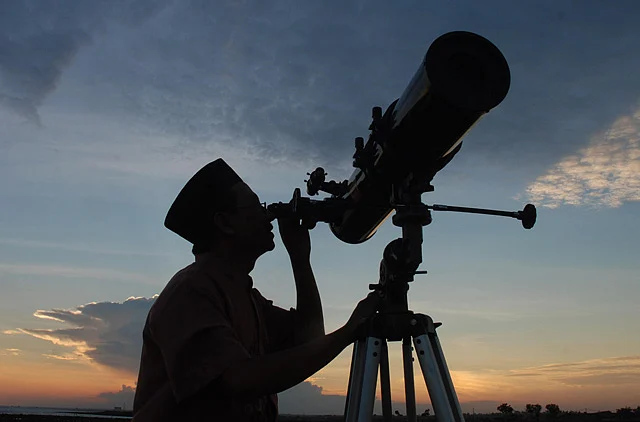
Dubai: Each year, as the Islamic world approaches Ramadan, attention turns skyward. In the UAE, the question of when the holy month begins is answered not by a calendar alone, but by a carefully structured process that blends centuries-old tradition with modern scientific precision.
One or two days before Ramadan, the UAE’s Moon Sighting Committee, which is made up of Islamic scholars and experts holds a meeting to deliberate the visibility of the crescent moon that marks the beginning of the lunar month.
The crescent of Ramadan is sought after sunset on the 29th day of Sha’ban, the month preceding Ramadan, by directing observation towards the western horizon.
The newborn crescent appears as a very thin arc, with its horns pointing upward and leaning slightly southward. If the crescent is sighted, Ramadan begins the following day. If not, Sha’ban is completed as 30 days.
While naked-eye observation remains central to the process, technology plays a supportive role. Binoculars and telescopes are used to assist observers in locating the moon’s precise position, especially when the crescent is extremely young.
Astronomical calculations, including the moon’s altitude, angular distance from the sun, and time spent above the horizon, are used in advance to assess whether sighting is physically possible.
According to subject-matter experts, the best observation points are elevated areas with an unobstructed western horizon, far from light pollution. Clear atmospheric conditions are essential. Dust, humidity or cloud cover can render sighting impossible even when the crescent is technically present.
Astronomers also caution against optical illusions. Bright planets, particularly Venus, can appear low on the horizon and are sometimes mistaken for the crescent by untrained observers. For this reason, the committee applies strict verification standards before accepting any testimony.
When science says “not possible”
For Ramadan 2026, most Islamic countries are expected to attempt moon sighting on Tuesday, 17 February. However, based on established astronomical criteria, including those developed by Ibn Tariq, Yallop, Ilyas, Bruin and the South African Astronomical Observatory, sighting the crescent that evening is considered either impossible or extremely unlikely across the Arab and Islamic world.
In the UAE, calculations indicate that the moon will set before the sun by approximately one minute on that day, meaning the crescent will not be present in the sky at sunset. Similar conditions apply across much of the region, including Saudi Arabia, Jordan and Egypt.
Astronomers point to the “Danjon limit”, a well-established threshold which states that the crescent cannot be seen, even with optical aid, if the angular distance between the moon and the sun is less than about seven degrees. On 17 February, that distance will be far below the required minimum.
Further evidence comes from a rare annular solar eclipse expected to occur later that day over parts of southern Africa and Antarctica, confirming that the moon and sun are in near-perfect alignment, a condition incompatible with crescent visibility.
As a result, countries that require confirmed moon sighting to begin Ramadan are expected to complete Sha’ban as 30 days, making Thursday, 19 February, the most likely first day of Ramadan in the UAE. Some countries applying different jurisprudential criteria may announce Ramadan a day earlier.
A moving calendar, a changing fast
Ramadan shifts earlier by roughly 10 to 12 days each year because the Islamic calendar is lunar. This annual shift affects fasting hours, climate conditions and daily routines across the Muslim world.
In 2026, fasting hours in the UAE will begin at approximately 12 hours and 46 minutes on the first day, around 30 minutes shorter than at the start of Ramadan last year. Rather than changing abruptly, fasting hours increase gradually week by week as sunrise advances and sunset occurs later.
By mid-month, fasting will exceed 13 hours, while the final days of Ramadan will see the longest fasts, reaching approximately 13 hours and 27 minutes, still shorter than the nearly 14-hour fasts observed in 2025.
Faith, reason and certainty
While some may question why moon sighting is attempted when calculations already indicate impossibility, scholars and astronomers emphasise that the process is about verification, not contradiction.
In cases where the moon is known with certainty to have set before sunset, several contemporary juristic bodies have concluded that sighting need not be attempted.
This position was formally endorsed during the UAE Astronomical Conference, which concluded that if definitive scientific data confirms the moon is not present in the sky, calling for observation serves no practical purpose and may invite error.
Sign up for the Daily Briefing
Get the latest news and updates straight to your inbox
Network Links
GN StoreDownload our app
© Al Nisr Publishing LLC 2026. All rights reserved.