Bone shattered into pieces: Indian worker in Dubai makes full recovery from rare arm fracture
Timely surgery and rehab restore hand function after serious workplace injury
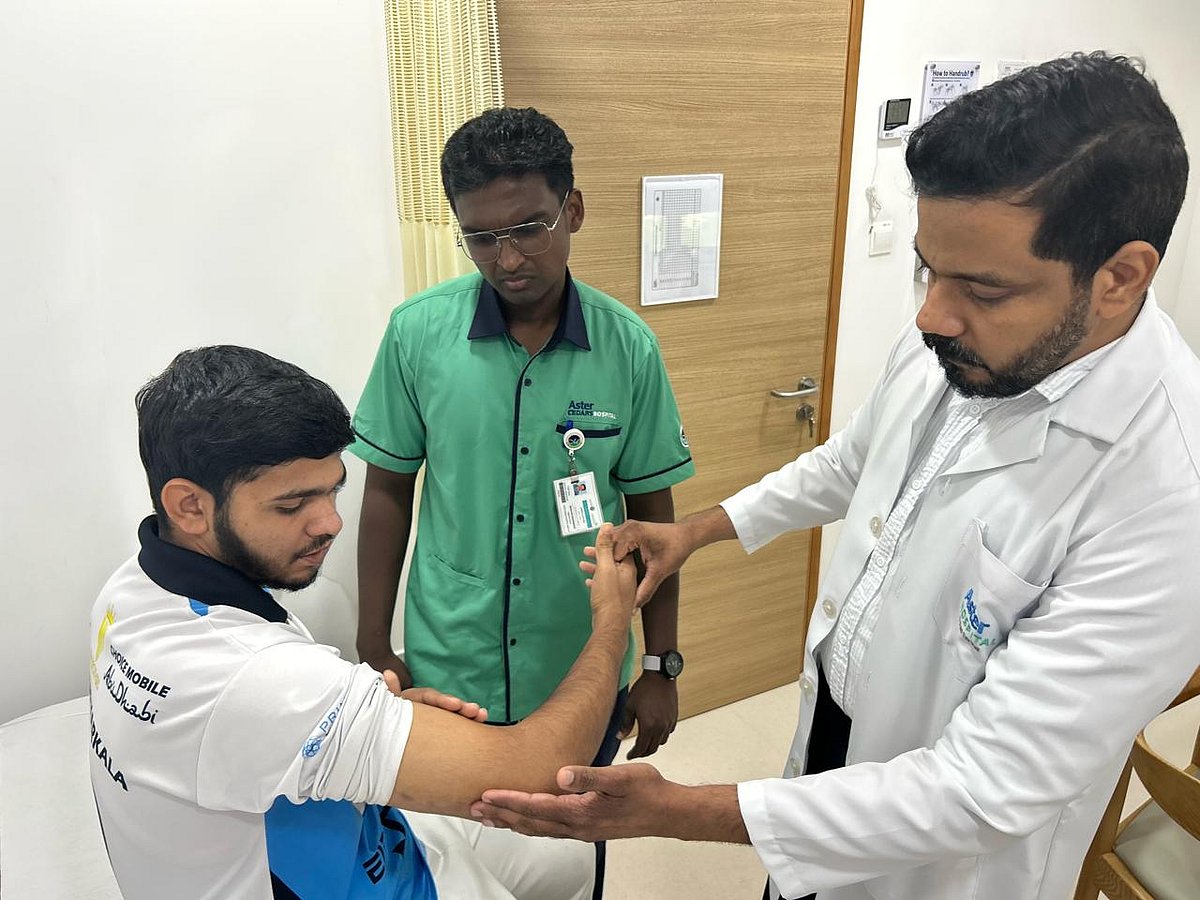
A 22-year-old Indian expat worker who feared permanent disability after a rare and serious arm injury has regained full use of his hand following timely surgery and rehabilitation.
Serious fall at work
Mohammed Saifuddin was rushed to the emergency department of Aster Cedars Hospital and Clinic in Jebel Ali after falling from a staircase at his workplace. He arrived with severe pain, swelling and visible deformity of his right upper arm, along with an alarming inability to lift his wrist and fingers – a clinical condition commonly referred to as wrist drop.
“When I couldn’t move my hand, I was very scared about my future and my job,” Saifuddin recalled.
Uncommon, high-risk fracture
Scans revealed that the lower portion of his upper arm bone had shattered into multiple pieces – a complex fracture known as a Holstein–Lewis injury – accompanied by high radial nerve palsy. The radial nerve controls movement and sensation in the wrist and hand, and damage can lead to permanent wrist drop if not treated promptly.
Doctors said the injury was both rare and high risk. Humeral shaft fractures account for only about 1 to 5 per cent of all bone fractures, and the Holstein–Lewis type – seen in only 7 to 7.5 per cent of cases – is uncommon but particularly dangerous because the radial nerve runs through a narrow space near the break, making it vulnerable to compression or entrapment.
Early surgery crucial
Dr Shafeed Thadathil Parambil, Specialist Orthopaedic Surgeon, who managed Saifuddin’s case, said early surgical intervention was crucial.
“Holstein–Lewis fractures are especially demanding because the radial nerve is highly vulnerable at this location,” Dr Shafeed said. “Without timely surgery, a trapped or irritated nerve can lead to permanent wrist drop, muscle wasting and loss of hand sensation. Early surgical intervention within the golden window of 24 to 72 hours allows us to directly visualise, protect and decompress the nerve while stabilising the fracture, significantly improving the chances of full functional recovery.”
Complex procedure
Saifuddin underwent open reduction and internal fixation procedure to repair broken bone. Surgeons confirmed that the radial nerve was intact but bruised and secured the bone with plates and screws. Intraoperative X-rays confirmed correct alignment, and an above-elbow splint was applied postoperatively for protection.
Nerve recovery monitored
The surgery was successful, and Saifuddin recovered in stable condition. However, because some nerve symptoms persisted, he was further evaluated by neurologist Dr Rajshekher Garikapati at Aster Hospital, Mankhool. Detailed nerve tests were done to monitor recovery and guide the rehabilitation plan.
Physiotherapy restores function
Under the supervision of physiotherapist Shruthi Janardhan Prabhu at Aster Cedars, Saifuddin underwent a structured rehabilitation programme focusing on pain management, nerve-gliding exercises, muscle strengthening, and retraining wrist and hand movements.
Within three to four weeks, the patient showed initial movement and progressed to full elbow and wrist range of motion, with grip strength reaching approximately 90 per cent of the unaffected hand.
The doctors and therapists never gave up on meMohammed Saifuddin
Back to daily life
Follow-up assessments confirmed full recovery of the radial nerve, normal movement of the hand and wrist, a healed surgical incision, and a stable bone repair. Saifuddin was cleared to resume work, with advice to avoid heavy lifting for six months.
Expressing his gratitude, Saifuddin said the medical team gave him hope when he feared the worst.
“The doctors and therapists never gave up on me,” he said. “Dr Shafeed explained everything clearly and treated me like family. Today, I can use my hand normally again. I am deeply thankful to the entire team for giving me my life back,” Saifuddin added.
Sign up for the Daily Briefing
Get the latest news and updates straight to your inbox
Network Links
GN StoreDownload our app
© Al Nisr Publishing LLC 2026. All rights reserved.