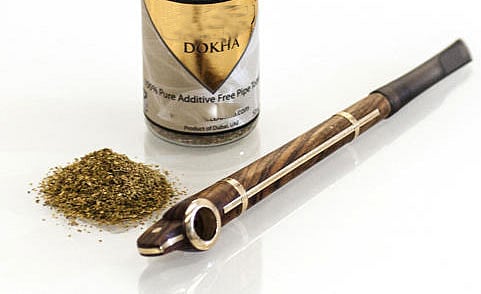
Dubai: Dokha — a blend of tobacco sold in the UAE — does not contain marijuana or any type of narcotic, Dubai Police’s Anti-Narcotics Department said.
The announcement was made after neurologist Dr Manal Al Fahham from Al Garhoud Private Hospital claimed that she found traces of marijuana in the urine of patients who smoked dokha using the medwakh (a wooden pipe used to smoke the tobacco).
Dr Manal earlier said she tested the urine of 40 patients and 30 per cent were found positive for marijuana, adding that the only common factor among all patients was that they all smoked dokha.
Following Dr Manal’s findings, the Anti-Narcotics Department of Dubai Police took the exact urine samples for testing and found no traces of marijuana.
Speaking at a conference held at the Dubai Police’s headquarters on Thursday, Colonel Fahd Al Mutawa, director of the Criminal Evidence and Criminology Department said the conference was held not to defend or promote smoking, but to clarify false information.
“After the doctor’s findings, we went to the hospital and took the urine samples, which were claimed to contain marijuana. These samples were tested by our forensic team using the latest state of the art machines and the results were negative, there was no marijuana,” Al Mutawa said.
Al Mutawa also said four samples of the actual dokha taken by these patients were tested and they also did not contain any marijuana. He said Dr Manal did not test the actual dokha, only the urine samples from patients.
He also said Dubai Police took 10 random dokha samples from six different shops with the help of the Department of Economic Development and they all tested negative for narcotics.
Hospital’s tests primitive
Al Mutawa said the hospital used a primitive method to test the urine, which is similar to how a pregnancy test works.
He said the test — popularly called rapid tests — looks similar to a medicine strip that has different types of drugs labelled on it and a colour appears for the corresponding drug when a urine sample is tested using it.
In fact, to test the accuracy of the method used by Dr Manal, Al Mutawa said the anti-narcotics forensic team took up to three urine samples that were already tested and found to be negative and used her method re-test the negative samples.
“The rapid test found that all of the samples are positive. This test is inaccurate,” Al Mutawa said.
Gulf News spoke to Dr Manal who said her main aim is helping youth not enter the spiral of addiction, adding that she is going to review her findings and conducts more tests to come out with more accurate results.
“The hospital, police’s antinarcotic department, the Department of Economic Development and I are all in solidarity; we are all working together to ensure the well-being of UAE yout, even if there is only a one per cent chance that they might be in harm’s way.”
Her main objective as a doctor, she said, is to help young people as it hurts her to see youth enter the world of addiction without knowing [about the consequences], which she said is something she often sees in her clinic.
Rapid tests are not conclusive
Dr Ebtisam Al Aboody, senior expert and head of the toxicology section at Dubai Police, said these rapid tests are not accurate.
Dr Ebtisam explained that the rapid tests used can appear positive if any similar material is found, adding that even after using state of the art machines, the forensic team always follow it up with more tests using more accurate machines, given the result is positive, for higher accuracy.
An expert from Freiburg Medical Laboratory-Dubai, agreed that urine screening methods should be followed by other, more accurate, tests.
“Urine screening methods (immunoassays) are highly sensitive and according to international guidelines, positive results should always be confirmed by methods like Gas Chromatography- Mass Spectrometry (GC-MS) or Liquid Chromatography - Tandem Mass Spectrometry (LC- MS/MS). These methods are accredited for forensic purposes. “
2013 study finds no narcotics in dokha
Al Mutawa said Dubai Police did not just start inspecting dokha. In collaboration with the University of Sharjah, a study examining 30 samples from 30 shops across the UAE found that there are no narcotics in the tobacco.
“The results were all negative. The students themselves got the samples — they went in as customers, not the police. This was done for greater accuracy, because if the police ask for samples, the shop keepers would not give us the dokha that contains the drugs, if there are any.”
Sign up for the Daily Briefing
Get the latest news and updates straight to your inbox
Network Links
GN StoreDownload our app
© Al Nisr Publishing LLC 2026. All rights reserved.