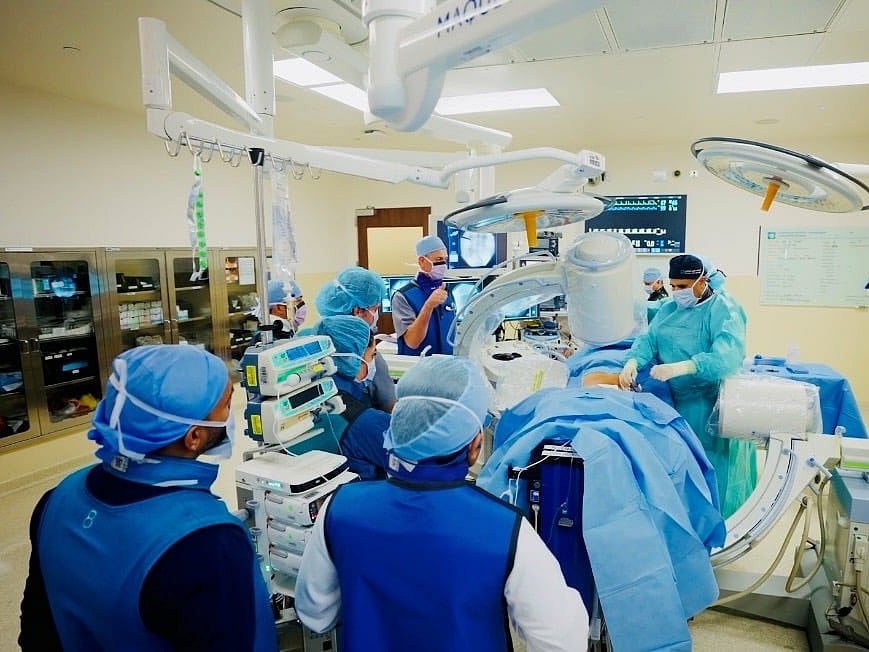
Cleveland Clinic Abu Dhabi has become the first hospital in the emirate to implant a wireless heart monitoring device that allows doctors to detect early signs of worsening heart failure before patients develop symptoms.
The new technology is designed for people living with chronic heart failure and enables doctors to monitor their condition remotely, allowing earlier treatment and reducing the risk of hospital admissions.
Get updated faster and for FREE: Download the Gulf News app now - simply click here.
The device is a small wireless sensor implanted into the pulmonary artery, the blood vessel that carries blood from the heart to the lungs. It continuously measures blood pressure in the artery and securely sends the information to the patient’s medical team for ongoing monitoring.
By tracking changes in pressure over time, doctors can identify signs that heart failure may be worsening and adjust medications or treatment plans before symptoms become severe.
Dr Georges-Pascal Haber, Chief Executive Officer of Cleveland Clinic Abu Dhabi, said the technology marks an important step in improving care for patients with chronic heart failure.
“Instead of waiting for symptoms to worsen and require hospitalisation, we can now monitor patients proactively and intervene earlier,” he said.
Dr Nadya Almatrooshi, Staff Physician in Cardiovascular Medicine at Cleveland Clinic Abu Dhabi, said the technology also gives patients greater confidence in managing their condition.
“For many patients, continuous cardiac remote monitoring provides reassurance and greater confidence in managing their condition day to day,” she said, adding that many patients experience better symptom control and improved quality of life.
The implant is intended for patients with moderate to severe heart failure who have been hospitalised at least once because of the condition during the previous 12 months despite receiving medical treatment.
The first two patients to receive the implant in Abu Dhabi were Emirati nationals aged 62 and 79, both of whom had a history of repeated hospital admissions due to worsening heart failure.
The procedure is carried out in the hospital’s cardiac catheterisation laboratory under local anaesthesia and mild sedation and usually takes between one and two hours. Most patients are monitored for up to 24 hours afterwards, with some able to return home the same day. Many can resume normal daily activities within one to two days.
The introduction of the technology builds on Cleveland Clinic Abu Dhabi’s cardiovascular services. The hospital is recognised as a Centre of Excellence for adult cardiac surgery by the Department of Health – Abu Dhabi and was ranked the No. 1 hospital in the Middle East for cardiology in Newsweek’s Best Specialised Hospitals Middle East 2026 rankings.
Hospital officials said the latest technology reflects its commitment to expanding access to advanced heart failure care and delivering more personalised treatment for patients across the UAE.
Network Links
GN StoreDownload our app
© Al Nisr Publishing LLC 2026. All rights reserved.