Peter Davos, Founder and CEO of Hale Education Group
PARTNER CONTENT
UAE students thrive in tougher US admissions as Hale delivers elite offers
Record offers, $10m+ in scholarships highlight Hale’s edge in a volatile admissions year
Last updated:
4 MIN READ
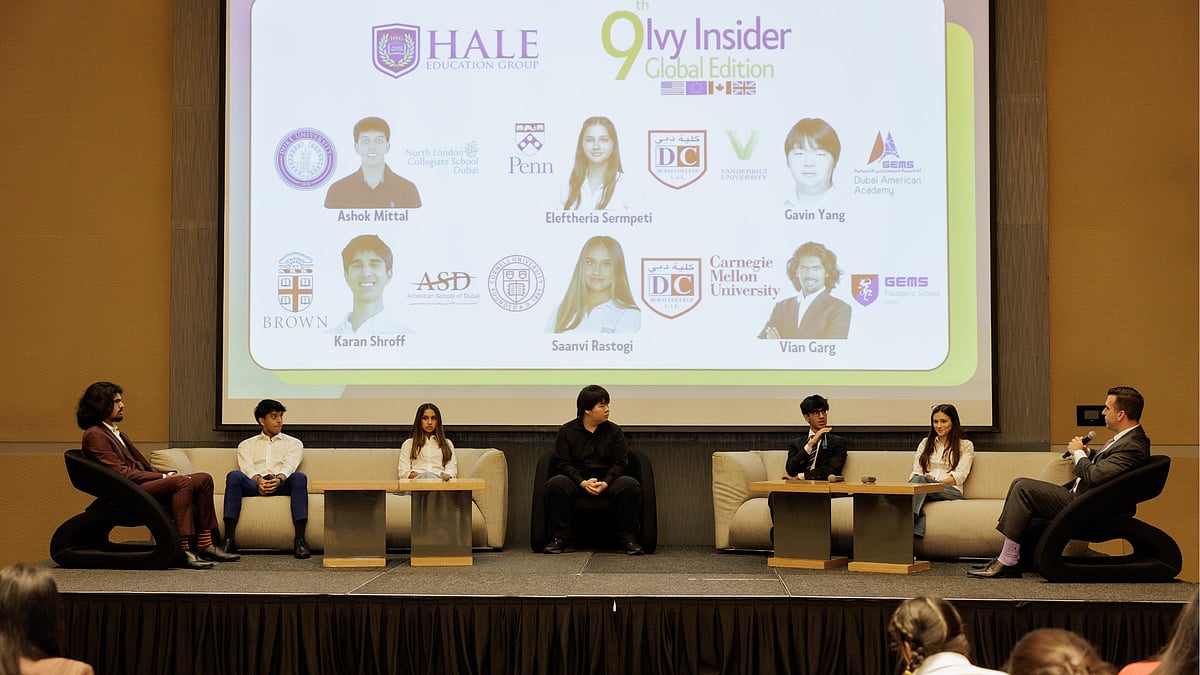
This past university application cycle was a dynamic and volatile one, marked by shifting geographic trends, a flight to quality, tighter visa restrictions in Canada and the UK, and the re-emergence of standardised testing requirements at top US universities.
Compared to previous years, UAE applicants applied to more universities in more geographies due to a combination of geopolitical uncertainty, visa anxiety, and the desire to create optionality due to unforeseen economic and political developments.
While international applications to all US universities dropped 9 per cent last year and international student enrollment in American universities dropped 20 per cent, many of the most selective universities in the US continue to witness a surge in application numbers. The University of Virginia experienced a 27 per cent year-on-year application increase, while out-of-state applications to the University of Texas increased by 48 per cent. 12.8 per cent more students applied to Brown University than last year, while applications to UPENN surpassed 60,000 for the first time.
Top-rated institutions see huge demand
Mid-tier universities across the English-speaking world suffered the greatest decreases in international applicant numbers, but demand for limited seats at top public flagship universities and private institutions did not abate.
"Every application season brings its own set of challenges and anxieties, but this year required an entirely different approach," says Peter Davos, Founder and CEO of Hale Education Group.
"Ultimately, there are a fixed number of highly selective universities that the vast majority of students want to apply to which do not have the ability to expand their incoming freshman class, which continues to compress acceptance rates as the overall number of applicants to these institutions continues to grow. Despite these headwinds, Hale students were able to excel, as they have done for the past 14 years, in their admissions journeys."
The last application cycle was a pivotal one with regard to the role that standardised testing plays in the US admissions process, as many universities that had previously championed test-optional policies reinstated the requirement for the submission of the SAT or ACT. Dartmouth led this early charge, followed by Brown, CalTech, Harvard, Dartmouth and the University of Texas, Austin.
“Just this past week, Columbia – the sole remaining test-optional university in the Ivy League – announced that it would be requiring standardised test scores from all applicants for the upcoming 2026-27 application cycle,” Davos explained. “It is only a matter of time before the University of California system follows suit, as 1,400 of its professors recently signed an open letter petitioning for their reinstatement for all STEM applicants.”
Authenticity in the age of AI
While students have increasingly integrated the use of AI into their application processes, universities have done the same in the application review process, not only in verifying the authenticity of the applicants’ writing, but also in reviewing transcripts for rigour, letters of recommendation from teachers and counsellors, and in predicting yield, whether or not a student will ultimately enrol if accepted.
“In the AI age, authenticity matters more than ever and those students who champion it – not only in their applications but in the entirety of their journeys – are at a distinct advantage compared to their peers who do not,” he said. “If everyone is using AI to generate a response to a college application supplement, then the outputs will also be similar, raising red flags.”
Hale Education Group, based in Dubai and whose students overwhelmingly come from the UAE, celebrated its fourteenth year of academic excellence with more than 850 total university offers, averaging over six offers per student. These included six acceptances to Columbia University alone, statistically the second-hardest Ivy League institution to gain admission to, right behind Harvard.
"Securing six acceptances to Columbia University in a single cycle, during a period of overall contraction for international applicants, is an extraordinary feat for our team," Davos notes. "Columbia’s selection process is notoriously rigorous, focusing intensely on core intellectual capabilities and distinct personal character, and its location in New York make it the perennial dream university for many UAE applicants.”
Furthermore, Hale celebrated its fourth admission in seven years to Penn’s highly selective dual-degree Wharton/Engineering Jerome Fisher Program (M&T), which caps intake at just 55 students globally, and its second-consecutive admission in two years to Columbia x Sciences Po Dual BA, which admits just 100 students worldwide. Finally, in the STEM disciplines, Hale helped secure a direct entry into the world's top-ranked Biomedical Engineering (BME) programme at Johns Hopkins University, an achievement underscored by a 2 per cent overall acceptance rate, as well as over 30 acceptances to Top Ten Engineering programmes as defined by US News. Hale students were also awarded over $10 million plus in merit scholarships, bringing its historical cumulative total to an unmatched $90 million plus in merit scholarships.
"At the end of the day, our track record speaks for itself," Davos said. "We don't need to hide behind ambiguous numbers or unverified percentages – our student success is both local and verifiable. Over the last 14 years, we have built an infrastructure that consistently delivers elite global outcomes for UAE families. While others promise, Hale delivers."
Sign up for the Daily Briefing
Get the latest news and updates straight to your inbox
Network Links
GN StoreAbout Gulf NewsTerms & ConditionsReach by GNSitemapContact usPrivacy PolicyGN FocusHave your sayWork with usAdvertise with usGulf News epaperPrinting Services
Download our app
© Al Nisr Publishing LLC 2026. All rights reserved.