Dubai's future: 40% of new buildings to use smart technology, with 3.5 million trees and 187 sqkm of greenery
Dubai's Dh30 billion Tasreef project will lift rainwater drainage capacity by 700% by 2033
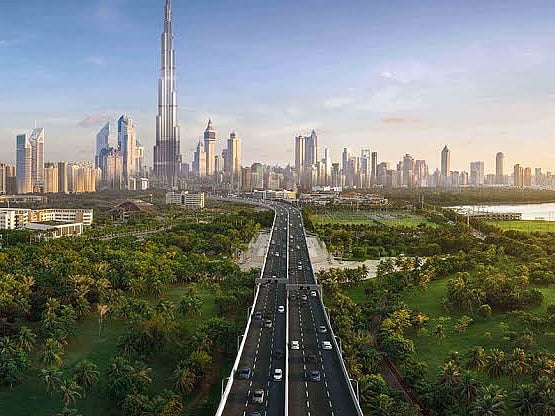
Dubai: Dubai plans to construct 40 per cent of its new buildings using advanced, fully smart construction technologies by 2033, expand its green spaces to 187 square kilometres and plant 3.5 million trees by 2040, under an ambitious strategy to reshape the city's infrastructure and improve quality of life.
Marwan Ahmed bin Ghalita, Director General of Dubai Municipality, outlined the plans during a session titled “Dubai Municipality and Life in Dubai 2033” at the Mohammed bin Rashid Leadership Forum.
Get updated faster and for FREE: Download the Gulf News app now - simply click here.
The strategy covers major infrastructure developments, public parks and beaches, urban greening, food safety, construction innovation and the use of digital twin technology to manage city operations.
The session featured a virtual dialogue between Bin Ghalita and Saeed, the municipality’s first AI-powered virtual media spokesperson, exploring how Dubai’s rapid growth, strategic planning and swift decision-making are shaping the city’s future.
Bin Ghalita traced Dubai's development over recent decades, highlighting the major projects, policies and strategic decisions behind its transformation into a city designed to make everyday life easier and improve residents' wellbeing.
Dh30 billion drainage project to boost capacity by 700%
One example was the Dh30 billion Tasreef project, whose launch was accelerated by the Hadeer low-pressure weather system.
The project, the region's largest and most operationally efficient integrated rainwater drainage and collection system, is scheduled for completion in 2033.
It will increase Dubai's rainwater drainage capacity by 700 per cent, enabling the network to handle more than 20 million cubic metres of rainwater a day.
Dubai to plant 3.5 million trees by 2040
The municipality also outlined plans to expand public spaces, parks, recreational facilities and beaches, creating more opportunities for families and young people to gather, socialise and enjoy leisure activities.
Under its targets for 2040, Dubai aims to plant approximately 3.5 million trees and increase its green and landscaped areas to 187 square kilometres.
The plans would also raise green space per person to 11 square metres and increase annual visitors to parks and recreational facilities to 95 million.
The initiatives build on decades of landscaping and urban development projects that have reshaped Dubai's appearance, strengthened residents' connection to the city and expanded its leisure offerings.
The municipality's vision is to create a people-centred city that balances work, recreation, wellbeing and environmental sustainability.
Smart construction to reshape Dubai's skyline
Dubai also plans to accelerate the adoption of advanced construction technologies, including 3D printing, robotic construction systems, modular building techniques and artificial intelligence.
By 2033, 40 per cent of new buildings in the emirate are expected to be constructed using modern, fully smart building technologies.
The municipality presented the target as part of Dubai's efforts to strengthen its position as a global centre for construction innovation, architectural development and the testing of emerging building technologies.
AI to support food safety inspections
The discussion also examined Dubai's food safety system, which is designed to protect public health through comprehensive and sustainable inspection and monitoring procedures.
Emirati teams at Dubai Municipality inspect and monitor more than 577,000 food shipments annually.
The municipality highlighted initiatives including the Montaji application and DM Check, which will incorporate artificial intelligence technologies to support its food safety operations.
Dubai aims to divert all waste from landfills by 2033
The discussion also addressed Dubai's recognition as the world's cleanest city for the sixth consecutive year, a distinction attributed to the municipality's integrated operations, advanced technologies, urban policies and the commitment of the wider community to maintaining cleanliness.
Looking ahead to 2033, the municipality aims to reduce daily waste generation per person to approximately 1.85 kilograms.
Its plans also include encouraging waste separation at source, expanding circular economy practices and diverting 100 per cent of waste away from landfills.
Digital twins to help manage the city
Dubai Municipality is also advancing the use of digital twin technology to support smarter management of city operations.
By combining real-time data with artificial intelligence, the technology will help authorities better understand what is happening across the city, improve the speed and efficiency of decision-making, and strengthen long-term planning.
The system is also intended to improve Dubai's ability to anticipate future needs and respond to changes in its urban environment.
Bin Ghalita stressed that Dubai's approach to development depends on its ability to anticipate future challenges and turn them into transformative projects.
“What we build and develop today is what Dubai will become in the future, and what will define the city's shape, character and identity for decades to come,” he said.
He explained that swift decision-making, the ability to anticipate future developments and the transformation of needs and challenges into major projects have distinguished Dubai as a model city of the future.
“Our goal is to make Dubai a city with advanced, resilient and smart infrastructure, a vibrant city ready for growth, capable of confronting challenges and turning them into opportunities,” he added.
The ultimate objective, he concluded, is to provide the highest standards of quality of life and wellbeing for residents and visitors, continually meeting their changing needs and making Dubai the world's best city in which to live, work and visit.
Network Links
GN StoreDownload our app
© Al Nisr Publishing LLC 2026. All rights reserved.