Shaukat Rana Muhammad Rafi with his sons, Taimur Rana and Muhammad Asad.
Dubai since the 1960s: How a Pakistani family preserved old bills, rental papers and rare photos in a home museum
Shaukat Rana Muhammad Rafi's sons are also carrying the legacy forward
Last updated:
8 MIN READ
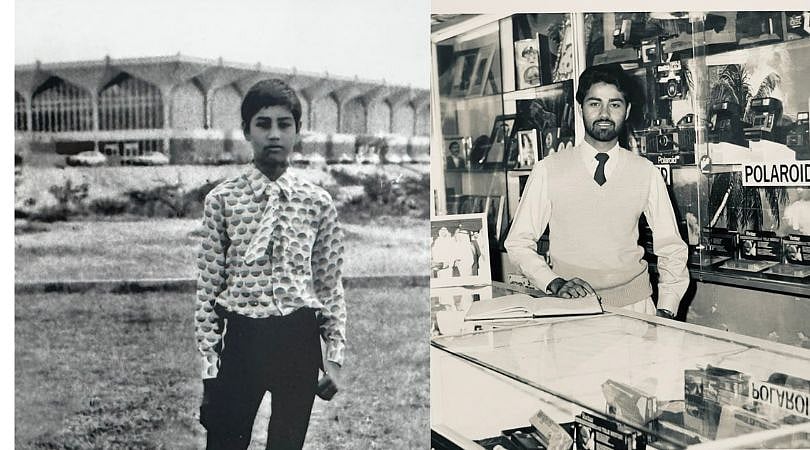
Shaukat Rana Muhammad Rafi has preserved decades of bills, telegrams, stamps in his home.
Supplied
Time machines do not exist, except when someone spends a lifetime preserving the pieces of a world that has disappeared.
They exist for those who choose to look: In old letters, photographs of places that no longer exist, electricity bills from decades ago, postcards, and crisp telegrams kept deliberately short because every extra word cost more.
And Shaukat Rana Muhammad Rafi's museum, housed in his own home, is proof. Past a well-kept living room with elaborately decorated chairs and sofas, he is more than happy to show us the many lives he has lived since the 1960s.
The time machine’s engines begin to turn.
We move through two rooms that hold old UAE as Shaukat Rana remembers it, he shares bits and pieces of his own story. “My father came in 1966, I came here in 1968. I was eight years old at the time, and since my childhood, I have loved history," he explains. “Since then, I have tried to capture everything with my camera.”
Accompanying us, are his sons Taimur Rana and Muhammad Asad, piecing together the days of old UAE, and, who are also carrying the legacy forward.
From cloth to cameras
Initially, his uncle had set up a cloth business in 1958, under the shop PO Box 504. Later, at 16, Shaukat Rana converted it into a photography imports and exports business. "I started a business in the export of photographic material, and an art gallery business," he says, recalling the days when rolls of film had to be developed in the dark room. "Someone had to teach you how to develop these things in the dark room."
He shows us his first trade licence, carefully laminated and kept safe: issued in 1976, bearing the same PO Box 504 as the cloth business.
The trade licence is just one of hundreds of memories preserved in his home. There are many more to come.
Shaukat Rana Muhammad Rafi's first driving license
A journey through currencies
As carefully encased as you would expect in museums, Shaukat Rana shows us Indian notes. “You’ve got your 1 rupee, you’ve got your 5, you’ve got your 10 and 100. This was what was used in that era of the 1950s up until just before the 60s, late 60s,” he explains.
And then, the collection shifts to the Riyals. He shows us the first currency issued, later. The 1,5, 10, 50 and 100 notes stare back from beneath a glassy table. You’re almost afraid of touching it: What if it just crumbles away?
So, you just watch in awe.
The trade license in 1976 issued by Dubai municipality
Family history: His grandfather’s first job and Dubai Airport memories
He doesn’t need to sit down and tell his story: He just walks us through it. After the currencies, he explains that his grandfather joined the British Bank from the Middle East. “This is my grandfather’s first job, his official letter from 1966,” he says, pointing to a quaint typewritten letter.
And later, his grandfather worked at a Dubai airport as a flight dispatcher. We see a photo of him standing at the Dubai airport too. “It’s the first airport, and that’s him right there,” explains Shaukat Rana.
Shaukat Rana's collection of stamps.
Personal records
Among the most personal documents in Shaukat Rana Muhammad Rafi’s collection are the ordinary records that tell extraordinary stories, stamp collections, birth certificates, health cards and medical documents from Dubai’s early years. “This is how a birth certificate looks,” he says, showing the papers. “These are health cards. There are some documents from Al Maktoum Hospital as well.”
Alongside them is another family record, his father’s passport entry from 1966, carrying a British visa issued during a very different era. “And this is my father’s entry in 1966,” he says.
Muhammad Rafi (Shaukat father) job letter in 1966
Seeing Dubai from the skies
Some of Shaukat Rana's photographs capture Dubai from unusual angles, even from the sky, taken mid-flight, one of them showing his current neighbourhood of Mirdif from above. He asks if I can recognise the area, and I strain my eyes, searching the frame. He points me toward it: "This is Khawaneej Road." The Arabian Mall sits right there, and the Chinese School we passed on the way in is still standing.
He had no particular thoughts in mind when he took the photo. He was a man with a camera, capturing moments that time would later turn into memory.
The other form of communication, was just letters and postcards. “We had to wait for two months to get correspondence because they were all coming by sea in those days,” he explains.
Yet, staying connected was expensive, as old phone bills reveal. “Two minutes, would be Dh14,” he says. Telephone services came with additional costs too. “On top of that, we had to pay rental charges on our phone, 150 dirhams.”
Telegrams, carefully preserved.
What a family road trip to Abu Dhabi felt like
There was a checkpoint between Dubai and Abu Dhabi. In a framed photo, it looks like little more than a string tied between two blocks of wood. "Whenever we had to go to Abu Dhabi, we had to cross the border," he says.
He shows us a photo of his first car, too, remembering that first trip. "The Dubai police gave us an exit form with our car number on it. I was in the car with my brother and sister. We were five in total, my mother, my father, my brother, my sister and me."
Shaukat Rana recalls the lack of roads beyond the checkpoint. "We waited there for half an hour. Then a taxi came, and we asked the driver how to get to Abu Dhabi."
The driver told them: "I'm going to Al Ain, but I'll drop you at the main road. You turn right, and I'll turn left."
That checkpoint may no longer exist, but the papers from that day still do — and for Muhammad Rafi, that's more than enough.
Carrying this responsibility forward is his son, Muhammad Asad Shaukat Rana, who serves as the guardian, conservator, and archivist of this collection documenting Dubai's history. "
Everyday Dubai in old bills: Electricity records, phone bills and telegrams
Then there was the regular life, the mundane, captured in electricity and phone bills, kept safe alongside an elegant old landline phone and a series of cameras that Shaukat Rana used in his youth. "That's a Mamiya," he says, pointing to a brand that would be priceless if sold today. Beyond the vintage cameras, the shelves are lined with old toy cars and floppy disks. He even has a proud collection of some of the earliest mobile phones, stored away.
It was a time before emails and WhatsApp, too. Dubai businesses communicated through telegrams, each one framed on the wall. "These telegrams are basically how correspondence was done back then," he notes. You would go to a telegraph building on Creek Road, where they would type up your correspondence, each word costing two dirhams. Sometimes you'd have to truncate your sentences further, just to avoid spending more. "That was the fastest way to do correspondence between business people overseas. And we would get the response within 36 to 48 hours."
Renting a villa in Karama: Dubai’s old property records
Among the documents in his collection are rental agreements from a very different Dubai. “See, this is our early agreements in Karama, when we took a villa there on rent," he says. As the documents show, the rent was around 2000 riyal for three bedrooms per year.
And, you can see the rent increasing gradually, from 2500, and then in the 80s, it was around Dh5000.
Preserving documents for another century
For Shaukat Rana collecting history is only the first step. Holding on to it is just as important.The documents have survived decades, but paper is fragile.“The thing about these documents, I’ve tried to manage to have them preserved in acid-free sleeves, just so that we can extend the age,” he explains.
They’re sensitive, to even light. Every document is carefully treated before being displayed. “What we try to do, we try to make sure they get encapsulated and preserved, and then displayed.”
As these pieces of history have already survived so much, he wishes them to last longer. Perhaps, another 100 years.
His son, Muhammad Asad Shaukat Rana, is implementing a meticulous preservation strategy, utilising advanced archival encapsulation techniques and climate-controlled storage to safeguard these fragile documents.
The first aerobatic air show
Among the hundreds of photographs kept safe in his home museum is one that takes Shaukat Rana Muhammad Rafi back to the 1970s, to a time when aviation itself represented ambition, possibility and a country in motion. He holds up a photograph from what he remembers as a historic moment. "This is the first aerobatic air show by Sheikh Mohammed," he says.
The photograph was not taken as part of an assignment, nor was Shaukat documenting the event as a professional photographer. "It was just passion."
And this passion, pushed him to carry his camera everywhere and record the world changing around him.
Sometimes his father would take him along to events and places where he could photograph. At other times, he would set out on his own, looking for moments worth capturing.
"A different life it was."
Honouring Dubai’s multicultural history: The Dubai Erh Award
Not every memory in Muhammad Rafi’s collection belongs to the distant past. Some documents reflect Dubai’s continuing story as a multicultural city shaped by the contributions of its residents. Among them is an award recognising his family’s connection with the UAE and their experience of engaging with local culture.
“This one here is where we won the Dubai Erh Award. My father’s here,” he says, pointing to the photograph.
The award, he explains, focused on the contributions and personal experiences of residents from Dubai, particularly their interaction with Emirati culture.
“Basically, the category is what is the contribution of residents from Dubai, and their personal experience, interaction with local culture,” he says.
The recognition was presented by some of Dubai’s most prominent leaders.
“This was honoured by Sheikh Mohammed bin Rashid Al Maktoum and Sheikh Hamdan bin Mohammed bin Rashid Al Maktoum as well,” he adds.
For Shaukat Rana Muhammad Rafi, history sits inside old papers, faded photographs and objects that once belonged to ordinary days. His home is a reminder that cities are not only built through towers and roads, but through the memories people choose to keep.
The time machine's engines don't stop whirring.
Network Links
GN StoreAbout Gulf NewsTerms & ConditionsReach by GNSitemapContact usPrivacy PolicyGN FocusHave your sayWork with usAdvertise with usGulf News epaperPrinting Services
Download our app
© Al Nisr Publishing LLC 2026. All rights reserved.