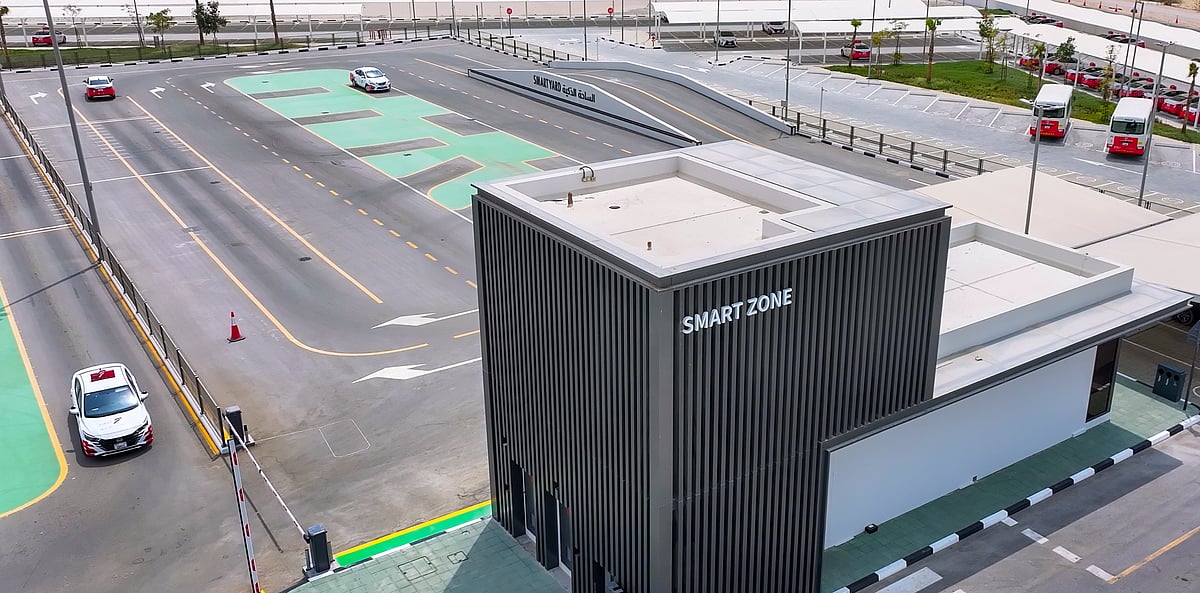
Dubai: Learner drivers in Dubai will be able to see exactly where they went wrong during their driving test under a new AI-powered assessment system that promises more accurate results, greater transparency and fewer inconsistencies in testing.
Dubai’s Roads and Transport Authority (RTA) has introduced the next generation of its Smart Test System (STS) for light-vehicle yard tests, combining artificial intelligence, computer vision, precision vehicle tracking and advanced data analytics.
The technology automatically monitors a learner’s performance and assesses manoeuvres in real time against standardised criteria, with no human intervention in calculating the final result.
Visual evidence
One of its most significant features is the ability to provide visual evidence of mistakes. Learners can replay their vehicle’s journey after the test, see exactly where major or minor errors occurred and understand why those mistakes were recorded.
The system can also monitor whether learners check their mirrors and blind spots and whether their hands are correctly positioned on the steering wheel while carrying out manoeuvres.
Tracking accurate to within 2cm
RTA said the upgraded system uses Real-Time Kinematic (RTK) positioning technology to track vehicles within the testing yard with an accuracy of up to two centimetres. This allows it to identify errors involving the vehicle’s path, parking position and other yard manoeuvres with greater precision.
An interactive 3D map recreates the route taken by the vehicle and pinpoints the locations where errors occurred.
Sultan Al Akraf, Director of Drivers Licensing at RTA’s Licensing Agency, said the technology was intended to ensure learners were assessed according to consistent criteria.
“The next-generation Smart Test System marks an important step forward in RTA’s smart transformation of driver licensing services, harnessing advanced technologies to enhance testing and assessment,” Al Akraf said.
“The system is designed to ensure that learner drivers are evaluated against consistent and precise criteria, minimising inconsistencies in assessment, strengthening customer confidence in test results and providing a clearer and more transparent testing experience.”
AI checks driving behaviour
The system does more than monitor whether a vehicle completes a manoeuvre correctly.
Smart cameras assess safety-related behaviour, including mirror and blind-spot checks, while the technology also monitors the learner’s hand position on the steering wheel.
Facial recognition is used to verify the learner’s identity, ensuring that each test and its result are linked to the correct person.
RTA said the technology is designed to work consistently during different weather and lighting conditions, including both daytime and night-time tests.
Automatic braking
Safety technology built into test vehicles can also intervene if a learner is in danger of causing a collision.
The upgraded preventive automatic braking system detects situations that could result in an accident and can apply the brakes automatically before a collision occurs.
Al Akraf said the technology was intended to make the testing environment safer while giving learners more useful information about their performance.
“The system goes beyond automating the calculation of test results. It provides an integrated framework for monitoring and analysing learner performance across different manoeuvres, while presenting recorded errors in a clear visual format,” he said.
“This enables customers to understand the reasons behind their results and identify areas for improvement.”
He added that AI-powered collision avoidance and emergency braking could help reduce accidents during tests and create a safer environment for learners.
Why did you fail the test?
For learner drivers, perhaps the biggest change will come after the test.
Instead of receiving only a result and list of errors, customers will be able to review their journey and see visual evidence showing where mistakes happened.
The performance data can also be integrated with the driver training system, allowing instructors to identify areas where individual learners need additional practice and tailor training accordingly.
RTA said the system should give customers a clearer understanding of why they passed or failed while improving confidence in the fairness and objectivity of driving tests. The initiative forms part of RTA’s wider push to use artificial intelligence and smart technologies in driver licensing and road safety services across Dubai.
Network Links
GN StoreDownload our app
© Al Nisr Publishing LLC 2026. All rights reserved.