Mohammad Al Gergawi, Chairman of The Executive Office of Sheikh Mohammed bin Rashid Al Maktoum and Chairman of the Mohammed bin Rashid Centre for Leadership Development
Al Gergawi: Sheikh Mohammed built a city where global talent comes
Mohammed bin Rashid Leadership Forum brings together 1,000 leaders in Dubai
Last updated:
6 MIN READ
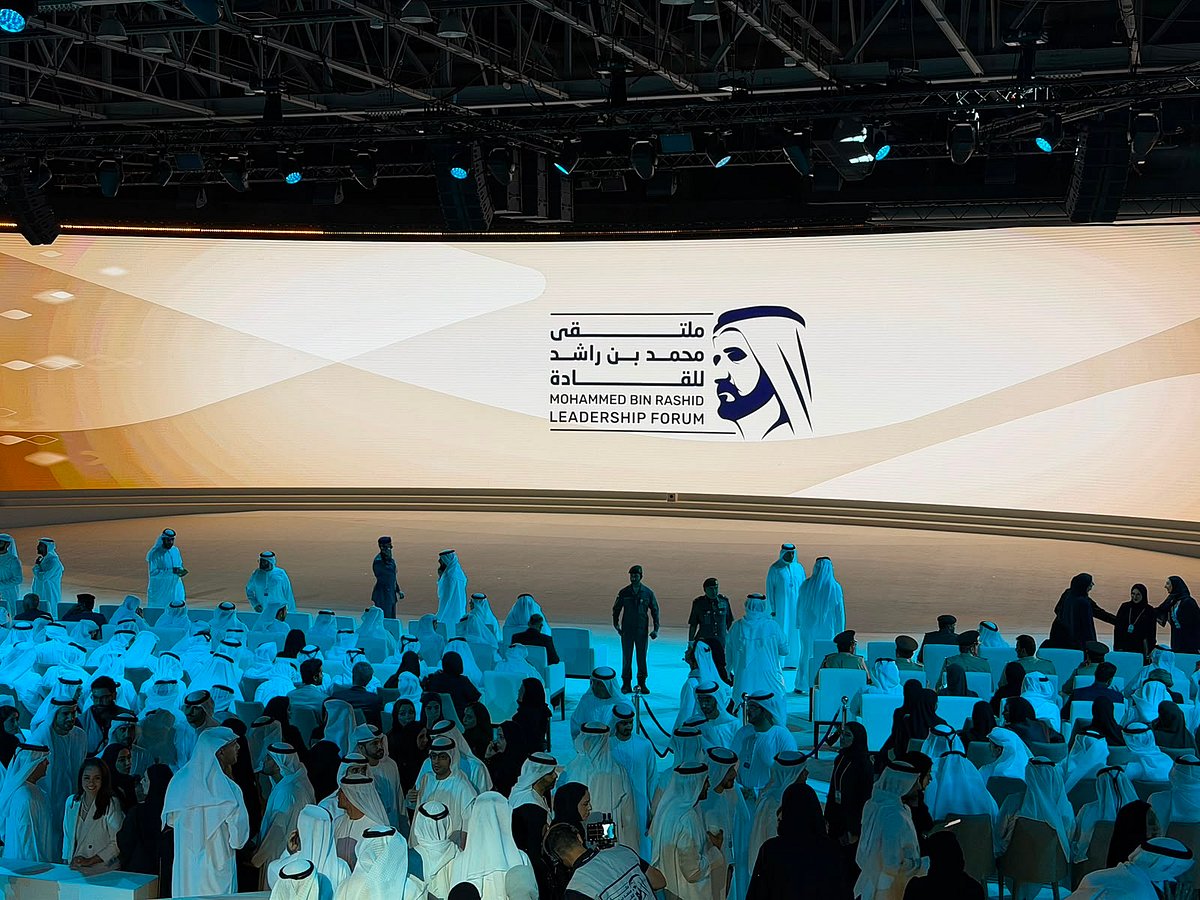
The Mohammed bin Rashid Leadership Forum opened today at Dubai World Trade Centre, bringing together 1,000 government and private sector leaders
Tricia Gajitos / Gulf News
Dubai: Artificial intelligence (AI), economic uncertainty, and the need to build more sustainable, people-centred cities were among the key issues highlighted by global leaders at the Mohammed bin Rashid Leadership Forum, which opened at Dubai World Trade Centre today.
Held under the patronage of His Highness Sheikh Mohammed bin Rashid Al Maktoum, Vice President and Prime Minister of the UAE and Ruler of Dubai, the annual forum has brought together 1,000 government and private sector leaders to discuss leadership, innovation, and the challenges shaping the future.
The gathering has eyed to strengthen Dubai’s leadership ecosystem by encouraging organisations to anticipate emerging opportunities, adapt to change, and turn new ideas into action through faster and more effective execution.
Get updated faster and for FREE: Download the Gulf News app now - simply click here.
Opening the forum, Mohammad Al Gergawi, Chairman of The Executive Office of Sheikh Mohammed bin Rashid Al Maktoum and Chairman of the Mohammed bin Rashid Centre for Leadership Development, has paid tribute to Sheikh Mohammed’s leadership and its impact on Dubai.
He has noted that Sheikh Mohammed has built not just a city, but a community and a culture that empowered people to dream bigger and believe that ambition was not limited by geography.
“He taught us that the impossible can be achieved. He changed our understanding of what is possible. Today, many countries compete in the tourism sector. They try to attract talent and improve their artists. Sheikh Mohammed, on the other hand, built a city where talents go. In a world that is torn by confict, Sheikh Mohammed built a place where different nationatilities and religion live in peace,” remarked Al Gergawi.
He has bared that the most meaningful expression of gratitude was a commitment to preserving what has been built and continuing to deliver results in the future.
“Thank you for believing in us, for raising our expectations, and for helping us achieve what is impossible. Our message is a promise to preserve what you built.”
Defining force for future leadership
AI has become an essential consideration for leaders seeking to strengthen their economies and remain competitive, according to David Haigh, founder and chief executive officer of Brand Finance.
Speaking to Gulf News on the sidelines of the forum, Haigh has identified AI and technology as two of the most significant considerations for global leaders, alongside the changing balance of economic and geopolitical influence.
Countries such as the UAE has an opportunity to take on a greater international leadership role as traditional global powers faced changing circumstances.
“Everyone’s talking about it but that doesn’t mean it’s not imporatant. They need to be able to grasp exactly how that will work for the benefit of the country,” Haigh told Gulf News.
David Haigh, founder and chief executive officer of Brand Finance
Looking around Dubai, Haigh has pointed out that it was possible to see innovation being applied across different areas, including the use of AI to accelerate processes and improve efficiency.
“The economy here was obviously built in the age of carbon energy, oil and gas are still important. One of the interesting things about Dubai and the UAE as whole is that they recognise that wealth needs to be deployed to create a really sustainable alternative.”
Haigh has described the UAE’s approach as an example for other countries seeking to translate technological progress into economic opportunities.
Jobs remain a concern
The global economic outlook has presented both significant risks and opportunities, with AI among the technologies that could support growth despite continuing geopolitical and financial pressures.
Nouriel Roubini, chairman and chief executive officer of Roubini Macro Associates, has pointed to geopolitical tensions in the Middle East, the Russia-Ukraine conflict, and strained relations between the US and China as risks facing the global economy.
“Advance economies are build up of public deficits that with rising interest rates may eventually become unsustainable. While there are some negative risks, there are also many opportunities in technology, innovation, AI, and otherwise provides a massive tailwind to the global economy,” Roubini shared with Gulf News.
Countries that develop AI and those that adopt it effectively could benefit from higher productivity, stronger potential economic growth, and lower production costs for goods and services.
Nouriel Roubini, chairman and chief executive officer of Roubini Macro Associates
In the short term, the expansion of AI infrastructure is also creating demand for workers and investment, including through the construction of data centres and the production of semiconductors.
The longer-term effect on employment has remained less certain. Roubini has acknowledged concerns that AI could eventually displace workers on a lasting basis, potentially increasing unemployment and income inequality. However, he has stressed that previous waves of innovation have also created industries and jobs that people could not have anticipated beforehand.
He has outlined an optimistic scenario in which AI makes individuals more productive while generating enough additional economic growth to help societies manage the effects of technological change.
“If growth is higher and you have the resources, you’ll be able to address those social consequences of it.”
The challenge, he added, will be managing the transition, particularly if the benefits of AI are distributed unevenly or certain categories of jobs disappear.
Putting people first
As Dubai continues to grow, the next phase of urban development should focus on energy efficiency, mobility, and public spaces designed around people's needs, said
Joao Albuquerque, partner at Bjarke Ingels Group, has underscored that buildings offered opportunities to improve energy performance, while transport planning needed to address the pressures created by rising urban density.
Cities should move away from being centred primarily on cars towards a more human-centred approach, without overlooking the challenge of managing traffic as populations and activity increase.
Public spaces also need greater attention, arguing that infrastructure should ultimately serve the people who use it.
For Dubai, where development and population growth continue to shape the urban landscape, such an approach means considering how residents move around the city, access public spaces, and experience their neighbourhoods.
Joao Albuquerque, partner at Bjarke Ingels Group
“It’s always dialougue. The more dialogue there is, the more openness to new ideas. What we see through our projects is that we often are told that things are impossible but when we discuss with series of developers and with citizens, then we explicitly understand what they feel like they want to have,” Albuquerque told Gulf News.
He added, “When you speak with municipal leaders and technicians, then you understand how to get there. If there’s openness in all the fronts and there’s constant dialogue, things go very far.”
AI has also started to reshape the architecture and design industry, accelerating routine tasks and opening up new ways of developing projects. Albuquerque has noted that the technology could help design teams work more efficiently while exploring different approaches and models of collaboration.
Although the industry is still at an early stage of fully embracing AI, its influence has already been becoming apparent. The opportunity lies not only in completing existing tasks more quickly, but also in using the technology to explore design possibilities that might otherwise take longer to assess.
Leadership model built around execution
The discussions at the forum have reflected a broader question facing governments and leaders, how to turn rapid technological and economic change into tangible improvements in people’s lives.
The forum has sought to institutionalise Sheikh Mohammed’s leadership philosophy through a sustainable operational framework that aligns the efforts of Dubai’s government entities, improves performance, and enhances quality of life.
Attendees engage in networking and side sessions
For the attendees of the gathering, the priorities are to harness AI to improve productivity, prepare economies for uncertainty, invest in sustainable development, and ensure that the benefits of innovation extend to the people who live and work in the city.
As Dubai continues to position itself as a global destination for talent, investment, and new ideas, the challenge will be to translate that ambition into practical results, through leadership that anticipates change, encourages collaboration, and delivers at speed.
Network Links
GN StoreAbout Gulf NewsTerms & ConditionsReach by GNSitemapContact usPrivacy PolicyGN FocusHave your sayWork with usAdvertise with usGulf News epaperPrinting Services
Download our app
© Al Nisr Publishing LLC 2026. All rights reserved.