AI, skills and adaptability drive graduate employability
Expert panellists at Edufair Abu Dhabi 2026 discuss degrees, skills and hiring trends
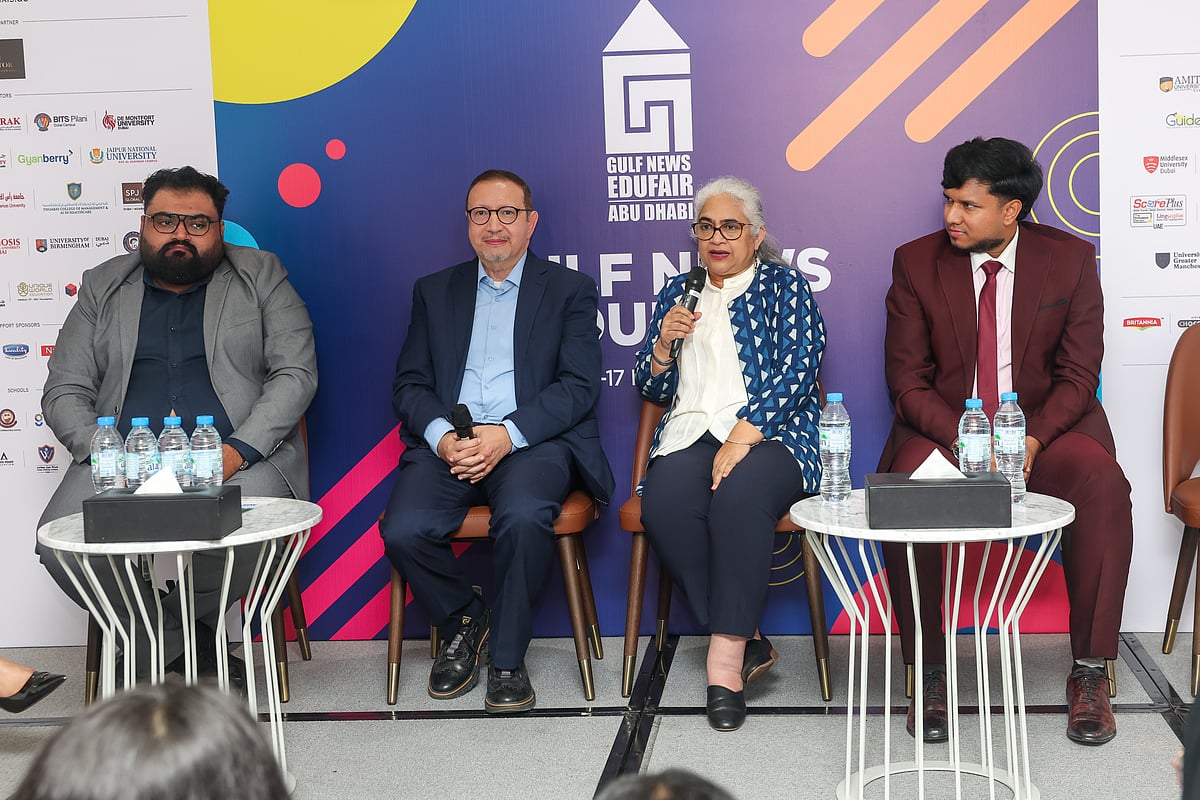
Industry exposure, communication skills and interdisciplinary learning are increasingly shaping hiring outcomes, education leaders said during a panel discussion at Edufair Abu Dhabi 2026 held at Radisson Blu Hotel & Resort Abu Dhabi Corniche from May 16 to 17.
The session, titled “The Employability Test: Which Degrees Open Doors First?”, explored which academic fields currently deliver the fastest transition into employment, what employers value beyond qualifications, and how students can future-proof themselves in a rapidly evolving job market shaped by AI, automation and changing industry needs.
Participating in the discussion were Dr Syed Mohammed Sajl, Lecturer in Mechanical Engineering and Engineering Management at University of Greater Manchester – Academic Centre; Amir F Zeid, Dean of Thumbay College of Management and AI in Healthcare at Gulf Medical University; Dr Anita Patankar, Executive Director of Symbiosis International University Dubai; and Syed Fahad, Regional Director – Marketing and Admissions at SIMS.
The panelists agreed that degrees alone no longer guarantee employability, with employers increasingly prioritising communication skills, adaptability, leadership potential and practical exposure alongside academic qualifications.
“Having a degree is just the beginning,” said Dr Sajl. “It is not like you finish your degree, get a certificate in your hand and the next day you automatically have a job. Organisations are looking at soft skills, communication abilities and whether students can apply what they have learnt in practical environments.”
He said students should avoid choosing degrees purely based on trends or external pressure and instead evaluate long-term opportunities and personal aptitude. “You should not just go by the hype that is happening at this point in time,” he said. “Think about how a course will help you five years from now. Construction will continue, engineering will continue, but there are also growing opportunities in photography, videography, content creation and many creative fields that are now recognised professionally.”
Dr Sajl also stressed the importance of extracurricular activities and internships in building employability. “If I see a student who has balanced academics with leadership roles, sports or student clubs, it immediately shows potential,” he said. “It tells me this person has discipline, time management skills and the ability to handle responsibility.”
Zeid said employers today are increasingly looking beyond grades and focusing on portfolios and demonstrated skills. “University degrees today are proof that you can work in a disciplined manner to earn a qualification,” he said. “But what really gets people hired is the portfolio they build on top of that degree.”
He added that students entering the workforce must develop stronger soft skills and learn how to use AI meaningfully rather than superficially. “People hire for attitude and soft skills,” he said. “Adding AI to your toolbox does not mean asking ChatGPT to complete your presentation. Learn how to use these technologies properly and meaningfully.”
Zeid also highlighted the growing value of interdisciplinary programmes that combine technology with other sectors. “We are now seeing combinations like AI and healthcare coming together,” he said. “A student may want to help save lives but may not necessarily want to become a doctor. These hybrid programmes create entirely new opportunities and skill sets.”
Dr Patankar said students should focus less on chasing job titles and more on understanding global challenges that industries are trying to solve. “You should look at the biggest problems the world is facing and ask yourself what kind of education can help solve them,” she said. “That is where future jobs are going to come from.”
She pointed to fields such as AI, healthcare, psychology, sustainability and interdisciplinary degrees as areas seeing strong demand. “The moment you combine disciplines like AI and law, psychology and technology, or sustainability and economics, you create graduates who can solve real societal problems,” she said. “That is where organisations are willing to invest.”
Dr Patankar also addressed the ongoing tension between parental expectations and student ambitions when choosing career paths. “Parents are often thinking about long-term financial stability and security,” she said. “Students, on the other hand, are thinking about what excites them now. I think honest conversations between both sides are extremely important.”
She said students need to demonstrate that their decisions are informed and carefully researched. “You need to build trust with your parents by showing them that your choices are not emotional decisions, but well-thought-out decisions,” she said.
Fahad said perceptions around career choices have shifted significantly in recent years, with parents becoming more receptive to alternative pathways and emerging industries.
“In the last few years, I have seen parents becoming more willing to listen to what students genuinely want to pursue,” he said. “Earlier, there was stronger pressure towards traditional careers. Now there is more openness to discussions.”
However, he stressed that students must take responsibility for researching their future careers and preparing themselves for industry expectations.“Employers today are not only looking at qualifications,” he said. “They are asking what skills you bring to the table from day one.”
Fahad said industry exposure through internships and practical learning has become increasingly important because companies expect graduates to contribute immediately. “They want students who are career-ready,” he said. “That is why internships, skill development and continuous upskilling are extremely important.”
The discussion also explored how students can remain employable in an increasingly uncertain and technology-driven future.
Dr Sajl said students should continuously adapt and embrace lifelong learning. “If you try things, you learn things,” he said. “Even if you fail, you learn how to do it better next time.”
Zeid warned that the rise of AI-generated content has also created a new challenge for young professionals trying to stand out. “Everything is starting to look the same today, whether it is CVs, LinkedIn posts or applications,” he said. “What will make a difference is authenticity. Be real and be unique.”
Dr Patankar said emotional intelligence and teamwork will remain essential despite technological advances. “The most successful people are often not the most academically brilliant,” she said. “They are the ones who know how to work with teams, adapt, communicate and make themselves valuable in changing environments.”
Fahad concluded by encouraging students to remain flexible and open to continuous growth.“Do not limit yourself to one narrow role or one definition of success,” he said. “The future belongs to people who are willing to keep learning, adapting and becoming irreplaceable.”
Sign up for the Daily Briefing
Get the latest news and updates straight to your inbox
Network Links
GN StoreDownload our app
© Al Nisr Publishing LLC 2026. All rights reserved.