Mohammed Ajmal describes the architecture of Zayed National Museum feels powerful yet graceful.
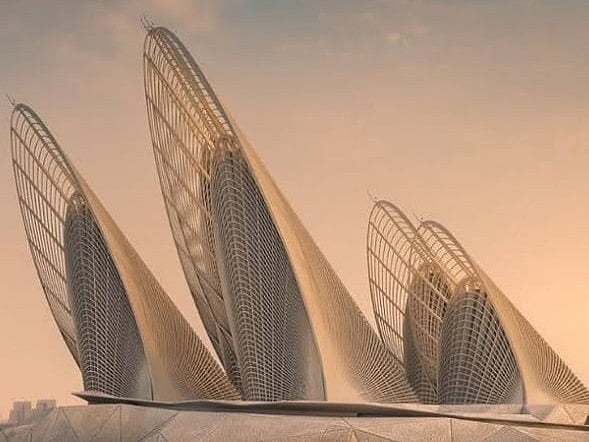
Abu Dhabi: You see the sturdy white wings. Five of them, rising from a green hill on Saadiyat Island, Abu Dhabi, curved and still, as if the wind has just paused them mid-flight. A falcon does not hurry before it flies. It opens its wings, listens to the wind, and waits. The Zayed National Museum holds that moment in steel.
Gulf countries used a traditional method of catching cool breezes from above and directing them indoors to cool rooms naturally. They called the tower ‘barjeel’.
Now imagine that mechanism converted into modern architecture. Inspired by the falcon wings, Foster + Partners architecture firm, designed the Zayed national Museum, where they built the five aerodynamic towers harnessing the principles of barjeel wind tower.
Two visitors, two impressions
While the visitors walk through the boundaries of the museum, the architects wanted the image of a falcon in flight, storming in pride and standing sturdy, 83 to 123 metres into the sky.
“I found myself wanting to pause and capture the details from different perspectives, because the building offers so many interesting compositions,” said Mohammed Ajmal, a Digital Marketing Manager, visiting the museum.
Norman Foster hand-sketched the initial conceptual designs, and the museum opened to the public on December 3, 2025, the day after UAE National Day, after roughly 15 years of construction.
For Ajmal, it is a place where architecture becomes an experience rather than simply something to look at. The thoughtful use of space, natural light, materials, and architectural details made the experience immersive for him.
For Advait Bal, an Abu Dhabi resident working as a solutions Consultant, capturing the moments on his camera, he said, “Being inside the museum gives me a sense of calmness, admiration, and pride.”
Inside the museum
The structure of the place creates an interplay of light and shadow, which, according to Ajmal adds depth to its interiors and makes exploring the museum a visual experience in itself.
Picture used for illustrative purposes.
“As you move through the museum, the changing perspectives encourage you to slow down and appreciate your surroundings,” he added.
When Advait walked through the white floors of the monument, he said, “there is something powerful about being surrounded by a design that reflects the identity of the UAE
The effect comes from the space itself. The interiors are mostly white, the rooms are wide and open, and the lighting is carefully designed. Together they create what he called a clean, futuristic atmosphere.
What stayed with him was a contrast. The building looks like the future, but the story it tells is deeply human.
“The museum tells a deeply human story about the UAE, its roots, its people, and its journey,” he said, “The architecture feels like a vision of the future while the exhibits connect you to the nation’s past and identity.”
Zayed National Museum
That story belongs to the national museum of the United Arab Emirates, a tribute to the nation’s founding father, Sheikh Zayed bin Sultan Al Nahyan, and to the ancient and modern identity of the country he united. The technology carries that story forward inside the museum.
Much of what visitors see is interactive, he added, with holograms and advanced technology bringing the exhibits to life. Heritage is not placed behind glass but something you can step into.
Standing beneath the dome
Asked for one moment he would carry home, Advait described standing in the centre of a circular theatre and looking up at its beautifully shaped dome.
Advait Bal sharing his best moment at Zayed National Museum.
“I felt almost abducted by a stronger force,” he said. “Feeling the beauty of modern architecture and cultural heritage inside you.” Advait needed only one word for everything he felt: “Breathtaking.”
For Ajmal, it was the museum’s soaring towers. Their striking form against the sky creates a powerful visual impression in his memory.
Sign up for the Daily Briefing
Get the latest news and updates straight to your inbox
Network Links
GN StoreAbout Gulf NewsTerms & ConditionsReach by GNSitemapContact usPrivacy PolicyGN FocusHave your sayWork with usAdvertise with usGulf News epaperPrinting Services
Download our app
© Al Nisr Publishing LLC 2026. All rights reserved.