Istanbul: old-world charm
The selfie and souvenir-seeking tourist will find plenty to please here
I took a pinch of the dark red, delicate strands that the shop owner held out in a spice trough and dropped it on my tongue. I couldn’t taste anything. All around me were rows upon rows of gold, rust, green and black spices piled high, alongside thousands of little vials containing myriad coloured potions that wouldn’t look out of place in Professor Snape’s office at Hogwarts.
And then, slowly, different flavours exploded in my mouth – a mix of bitter and sweet, a taste of the sea and grass at the same time, a taste unlike any other. ‘Very unusual,’ I said to the shop owner, grimacing.
This was one of the many surprises the beautiful, bustling, double-continent-spanning city of Istanbul sprung on me in the few days I spent there.
It started when we stepped off the business class cabin of Turkish Airlines, with its Flying Chefs, Cerruti amenity kits, ottomans to rest your feet on, and seats that recline to almost fully flat. Add to this excellent gourmet meals such as goat cheese salads and perfectly spiced lamb with pilaf, and you’d be forgiven for thinking you were feasting at a fine-dining restaurant in Dubai instead of cruising at 35,000ft.
In fact, the abundance of leg room during the flight might make it difficult to reach the touchscreen monitor – but hey, what’s the remote control for?
Expensive spice-tasting paid for, we continued in the luxury I’d quickly become accustomed to. We drove to Nişantaşı, where Istanbul’s Gucci-handbag-swinging, Tissot-wearing set congregates every evening for a hopping party, and every morning for a decadent breakfast and some excellent Turkish coffee in the restaurants and cafés. They then presumably trawl through the many high-end fashion boutiques here. Called Istanbul’s Fifth Avenue, this was also our home over the next few days.
A few months old, the St Regis’s art deco yet contemporary influences (the towering, shiny, wood-and-glass case filled with books in the reception area is so stunning, I spent a few minutes paying homage to it), views of Maçka Parkı and the Bosporus, rooftop restaurant by Wolfgang Puck, the Iridium spa with its indoor pools and Turkish baths, a celeb-style beauty salon, and proximity to key tourist sights have made it the new spot-to-be-seen-at. And it isn’t all copy-and-paste from one room to the other. There’s a different piece of art or sculpture from Demsa Group’s (which owns this St Regis) extensive Demsa Collection across the hotel.
The St Regis’s century-old butler service was the highlight of the stay. ‘Allow me’, the catchphrase, is thrown around a lot. My butler did everything from packing and unpacking my suitcase (for those not filled with dread at the thought of someone handling your clothes and inners), to pressing my dresses, arranging for my favourite foods and beverages in-room, and anticipating my needs even before I knew them. And this being the tech century, it’s not just old-fashioned Downton Abbey-ing here – you can even message or email your butler with what you want, and he/she will have it delivered to you before you can say Mr Carson. This is not a place for those uncomfortable with luxury.
We dined that night at Spago, the first international outpost of the Beverly Hills restaurant by Wolfgang Puck. If you can take your eyes off from the great views of the skyline to look at the extensive, changing menu that operates based on a farm-to-table concept, you’ll see options such as red snapper sashimi salad with salmon pearls; hand-cut farfalle with King Crab, shrimp, lobster and shellfish emulsion; and grilled lamb chops with harissa aioli, charred eggplant, falafel macaroons and natural jus.
The efficient, knowledgeable staff tell us that every evening the kitchen is inundated with orders for the steamed sea bass cooked Hong Kong-style and the filet mignon with peppercorn sauce, so we decided to try both, along with a selection of starters – and we didn’t regret a second of it. With flavours and spices dialled up to just the right amount, a wonderful interplay of textures, and the flesh coming off the bone with just a soft pull of the fork, as well as scrumptious sides such as potato purée, roasted cauliflower, and tempura-style onion rings – it was hands down one of the best meals I’ve ever had.
We then moved to the lounge, next to the live DJ. They don’t really leave any room for error at Spago. I hear tales of how each piece of ice that goes with the drinks are hand-cut. Guess the four-week waiting list to nab a table here is worth it then…
The next morning, we had breakfast at the less-formal St Regis Brasserie, choosing to sit outside (contrary to popular perception, October offers great weather in Istanbul, slightly nippy but with enough sunshine so you’re snug) and watch Nişantaşı wake up over cups of steaming Turkish coffee, cold cuts, muffins, cheese and my favourite – chunks of sweet honeycomb that you can eat whole.
Amply satiated, we set out to the Galata Tower, walking through narrow cobbled streets filled with cafés, boutiques and restaurants. Piles of jewelled bowls – pomegranate – line almost every shop.
The 700-year-old cylindrical tower, 67m tall and with a conical roof, has been the tallest structure in the city for centuries. It was first used for defence and communication. After Ottoman rule, it was used as a prison, a lighthouse, and then a fire watchtower. But its most notable story revolves around a man called Hezârfen Ahmed Çelebi, who in 1638 attempted – and succeeded – to fly with wings attached to his arms, soaring past the Bosporus, buoyed along by the wind. The renovated version of the tower now houses an elevator, a restaurant and a souvenir shop.
And in case you’re wondering, for his trouble Hezârfen was exiled to Algeria, being seen as a threat to the ruler.
But the place has been serving loyal customers since 1920 and doesn’t seem to have gained a reputation for disappointing the huge queues gathered around, as we found out when we scooped out the insides from our fresh hunks of bread, filled it with the juicy, heavily seasoned meatballs and topped it with fiery (very fiery) red chilli sauce, upon our guide Fatoş’s recommendation. The eatery might be very touristy, but it makes up for everything with those superb meatballs, which we washed down with ayran, a yogurt drink with salt.
Our next stop was the Basilica Cistern. This was one part of the itinerary I was really curious about. What exactly would we do in a place which, for all purposes, sounds like it was an underground medieval sewer system? What was so mysterious about this place that the James Bond film From Russia with Love was shot here (though its actual location is some distance away from the former Soviet consulate it was filmed as being under)?
We descended 52 steps into a dark chamber. The cistern was commissioned by Emperor Justinian and built in the sixth century. And immediately, I understood why this reservoir was described as, of all things, romantic. With atmospheric lighting, and even music, I saw before me 336 marble columns in rows, reflected in the still water below – still except for the occasional school of carp whirling through.
These columns were salvaged from ruined temples, and feature a variety of engravings. Dark shadows played about. The symmetry, the serenity, the immense space… this is an unlikely, intense experience, and a great retreat for residents in summer. (Come in winter and you’ll have the occasional stream of ice-cold water dripping on your head.)
While the revelation that this was once a dumping ground for corpses brought down my elation for a bit, it still didn’t take away from its beauty. We listened in fascination as our guide related the story of how this forgotten place was rediscovered when residents told a scholar they could miraculously access water, and even fish, when they lowered buckets into a dark space through the basements in their houses.
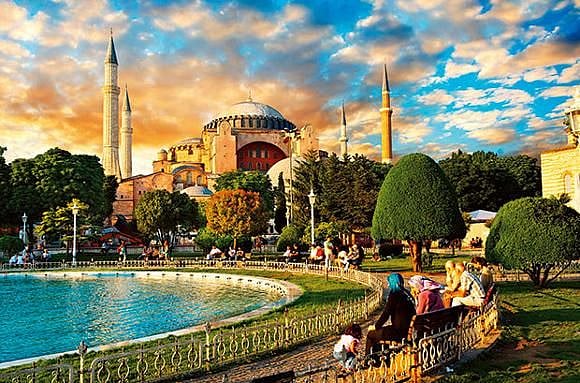
After visiting two more of Istanbul’s must-sees – the imposing Blue Mosque (overwhelming with its domes, minarets, and tens of thousands of blue iznik tiles), and the Hagia Sophia (a church/mosque/museum), both as impressive and photogenic as every guidebook describes them – we set off to the aptly named Grand Bazaar for a quick round of shopping. Upon arrival though we promptly realised that quick was something that was simply not possible in here.
With over 4,000 shops, there’s not much you won’t be able to find in this 550-year-old market. Tea, food, rugs, marvellous silk scarves, ceramics, items of clothing with cheesy messages painted on them, hidden gems and pieces of jewellery that are purported to be silver and gold, but with patterns you’d be hard-pressed to find in any other city in the world – it’s all here. Don’t expect to always pay dirt-cheap prices though. This is no mere souq anymore, it’s now a serious commercial area, with even world-class designers and artists buying up space.
The shop owners’ stellar sales techniques (read aggressive: we were followed by salesmen making statements such as ‘we have genuine fake bags and carpets’ or ‘you look like someone who wants to buy a gem-studded knife’) mean you’re guaranteed to leave behind a huge chunk of your bank account. Make the massive mistake of letting slip that you’re from Dubai and you’ll immediately be charged five times the price.
Another word of advice: it’s probably a good idea to keep your belongings and loved ones close while you trawl the bazaar if you want to see them again anytime soon.
The next day, lounging at the hotel after a blissful massage at the spa, I fell in step with the head butler Atilla Cimsit, curious to know if he had faced any excessive, bizarre demands yet from guests who have consumed a steady diet of shows such as Downton Abbey or books with Wodehouse’s Jeeves. Fresh ice cut in the shape of little lilies? Tame tigers to adorn the room? A few belly dancers for an exclusive performance?
‘No,’ Atilla replies without batting an eyelid. ‘We don’t look at it that way.
‘As long as it’s not illegal or immoral, we’ll do anything to make our guests’ stay here memorable.’
I think he might just have summed up Istanbul in 18 words.
Sign up for the Daily Briefing
Get the latest news and updates straight to your inbox
Network Links
GN StoreDownload our app
© Al Nisr Publishing LLC 2026. All rights reserved.