Wassef Boutros-Ghali: Celebrating the artistic legacy of an Egyptian architect
A new catalogue raisonné and debut solo exhibitions are gaining global recognition
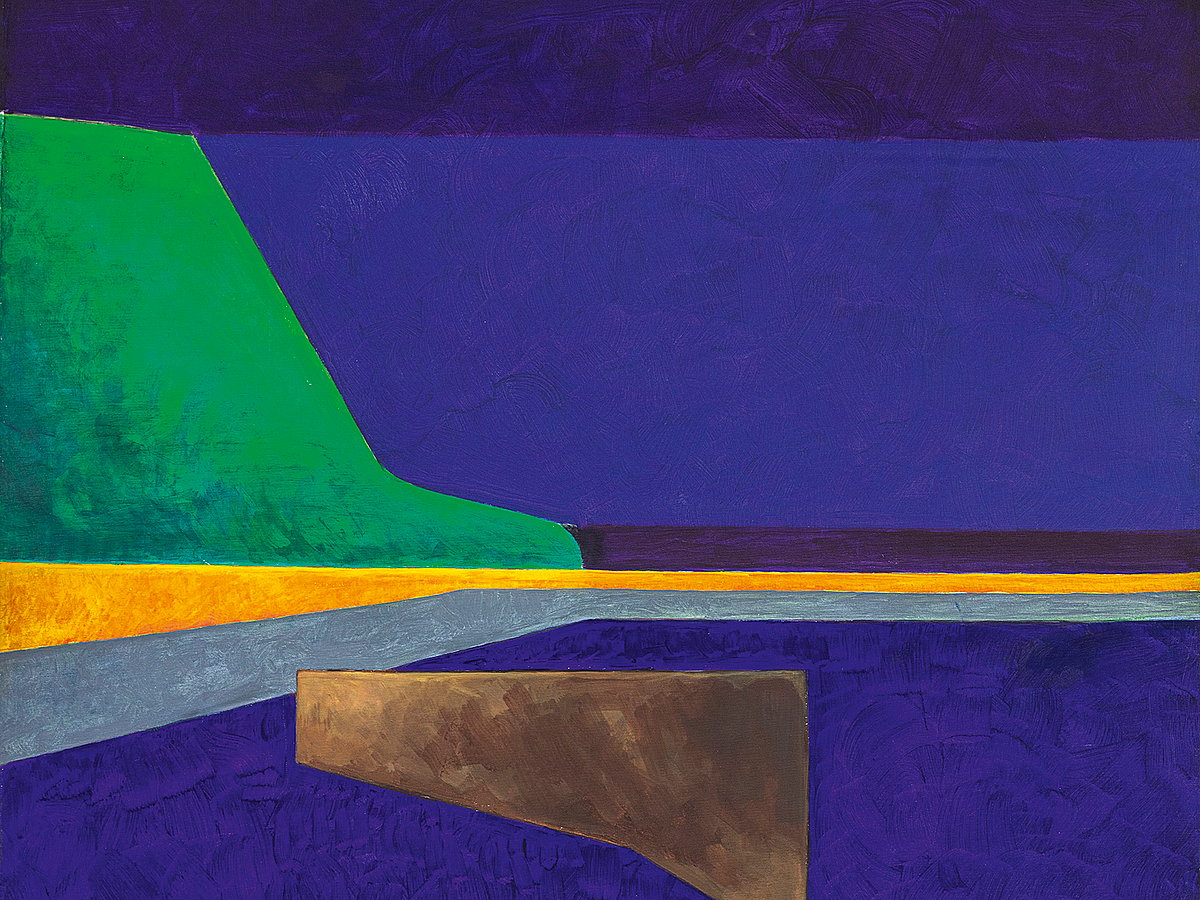
Inside the main space of Leila Heller Gallery in Dubai dazzling abstract compositions, vibrantly coloured and highly architectural in structure, yet calm and gentle in appearance, aligned the walls. These alluring abstractions by Egyptian painter and architect Wassef Boutros-Ghali are inspired by not only the unrelenting sunlight of the artist’s North African homeland, but nuanced observations of daily life, mythology and references to dreams. They are otherworldly. Titled Wassef Boutros-Ghali: A Retrospective (1965-2016), the exhibition marked the late artist’s first exhibition in the Middle East.
Born in 1924 into a family of politicians in Cairo, Egypt, Wassef Ghali was drawn to the arts as a child and as early as 12 years old demonstrated natural talent as a draftsman. While his brother Boutros, Boutros-Ghali followed the family’s long history of involvement in politics, becoming an Egyptian politician and diplomat who served as the sixth -secretary-general of the United Nations from 1992 to 1996, Wassef set aside his family’s political legacy and devoted himself to a career in architecture and a prolific pastime of painting. While his brother was an architect of the Camp David Accords, Wassef served as a technical consultant for the environment and urbanism with the United Nations, executing buildings in Egypt, Ethiopia, Saudi Arabia and Sudan, among others.
While Wassef trained as an architect and worked as so all his life, painting was his first love. The architect-artist, who passed away in March 2023 at the age of 98, painted up until his death.
“He was the one out of the family that was the least interested in politics and far more interested in the arts,” recounted his son Teymour Boutros-Ghali. “Around the age of 12, his father arranged for him to take art lessons with a teacher in Cairo. This is where he began his drawing, largely classical in style, using a charcoal ink pen.”
At the time, it wasn’t considerable socially acceptable for an Egyptian man of such a prominent political family to become a painter, and so Wassef became an architect. He did love architecture and the first building he created, recounts Teymour, was an apartment building in Giza where his family move to after it was completed.
“To reduce Wassef to any one title would be to miss the essence of who he was,” writes Teymour in the foreword to his catalogue raisonné published in 2025 by Skira and edited by Lesley Campoy. “He was a Renaissance man in the truest sense: an architect, artist, poet, businessman, mathematician, historian and philosopher. He read voraciously, thought deeply, and engaged joyfully with both the arts and sciences.”
Wassef’s paintings are akin to vivid geometric forms in space—in many ways they resemble modernist architecture. They reflect both Egyptian landscapes and constructivist compositions, including the essence of figural representations, buildings beaming with sunlight and many canvases capturing the beauty of the desert and the sea. While Wassef’s art charts everything in abstract terms from politician revolutions and upheavals to relocations in Rome, Italy, a move to New York in 1971 followed by years in Connecticut, his canvases remain buoyant and uplifting, richly evocative and sensitive to the people and landscapes around him.
While from the 1950s to the 1970s modernist architecture flourished in the Arab world, Egypt during the same period was not particularly known for its contributions to the development of abstract art. Wassef’s contemporaries, such as Abdel Hadi Al Gazzar (1925-1966) reinterpreted folkloric and religious themes as well as mysticism, while Inji Efflatoun (1924-1989) created heightened canvas known for their politically charged and surrealist compositions. The renowned Mahmoud Saïd (1897-1964) became renowned for his portraiture portraying both the wealthy and poor of Egypt alongside his evocative landscapes.
Wassef stands out, underlines Sultan Sooud Al Qassemi in the catalogue raisonné, for his approach to abstraction that was rare for the time.
Until 2019 very few people knew anything of Wassef’s art. He was known for his career as an architect. “He never intended to promote or sell his work,” said Campoy. Yet when she found herself in his studio during a visit to Cairo, amid hundreds of breathtaking works produced quietly over the last few decades, she asked her father-in-law what he was planning to do with them. He shrugged as if to say he had no set intentions. His art was a private, passionate project. After she told him that his work deserved to live out in the world. He simply replied: “Well, if you would enjoy that, have at it.” And Campoy did.
Through various connections, she met Rhona Hoffman, a long time Chicago-based gallerist, who, enraptured by Wassef’s work after a trip to Cairo, decided to bring a few paintings to Art Basel Miami in 2019, marking the first public display of his art. He became the star of Rhona’s booth. It was just the beginning. Since then, Wassef’s work has been showed in numerous international art fairs, including The Armory Show in New York, Art Basel in Paris and Miami, Frieze Masters and Abu Dhabi. In late 2020, Albertz Benda Gallery in New York gave Wassef his debut gallery exhibition. This was followed by a retrospective at Hoffman’s Chicago gallery the following year and most recently, a retrospective and book launch of the recently published catalogue raisonné at Leila Heller Gallery in Dubai. Leila Heller now represents Wassef through her galleries in Dubai and New York.
While Wassef will be remembered greatly for his architectural contributions, his paintings, now discovered and out in the world, provide a sense of everlasting beauty and the hopeful spirit of endless possibility.
“I don’t know what I would have done if I couldn’t paint,” said Wassef at the age of 96 years during a conversation with curator Glenn Adamson, published in the catalogue raisonné. “It’s interesting—I’ve reached an age where I have seen a lot, by definition. But even if I had always lived in the same city, in the same room, I would have seen a lot. It is a consolation to find that I can still express myself on the canvas. It is a feeling that I can now say goodbye.”
Network Links
GN StoreDownload our app
© Al Nisr Publishing LLC 2026. All rights reserved.