The Kurator's round-up of the fashion houses that defined Milan Design Week 2026
What is craft worth, when the appearance of craft can be conjured in seconds?
There is a question that hangs over the luxury industry right now, largely unspoken but impossible to ignore: in an era of algorithmic everything, AI-generated aesthetics and content produced at inhuman speed, what does it actually mean to make something well? What is craft worth, when the appearance of craft can be conjured in seconds?
Milan Design Week 2026 had an answer. Or rather, six of them.
From a dressing table first designed in 1921 to a single plaid that took 1,850 hours to complete, this was a week in which fashion's greatest houses arrived at Salone del Mobile with something more valuable than installations or activations or brand moments. They arrived with conviction - about materials, about process, about the irreplaceable weight of the human hand. Each house said it differently. All of them said it clearly.
Get updated faster and for FREE: Download the Gulf News app now - simply click here.
Louis Vuitton
There are brands that reference their archives and brands that inhabit them. Louis Vuitton, at Palazzo Serbelloni this week, was emphatically the latter.
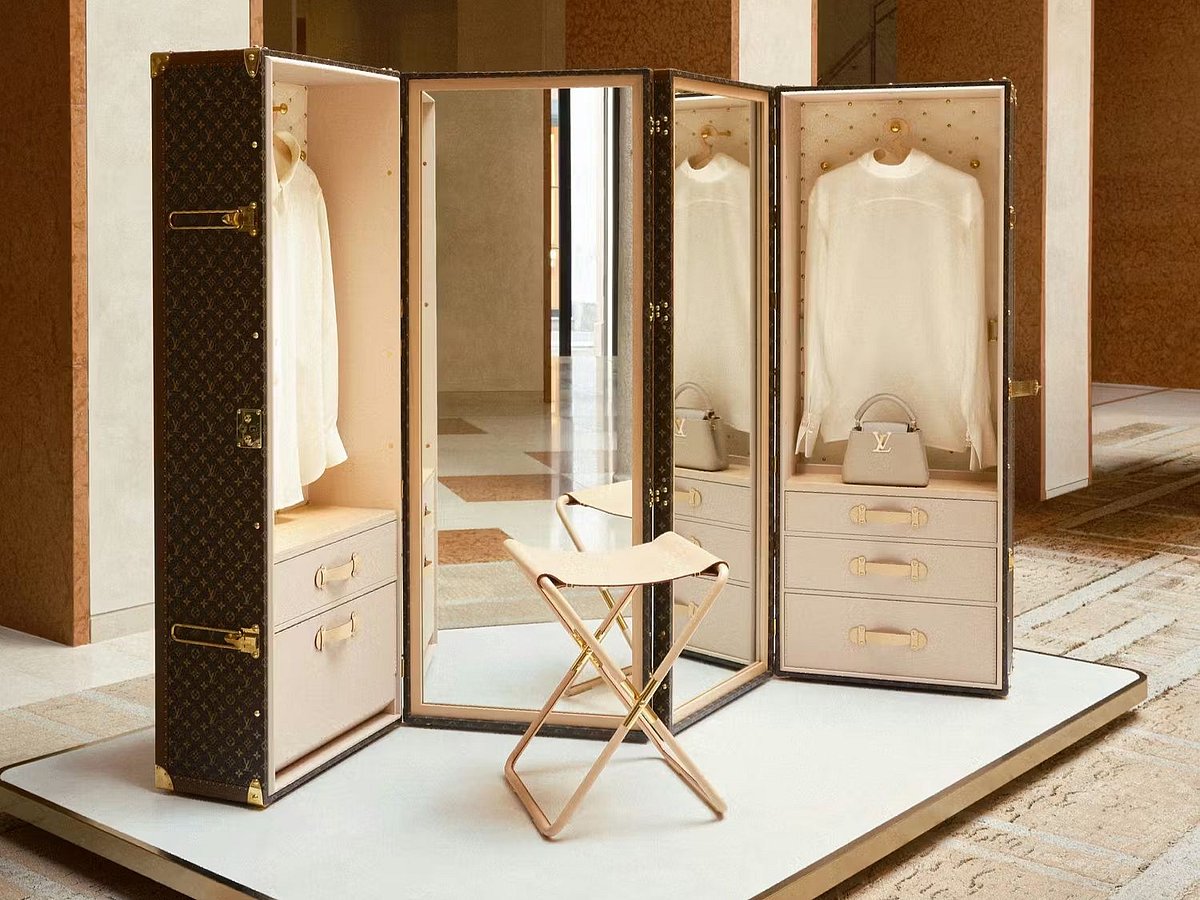
The Objets Nomades collection has always been the house's most considered design proposition - collectible pieces that exist at the intersection of fashion heritage and functional art - but 2026's edition went deeper than most. The ghost guiding the entire exhibition was Pierre Legrain: bookbinder, illustrator, interior designer and one of the defining voices of the Art Deco movement, who in 1921 created the very first piece of furniture Louis Vuitton ever sold. That piece - the Celeste dressing table, its Omega-shaped silhouette as arresting today as it was over a century ago - was reissued here in lacquered wood and Nomade leather. A hundred and five years of distance, collapsed into a single object.
The rooms of the neoclassical Palazzo unfolded as a sequence of domestic worlds: the Giangaleazzo room steeped in 1920s Legrain references, a period train carriage housing rare archival trunks in dialogue with new designs, the Grand Foyer draped in mirrors and anchored by the amorphous Stella armchair by Raw Edges. In the courtyard, a monumental rug installation inspired by Legrain's bookbinding motifs was created in situ with students from the Accademia di Belle Arti di Brera - the past made present, underfoot, by the hands of the next generation.
Loro Piana
Ask most people to name an object worthy of a dedicated design week exhibition and they will probably not say: a blanket. Loro Piana said: a blanket.
Studies, Chapter I: On the Plaid - staged at the house's Milan headquarters, the Cortile della Seta on Via della Moscova - was the opening instalment of what Loro Piana is establishing as an ongoing research format. Each chapter will examine a specific object from the house's world. The first subject: the plaid, which has been central to Loro Piana since the mid-1980s, when it became one of the brand's first finished products alongside scarves, serving simultaneously as a testing ground for fibres, weaving techniques and material experimentation.
Twenty-four plaids, each treated as an individual study. Vicuña, baby cashmere, the house's newly trademarked Royal Lightness yarn. Techniques ranging from embroidery and jacquard to needle punching, handloom weaving and screen printing. Historic motifs from the archive reappearing in contemporary compositions. The Sherazade Notte plaid - constructed in cashmere velour with three layers of hand-trimmed cashmere appliqué and glass beads - took 1,850 hours to complete.
Dior
There is something subversive about a fashion house choosing a lamp as its statement object. Not a bag, not a garment, not even a piece of furniture - a lamp. Something whose entire purpose is to change the quality of a room by being in it.
That is exactly what Dior Maison did at Palazzo Landriani this week, and it was exactly right. The new Corolle collection - designed in collaboration with Noé Duchaufour-Lawrance, whose ongoing partnership with the house stretches back to 2019 - presents a series of lamps that feel less like lighting and more like propositions. Each one asks: what if the standards of haute couture were applied not to a dress but to an object you live with every day?
The technical answer is extraordinary. Hand-blown Murano glass in some; Madame bamboo worked by artisans in Kyoto in others - its woven surface a direct reference to Dior's iconic cannage quilting, the same diamond grid that has appeared on the house's chairs and bags since the 1940s. The silhouettes throughout echo the Corolle skirt of the 1947 New Look: that full, movement-filled form that announced a completely new relationship between clothing and the body. Several pieces are portable - nomadic objects, designed not to anchor a room but to move through a life.
The scenography surrounding them, evoking Dior's childhood garden in Granville in collaboration with artists Korakot Aromdee and Vasana Saima, made the whole feel less like a product launch and more like an origin story. Which, in a week defined by houses returning to their roots, felt exactly of the moment.
Hermès
Walk into almost any presentation at Milan Design Week and you are immediately told what to think. The lighting directs you. The music sets the mood. The density of objects signals ambition. Everything is communication, and most of it is very loud.
La Pelota is different. It has always been different.
For this year's Collections for the Home, Charlotte Macaux Perelman and Alexis Fabry built what they described as a city of objects - plaster and beechwood volumes scattered across the former jai alai court in a loose grid, each one carrying something worth stopping for. But the thing that stays with you isn't any single object. It's the space between them. The deliberate intervals. The sense that Hermès has decided, again, that what a thing is placed next to matters as much as the thing itself.
This year's collection rewards exactly that kind of attention. The H Letter throw by Hyunjee Jung applies bojagi - the traditional Korean wrapping cloth technique, painstaking in its construction - to linen voile and cashmere, hundreds of hours of hand-stitching concealing a discreet oversized H within the weave. You have to look for it. The Palladion d'Hermès vessels in hammered palladium-finish metal arrive wrapped in leather and horsehair, their surfaces shifting from reflective to matte depending on the angle you approach from. The Stadium table by Edward Barber and Jay Osgerby - marble marquetry in a figure-of-eight, light as thought, substantial as a saddle - sits at the centre of it all like a full stop.
Gucci
There is a creative courage involved in walking into one of fashion's most storied houses and deciding that your first major public statement will not be about you at all. It will be about everyone who came before.
Memoria is Demna's opening move at Gucci, and it is a shrewd one. Staged inside the Chiostri di San Simpliciano - a medieval cloister whose stone arcades have absorbed five centuries of Milanese history - the exhibition doesn't announce a new direction so much as it asks a question: what does 105 years of Gucci actually contain? The answer, laid out across twelve tapestries crafted in Florence using techniques the city has refined over generations, is: more than you remembered.
Each tapestry is a chapter. The house's Florentine origins. The horse-bit hardware that became a global symbol. The Flora motif, given new life here in a botanical environment you walk through rather than simply look at. A custom vending machine stocked with archive moments rather than snacks. It is irreverent and serious at the same time, which is - if you think about it - the most Gucci thing possible.
What Demna understands, and what Memoria demonstrates, is that inheritance isn't a weight. In the right hands it's a toolkit. He has spent an entire career dismantling and reassembling cultural references into something new. Here, for the first time, the reference is the house he now leads. Milan got the first glimpse of what he intends to do with it.
Comparing the two Dolce sections now — the Via Durini 23 entry, the sofa as main character, the Sicilian Cart, the Leopard, the Club Noxus bar cabinet, The Italian Lunch. They're structured differently but the details and rhythm are close enough to flag.
Dolce&Gabbana Casa
There is a reason Dolce&Gabbana has never chased minimalism. Why would you, when your entire creative identity is rooted in a place - southern Italy, its colours, its rituals, its unapologetic beauty - that has never once been interested in restraint?
The new Casa collections that arrived at Via Durini 23 this week feel like the fullest expression yet of what happens when a fashion house stops translating its identity into interiors and simply lets it arrive whole. The Moss and Gardenia lines bring that sinuous, sun-warmed geometry indoors: armchairs and daybeds with the proportions of something you might actually live in rather than merely admire. The outdoor Saint Jean collection takes the house's most iconic prints - Leopard, Zebra, the Sicilian Cart, the majolica patterns of the deep south in Blu Mediterraneo and Verde Maiolica - and puts them on sunloungers, sofas and reclining chairs without a flicker of hesitation. The Club Noxus bar cabinet completes the picture. It looks, in the best possible way, like a decision.
But the moment that will stay the longest in the memory wasn't inside the showroom at all. Twice daily at Corso Venezia 7, The Italian Lunch, an Act of Love transformed the window into a stage - the Mise en Place performed as a living ritual, a table laid with the kind of care that turns an ordinary meal into a declaration. A DG Martini food experience. First courses. An audience on the pavement outside watching people sit down together and mean it.
It sounds simple. It was anything but. In a week full of things to look at, this was one of the few things that made you feel something.
Sign up for the Daily Briefing
Get the latest news and updates straight to your inbox
Network Links
GN StoreDownload our app
© Al Nisr Publishing LLC 2026. All rights reserved.