WGS 2026: AI is becoming a sovereignty decision for governments, global leaders warn
Leaders say AI will shape national productivity, data control and economic power
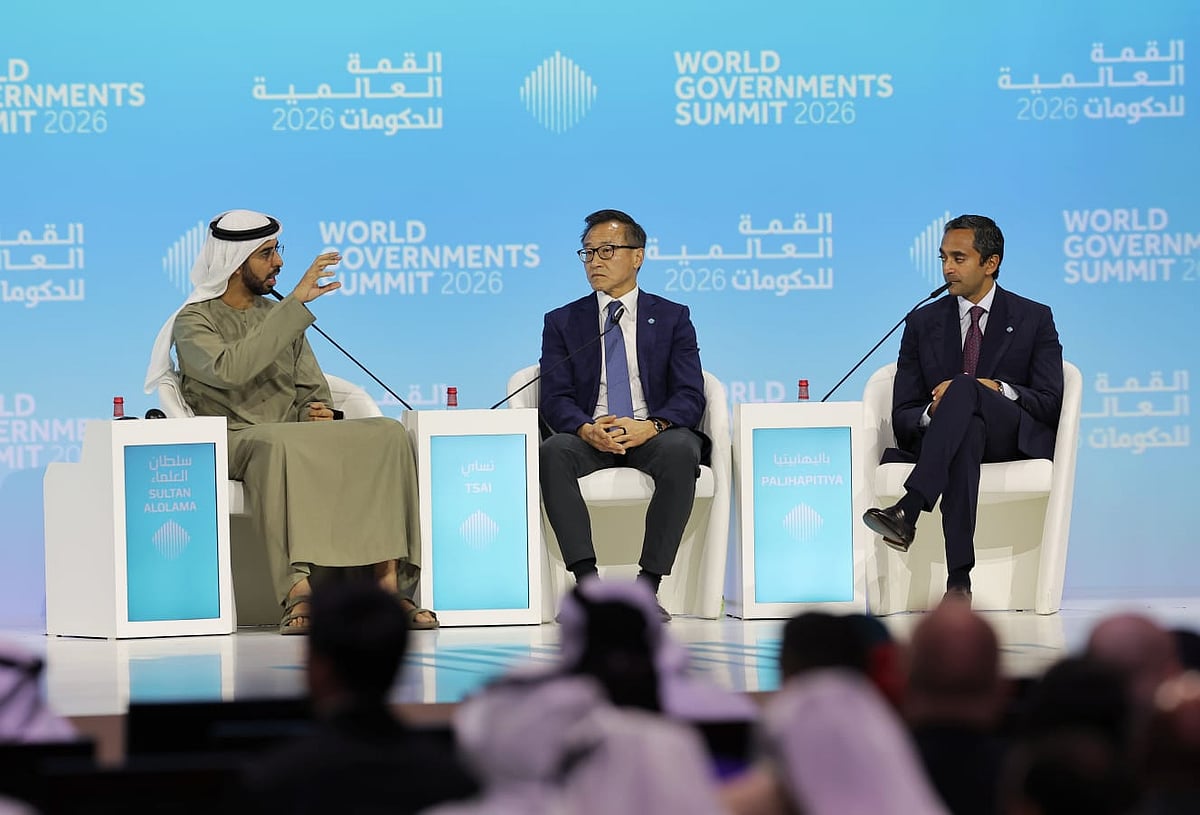
Dubai: Artificial intelligence is rapidly shifting from a corporate technology choice to a sovereignty decision for governments, with national productivity and economic control increasingly tied to which models countries adopt and how they deploy them.
Chamath Palihapitiya, Founder and Managing Partner, Social Capital,
said countries will soon be forced to decide how much control they want over their own economic output. AI models, he said, are evolving into a key engine of productivity, choosing technology a matter of national interest.
“Every country, probably in the next three to five years, will be forced to make a very important decision, which is around the sovereignty of their own productivity and GDP,” Palihapitiya said.
Speaking at a panel at the World Government Summit, he described open-source models as offering a clearer path for governments seeking transparency and control, since they allow full visibility into how systems operate and can be adapted locally.
Joseph Tsai, Chairman and Co-Founder of Alibaba Group, agreed that open source is increasingly attractive to countries focused on data control and independence, particularly because it enables governments to deploy AI on their own infrastructure.
“You can take an open source model and deploy it on your own infrastructure,” Tsai said. “Whatever you do to post-train the model or run inference will have nothing to do with the original open source model maker, and thereby you basically claim sovereignty and ownership of the model.”
Tsai said the shift toward open source in China was driven by economic realities rather than ideology. Traditional software-as-a-service models never scaled widely, pushing developers to prioritise adoption and usage over direct monetisation.
Infrastructure over software
The discussion also highlighted how the economics of AI are moving beyond software alone. Tsai said companies that combine models with cloud infrastructure are better positioned to generate returns, since training and inference increasingly rely on large-scale computing environments.
Palihapitiya expanded on that point, noting that open-source adoption still requires power, data centres, batteries, specialised materials, and financing. Governments, he said, may ultimately play a larger role in coordinating and funding those layers.
“The business model becomes more at the governmental level,” Palihapitiya said, particularly in countries where public infrastructure can support large-scale AI deployment.
Rethinking the AI bubble debate
Concerns around an AI investment bubble were also challenged. Palihapitiya compared the current surge in spending to historical infrastructure booms that left lasting physical and economic legacies, even when early returns were unclear.
Also Read
AI will be more important than electricity: Microsoft, G42 leaders at Dubai’s World Government SummitBuilding the AI moat: The Middle East’s long game in artificial intelligenceAI tsunami could disrupt 40% of jobs worldwide, IMF chief warnsBuilding the AI moat: The Middle East’s long game in artificial intelligenceAI, he said, could reshape how energy, materials and industrial systems are valued, especially if future models unlock breakthroughs in areas such as storage, materials or computing efficiency.
Path for governments
When asked how countries that have yet to deploy AI should proceed, Palihapitiya urged a focus on immediate public value. Education, healthcare and basic government services, he said, offer clearer returns than chasing frontier concepts.
“Pick a model, deploy it inside your own borders with your own power and your own people,” he said. Improving quality of life, he added, may prove more transformative than racing toward speculative applications.
Tsai echoed that view, advising governments to start with specific use cases and lean on open-source systems that offer control and security.

Sign up for the Daily Briefing
Get the latest news and updates straight to your inbox
Network Links
GN StoreDownload our app
© Al Nisr Publishing LLC 2026. All rights reserved.