Trump crashes Jensen Huang’s live interview: ‘AI fears are a hoax,’ data centres are ‘great, oil of the next 25 years'
Surprise Trump call turns AI safety debate into rally for data centers and growth
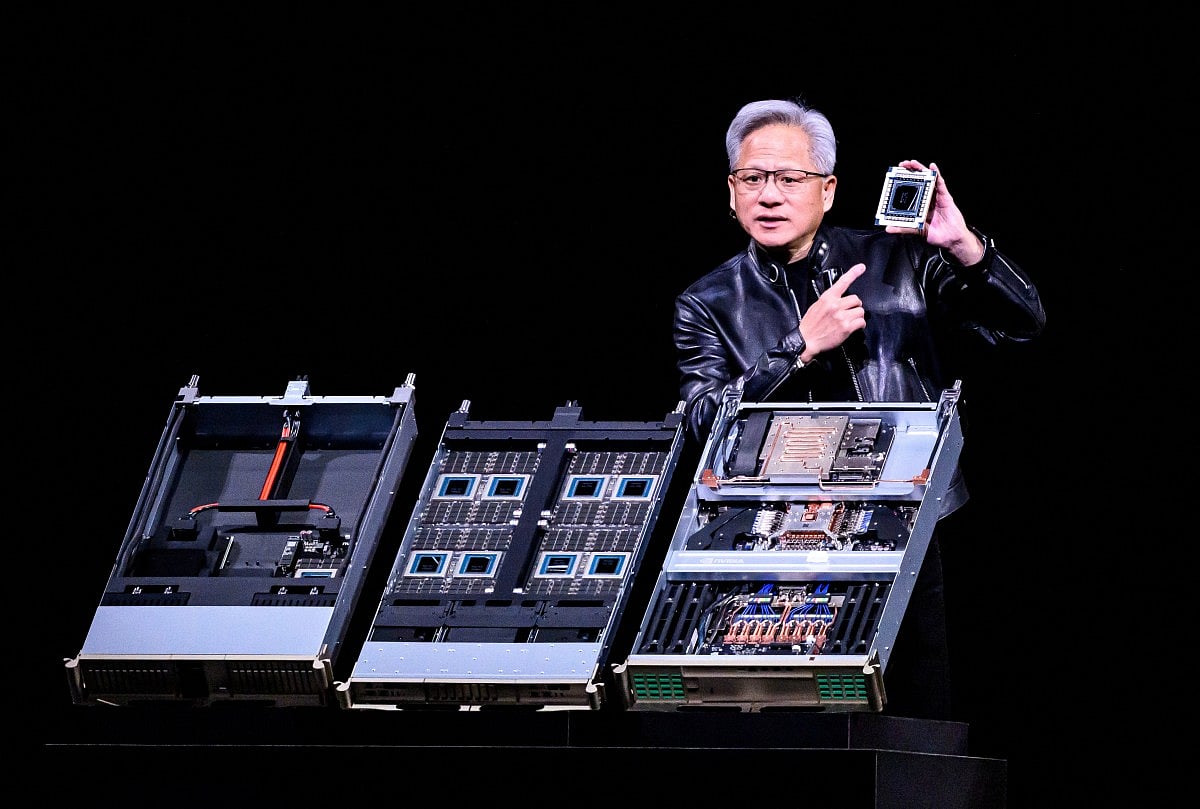
US President Donald Trump made a surprise appearance — by telephone— during a live interview with Nvidia CEO Jensen Huang, abruptly inserting himself into one of the tech industry's most heated debates: whether the rapid development of artificial intelligence (AI) needs stronger safety rules.
Huang was speaking at the All-In Summit in Los Angeles on Sept. 14 when he received Trump's call.
He put the president on speakerphone before the live audience, turning an interview about AI into an impromptu presidential intervention.
Get it: Fast, verified news for FREE ... download the Gulf News app — simply click here
Trump's message was blunt: concerns about AI taking over the world are a "hoax."
"The robots are not going to be taking over the world," Trump said, dismissing the idea that AI could lead to catastrophic consequences.
He also criticised calls for slowing AI development, saying the United States must be careful but should not stop an industry that he sees as strategically and economically vital.
Trump also went after opposition to the enormous data centres being built to power AI.
"The data centres are great," Trump said, according to reports of the call, arguing that they create wealth and benefit states.
He compared data centers' strategic importance to oil and described AI as potentially bigger than the internet.
Huang: AI fears are not grounded in science
Huang, whose Nvidia has become one of the central beneficiaries of the AI boom, largely agreed with Trump's broader argument.
Earlier in the discussion, Huang criticised what he called AI "doomerism," arguing that predictions of AI destroying humanity or eliminating huge portions of American jobs are not supported by science.
In a July interview with Axios, Huang similarly argued that policymakers should not allow science-fiction scenarios to determine AI policy.
But Huang drew an important distinction between legitimate safety concerns and predictions about an apocalyptic future.
He said whistleblowing is legitimate: highly specific predictions about AI destroying humanity require scientific evidence.
The timing is significant
The exchange comes amid an unusually intense fight inside the technology industry.
Anthropic CEO Dario Amodei has called for a slower, more coordinated approach to advanced AI development and stronger government oversight. Leaders and prominent figures associated with OpenAI, Google DeepMind and SpaceX have also expressed concern about increasingly powerful AI systems.
Trump has taken the opposite position, portraying excessive regulation as a threat to America's technological lead over China.
The president's intervention therefore wasn't simply an off-the-cuff phone call. It placed the White House squarely behind the "build faster" camp of the AI debate.
Social media catches the moment
The surprise exchange quickly spread across social media.
An X post circulating shortly after the appearance summarized Trump's position bluntly: AI taking over the world and destroying humanity is a "hoax."
Instagram was similarly flooded with clips of Huang taking Trump's call onstage.
Several posts highlighted the unusual spectacle of the Nvidia CEO putting the US president on speakerphone during a live technology summit, while others focused on Trump's dismissal of AI fears and his defense of data-center construction.
The moment was tailor-made for social media: one of the world's most powerful technology executives, discussing the future of AI, suddenly receives a call from the president — and puts him live on speaker.
The bigger fight: AI versus the power bill
Behind the dramatic exchange is a much more concrete issue.
AI requires enormous amounts of computing power. That means chips, servers, data centers, electricity, cooling systems, water and transmission infrastructure.
Trump's enthusiastic defense of data centers comes as communities and policymakers increasingly debate their local costs and benefits.
The pro-AI argument is straightforward: data centers bring investment, jobs, tax revenue and technological infrastructure — and can make regions participants in the next major industrial revolution.
The opposing argument is equally concrete: communities may have to deal with higher electricity demand, pressure on grids, water consumption, land use and environmental impacts.
That debate is different from the philosophical question of whether AI could eventually threaten humanity.
And that distinction matters.
Trump may dismiss existential AI fears as a hoax, but the physical infrastructure required to run AI is very real.
So is the electricity. So is the water.
So is the investment. And so is the question of who ultimately pays for the AI boom.
For Huang and Trump, the answer is clear: build it.
For their critics, the question is whether America can build it fast enough without losing control of the technology — or paying an unexpectedly high price for the infrastructure underneath it.
The AI race is no longer simply about who has the smartest model. Increasingly, it is about who has the chips, power, water and data centers to run it.
Network Links
GN StoreDownload our app
© Al Nisr Publishing LLC 2026. All rights reserved.