Jensen Huang
Top billionaires shaping the global chip industry in AI age: Leaders behind NVIDIA, TSMC, Arm, Intel, AMD, Samsung, ASML, Foxconn, Cambricon
Wealth, wafers and war rooms: billionaires at the heart of chip geopolitics
Last updated:
8 MIN READ
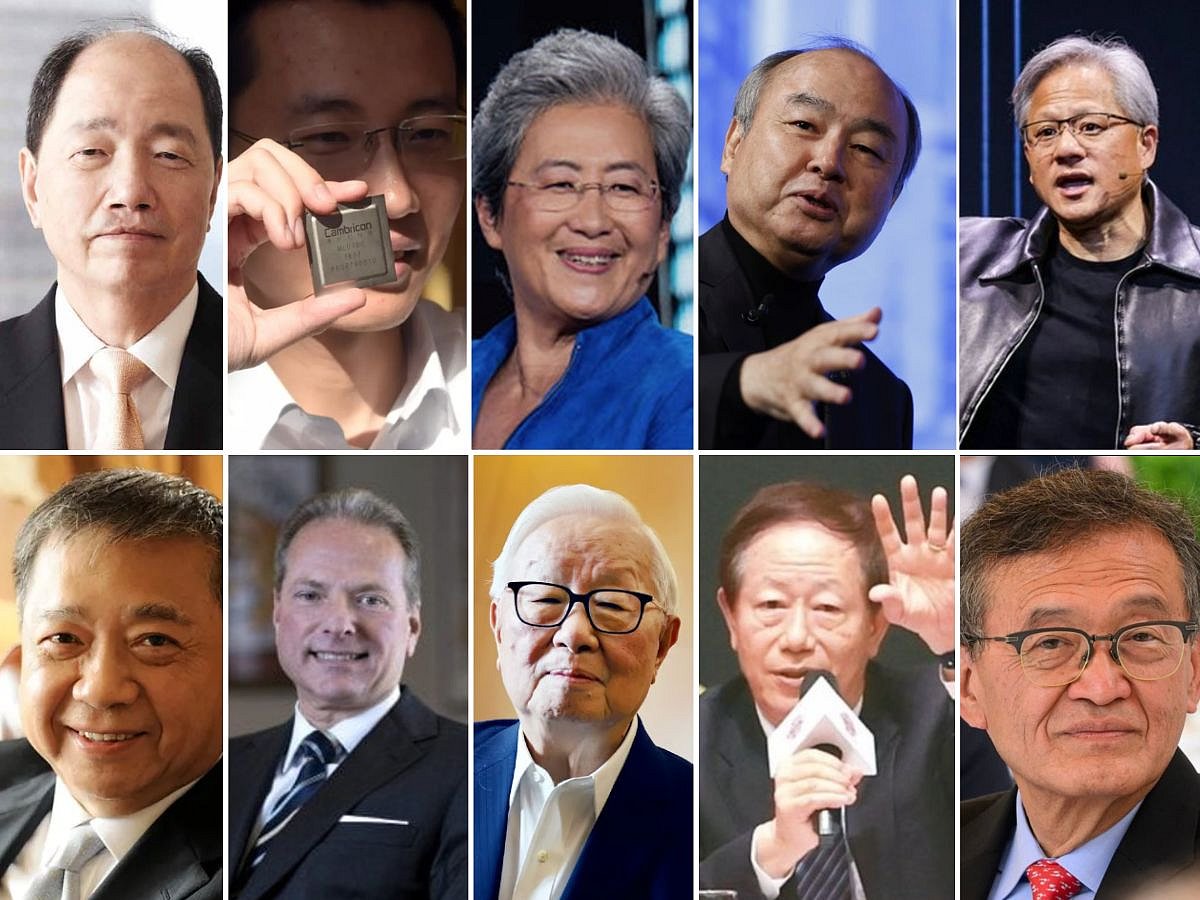
TOP CHIP EXECS: As AI adoption accelerates, demand for high-performance chips has surged, transforming semiconductor companies into some of the world's most valuable businesses and creating unprecedented wealth for their founders and major shareholders.
Semiconductors have become the strategic resource of the 21st century, powering everything from smartphones and electric vehicles to artificial intelligence, cloud computing, defense systems, and advanced manufacturing.
The industry's role extends far beyond technology. Governments increasingly view chip production as a matter of national security, prompting billions of dollars in public investment across the US, Europe, Japan, South Korea, Taiwan, and China.
Companies making graphics processors, advanced silicon wafers and producing semiconductor equipment, or supplying critical components now sit at the centre of geopolitical competition.
Get it: Fast, verified news for FREE ... download the Gulf News app — simply click here
These companies — NVIDIA, TSMC, Arm, Intel, AMD, Samsung, ASML, and Foxconn, Cambricon — form the the backbone of today's chipmaking ecosystem, driving AI, high-performance computing, consumer electronics, and digital infrastructure.
Below are the world's most influential billionaires closely associated with computer chips, led by Jensen Huang, Henry Samueli, Chen Tianshi and Morris Chang. Rankings are approximate because net worth fluctuates daily with stock prices:
Jensen Huang
Age (2026): 63
Approx. Net Worth: US$170–190 billion
Company: NVIDIA
Distinction: Architect of the AI GPU revolution
Jensen Huang co-founded NVIDIA in 1993 and transformed it from a graphics chip maker into the world's dominant artificial intelligence computing company. NVIDIA's GPUs power ChatGPT, autonomous vehicles, robotics, and data centers. The AI boom propelled Huang into the ranks of the world's wealthiest individuals and most influential technology leaders.
Masayoshi Son
Age (2026): 68
Approx. Net Worth: US$35–40 billion
Company: SoftBank / Arm Holdings
Distinction: Owner of the world's most widely used processor architecture.
Masayoshi Son, chairman and CEO of SoftBank Group, speaks during a business event in Tokyo, Tuesday, July 14, 2026. (Miyuki Saito/Kyodo News via AP)
Masayoshi Son acquired British chip designer Arm through SoftBank, giving his company control over processor architectures used in billions of smartphones, tablets, IoT devices, and increasingly AI systems. Arm's designs are licensed globally, making Son one of the semiconductor industry's most influential investors despite not manufacturing chips.
Henry Samueli
Age (2026): 72
Approx. Net Worth: $35.8 billion
Company: Broadcom
Distinction: Inventor behind 75 US patents, known for his contributions to high bit-rate digital communication systems
Henry Samueli is a co-founder and chair of Broadcom, a US tech giant that supplies chips for wireless and broadband communication.
Henry Samueli is a distinguished adjunct professor in the Electrical Engineering and Computer Science Department at UC Irvine. He is a named inventor in 75 US patents, and is known for his contributions to VLSI architectures and realisations for high-bit rate digital communication systems. Broadcom was acquired in 2016 for $37 billion by Avago Technologies, which then adopted the Broadcom name. Today, the business operates as part of Broadcom Inc., a massive global supplier of semiconductor and infrastructure software products.
Lei Jun
Age (2026): 56
Approx. Net Worth: $30–35 billion
Company: Xiaomi
Distinction: Revived Xiaomi's chip development ambitions
Lei Jun, Chairman and CEO of Chinese electronics company Xiaomi, introduces Xiaomi's Vision Gran Turismo concept car at the Beijing Auto Show in Beijing on April 24, 2026.
Lei Jun founded Xiaomi and turned it into one of the world's leading smartphone manufacturers. Under his leadership, Xiaomi revived its in-house semiconductor program to reduce dependence on external suppliers. The company now combines smartphones, AI devices, electric vehicles, and proprietary chip development into a growing technology ecosystem.
Chen Tianshi
Age (2026): 41
Approx. Net Worth: $27.3 billion
Company: Cambricon Technologies
Distinction: He became the world’s third-richest person under age 40 with a $22.5-billion fortune in 2025
Chen Tianshi, 41. His meteoric rise underscores how China’s robust support for its domestic AI industry is minting a new class of state-aligned tech elites.
Chen Tianshi, 41, born in Nanchang, Jiangxi, China, is the chair and CEO of chipmaker Cambricon Technologies, sometimes dubbed "China's Nvidia". Before cofounding Cambricon in 2016, he worked for the Chinese Academy of Sciences' Institute of Computing Technology as a researcher. The institute still owns a minority stake in Cambricon. Chen holds a PhD from the University of Science and Technology of China. Forbes estimates Tianshi's net worth at $27.3 billion (as of March 2026). US export controls on semiconductors created a protected Chinese market, sending Cambricon shares surging over 765% in just 24 months.
Henry Nicholas III
Age (2026): 66
Approx. Net Worth: $22.6 billion
Company: Broadcom
Distinction: Co-founder of Broadcom alongside Henry Samueli, with a multi-billion dollar stake. Served as CEO and took the company public in 1998, driving early high-speed broadband and networking chip development.
Henry Thompson Nicholas III, 66, holds a Master's and PhD in Electrical Engineering from University of California Los Angeles.
Henry Thompson Nicholas III is known for his pioneering work in semiconductors and his role in creating Broadcom. He co-founded Broadcom Corp. in 1991 with engineer Henry Samueli. The company began in a condominium in Redondo Beach, California, before growing into a global semiconductor and software powerhouse. As Broadcom's CEO, Nicholas helped drive the development of chips for high-speed broadband, networking and communications, positioning the company at the heart of the digital revolution. Broadcom went public in 1998, a milestone in its drive into a technology giant. He's been active in philanthropy, particularly in engineering education, and has supported the victims' rights movement.
Jason & Richard Chang
Age (2026): 82, 79
Approx. Net Worth: US$22.4 billion
Company: ASE Technology Holding
Distinction: Leaders of ASE Technology Holding, the world's largest chip packaging and testing provider
Jason Chang (right) and Richard Chang.
Jason (82) and Richard (79) Chang came from a refugee family-turned-semiconductor-billionaires. The siblings transformed their family fortune built in real estate into one of the world's most important semiconductor businesses. As of June 10, 2026, Forbes estimated their combined fortune at $22.4 billion, making them Taiwan's richest people for the first time. Their wealth jumped by about $14.5 billion in one year, propelled by the AI-driven semiconductor boom.
The Changs were born in Shanghai and moved to Taiwan after the 1949 Chinese Revolution. Their mother, Chang Yao-Hung-Ying, rebuilt the family's business in Taiwan, initially through real estate development. That background became important to the brothers' eventual fortune: they didn't inherit a semiconductor empire — they helped create one.
Morris Chang
Age (2026): 95
Approx. Net Worth: US$9.6 billion
Company: TSMC
Distinction: Known as the "godfather" and founder of the modern pure-play semiconductor foundry industry.
Morris Chang
Born in 1931 in Ningbo, China, Morris Chang grew up amid war and poverty. His father, a local government official, urged him to focus on education as violence repeatedly forced Chang and his mother to move. In 1948, amid China’s civil war, they fled to Hong Kong. A year later, Chang was accepted to Harvard and moved to the US. After one year at Harvard, he transferred to MIT, where he studied mechanical engineering and earned both his bachelor’s and master’s degrees in 1953.
Chang worked for 25 year at TI and then joined the Taiwan research body that spun off TSMC in 1987, now the world's top chipmaker. TSMC manufactures semiconductors for companies including Apple, NVIDIA, AMD, and Qualcomm. Taiwan has become indispensable to modern technology. He retired from the chairman's post in 2018. Bloomberg estimates his net worth at $9.93 billion.
Terry Gou
Age (2026): 75
Approx. Net Worth: US$10–12 billion
Company: Foxconn
Distinction: Electronics manufacturing giant expanding into semiconductors.
Foxconn’s founder Terry Gou.
Terry Gou founded Foxconn, the world's largest electronics contract manufacturer and a key supplier to Apple and other technology companies. In recent years, Foxconn expanded aggressively into semiconductor manufacturing, recognizing chips as a strategic industry essential for electric vehicles, artificial intelligence, and advanced electronics production.
Mark Liu
Age (2026): 72
Approx. Net Worth: US$7.2–10 billion
Company: TSMC
Mark Liu
Mark Liu helped lead TSMC through its rise as the world's premier advanced chip manufacturer. During his tenure, the company expanded production of cutting-edge process technologies powering AI processors, smartphones, and high-performance computing. His leadership strengthened TSMC's technological advantage amid increasing global competition and geopolitical tensions.
Lip-Bu Tan
Age (2026): 66
Approx. Net Worth: US$2–3 billion
Company: Intel / Walden International
Distinction: Veteran semiconductor investor and executive.
Intel Corporation CEO Lip-Bu Tan (R) watches as US President Donald Trump speaks during a Rose Garden Club event on the Rose Garden of the White House in Washington, DC, on July 6, 2026.
Lip-Bu Tan built his reputation through venture capital firm Walden International, investing in semiconductor startups worldwide. He later became one of the industry's most respected executives, serving in leadership roles at Cadence Design Systems and Intel. His decades-long influence spans chip design, software, manufacturing, and technology investment.
Lisa Su
Age (2026): 70
Net Worth: $1.2–1.4 billion
Distinction: Steered chipmaker Advanced Micro Devices (AMD) away from potential bankruptcy into a major semiconductor powerhouse.
Lisa Su, Chair and CEO, AMD
Su's net worth is driven primarily by her extensive stock holdings and executive compensation at Advanced Micro Devices (AMD), as per Hustle Fund. Dr Su earned her bachelor's, master's, and PhD in electrical engineering from the Massachusetts Institute of Technology (MIT). She held prominent engineering and management positions at IBM (where she spent 13 years working on silicon-on-insulator technology) and served as CTO at Freescale Semiconductor. Dr. Su Joined AMD in 2012 as senior vice president and general manager, and was appointed president and CEO in October 2014, steering the struggling chipmaker away from potential bankruptcy into a major semiconductor powerhouse. She is a first cousin (maternal side) of Nvidia co-founder and CEO Jensen Huang.
Special mentions
Pat Gelsinger, 65 — Known for serving as the CEO of Intel from 2021 to 2024, leading Intel's manufacturing turnaround efforts, and acted as chief architect of the 80486 processor. He also led VMware as CEO. He is currently a general partner at venture capital firm Playground Global and executive chair/head of technology at Gloo.
Miin Wu, 77 — Known as the flash memory pioneer, and combined semiconductor design and statistical knowledge to pioneer the world's first fully automated, computerized fabrication facility. He is the founder/Chairman and CEO of Macronix, a leading semiconductor company listed on the Taiwan Stock Exchange. His personal wealth tied heavily to his stake in his multi-billion dollar company. He's known as an innovator who integrated statistical analysis into semiconductor manufacturing to create the world's first fully computerised fab. He personally donated NT$1 billion (around $34 million) to establish the Miin Wu School of Computing.
Chang Hsueh-Cheng, 70 — Known as a semiconductor packaging and testing pioneer. Chang Hsueh-Cheng helped build Siliconware Precision Industries (SPIL) into one of the world's largest providers of semiconductor packaging and testing services. Packaging has become increasingly important for AI chips, making SPIL a critical link in the semiconductor supply chain that connects chip fabrication with final electronic products.
James Wei — Veteran semiconductor entrepreneur. He co-founded Worldview Technology Partners in 1996 and has been a venture capitalist since 1991. He invests primarily in early-stage semiconductor, component, and communications startups. James pioneered the model of integrating business development with venture capital. Wei is currently a partner at Worldview Technology Partners, a venture capital firm he co-founded in 1996, and serves as a directors at CommVerge Solutions. James Wei holds a BS in Engineering from the University of Waterloo, Canada.
C.C. Wei, 72 — CEO leading TSMC during the AI boom. C.C. Wei succeeded Morris Chang in leading TSMC through the artificial intelligence era. Although not generally ranked among the world's billionaires, he oversees the company producing the world's most advanced chips for NVIDIA, Apple, AMD, and other global technology leaders, making him one of the industry's most influential executives.
Sanjay Mehrotra, 68 — President and CEO of Micron Technology, entering the billionaire ranks with a net worth of $1.2 billion.
Yu Renrong, 60 — Founder of Will Semiconductor, a major Chinese designer of CMOS image sensors, with a multi-billion dollar valuation.
Sung Kyu-dong, 69 — Founder and CEO of South Korean semiconductor equipment manufacturer EO Technics, with an estimated fortune of $1 billion.
Also In This Package
Top 25 companies in 2025: How they crushed the market
Nvidia loses top spot to Apple after selloff
Intel shares plunge on earnings expectations
US, Taiwan sign $250b trade deal, tariffs cut to 15%
Samsung Electronics forecasts record profit in Q4-2025
From dishwasher to $4.46 trillion: Jensen Huang's story
Network Links
GN StoreAbout Gulf NewsTerms & ConditionsReach by GNSitemapContact usPrivacy PolicyGN FocusHave your sayWork with usAdvertise with usGulf News epaperPrinting Services
Download our app
© Al Nisr Publishing LLC 2026. All rights reserved.