From dishwasher to $4.46 trillion: Jensen Huang's story
While many saw GPUs as rendering tools, Huang saw them as engines of parallel computing
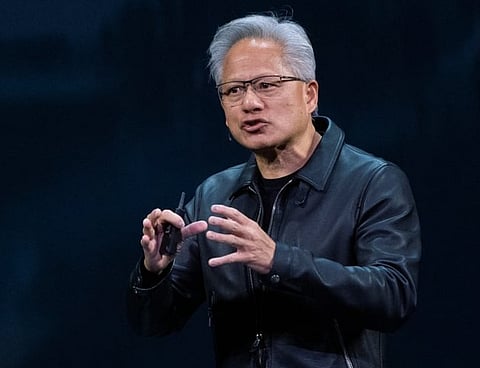
In the world of tech titans, few stories resonate like that of Jensen Huang — a humble immigrant who went from washing dishes to steering one of the most valuable companies on Earth.
Born in 1963 in Tainan, Taiwan, Huang’s family moved to the United States when he was a teenager.
Life in a new country wasn’t seamless.
Adjusting to a different culture and language, Huang took a job washing dishes at a Denny’s restaurant in Oregon.
It wasn’t glamorous.
But it gave him something priceless: work ethic, grit, and a deep understanding that hard work wasn’t just about effort — it was about collecting insights opportunity.
While others may remember their high-school years for social milestones, Huang’s were defined by curiosity and determination.
He excelled in mathematics and science, not because it was easy, but because he loved the challenge.
'I wish upon you plenty of pain and suffering'
That passion — and the willingness to embrace pain and suffering to pursue one’s dream — led him to Oregon State University, where he studied electrical engineering.
Afterwards, he pursued a master’s degree in electrical engineering at Stanford University, placing himself at the heart of innovation.
After graduating, Huang made his way into the burgeoning tech world of Silicon Valley.
In 1993, together with Chris Malachowsky and Curtis Priem, he co-founded Nvidia — a company that, at first, was just another startup with ambitious dreams and limited resources.
The early years were tough: technology was fast-moving, competition fierce, and Nvidia’s future uncertain.
It's perhaps due to his life experiences that Huang is big on embracing "pain and suffering".
GPU champion
Yet Huang’s leadership was anything but uncertain.
He championed graphics processing units (GPUs) not just for gaming, but for the future he knew was coming — one powered by data, algorithms, and artificial intelligence.
While many saw GPUs as tools for rendering images, Huang saw them as engines of parallel computing that could power machine learning, simulations, and large-scale data processing.
That vision, once questioned, has since been vindicated spectacularly.
Fast forward to 2025, and Nvidia, under Huang’s leadership, became the world’s most valuable company by market capitalisation, with its stock soaring on the back of unprecedented demand for AI chips.
Investors, corporations, and technologists alike now see Nvidia as essential infrastructure in the age of artificial intelligence — the quiet backbone powering innovations from generative AI to autonomous vehicles.
Key Moments
Feb. 17, 1963 — Jensen Huang is born in Tainan, Taiwan.
Late 1970s / Early 1980s — Immigrates to the United States; works as a dishwasher.
1984 — Graduates with a degree in electrical engineering from Oregon State University.
1992 — Earns a master’s degree in electrical engineering from Stanford University.
1993 — Co-founds Nvidia.
2000s — Nvidia establishes itself as a leader in graphics processors.
2010s–2020s — Nvidia GPUs become dominant in AI and data centres.
2025 — Nvidia becomes the world’s most valuable company by market cap ($4.46 trillion as of December ($183.69/share) as of Dec. 23, 7:14 AM EST)
The arc of Jensen Huang’s life reads like a blueprint for possibility.
From doing the dishes to leading a company currently valued at $4.46 trillion, his story reminds us that resilience and vision can transform not just one life — but the world.
It shows that true innovation often comes from those who embrace challenge, look beyond the obvious, and believe that the future, however daunting, can be built one courageous idea at a time.


