iPhone Duo screen cracks: Why do foldable displays fail at the fold?
Crackgate controversy: iPhone Duo's fragile foldable design under scrutiny
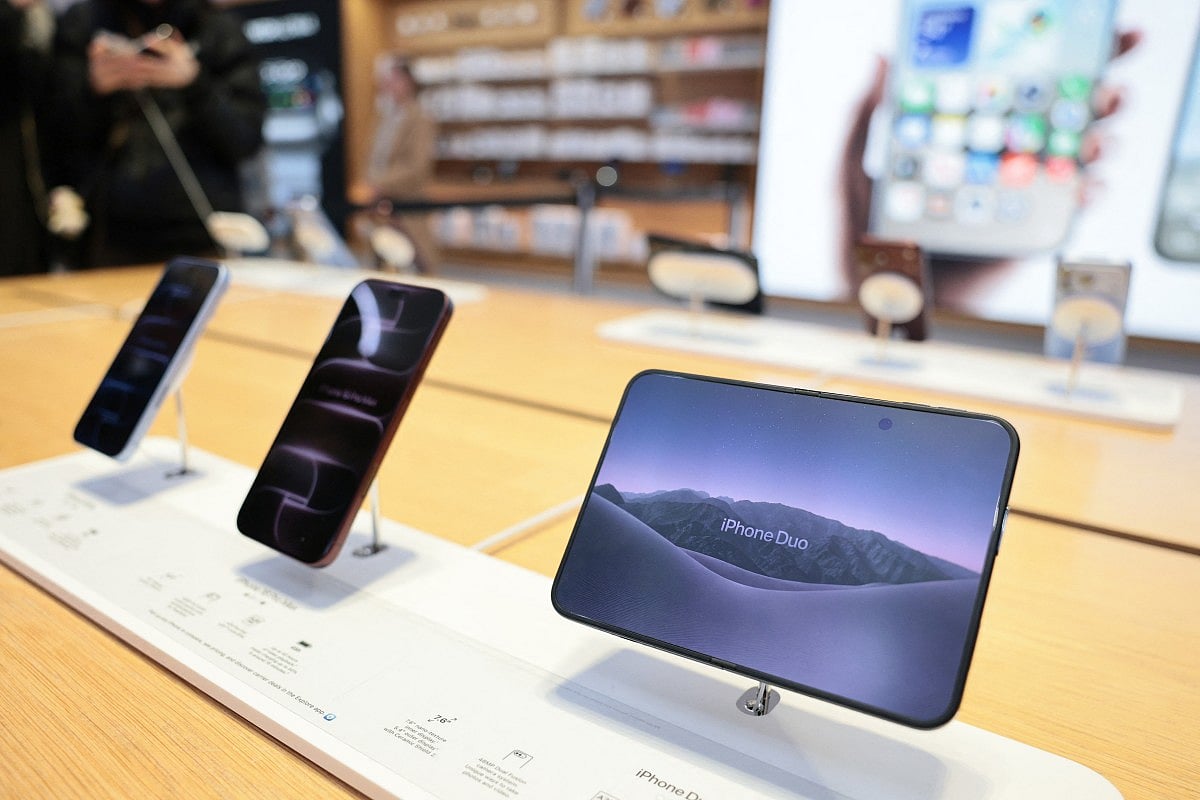
A foldable screen almost never fails at random: When it breaks, it breaks along the fold, because that is the one strip of the phone asked to do something glass normally cannot.
That is why the early iPhone Duo reports look so alike. Apple’s first foldable went on sale on October 23 at $1,999 (Dh8499 in UAE) and up. Within days, owners were posting photos of inner screens cracked along the center line of the hinge. On October 26, Apple said it was aware of an issue on 'a small number' of units and told affected owners to contact AppleCare for a replacement. It did not say what causes it.
If you have never owned a foldable, here's what is actually inside that bending screen, why the fold is the weak point, and what the hinge has to get right. It also covers what is known, and not yet known, about the Duo.
Glass that bends
Glass can bend if it is thin enough. The trick behind every modern foldable is not a new kind of glass but glass made extraordinarily thin.
A window pane snaps when you bend it because its outer surface is pulled apart. The thicker the sheet, the harder that outer surface is stretched for a given curve. Make the sheet thin, and the same curve barely stretches it. As Northwestern materials scientist John Rogers put it to The New York Times, thickness governs how stiff something is against bending.
How thin? A human hair is roughly 50 to 100 micrometres across. The glass layer in the iPhone Duo is reportedly under 30 micrometres. Samsung describes its own ultra-thin glass, or UTG, as about a third the thickness of a hair.
The trade-off is built in. Corning, the US glass company best known for the Gorilla Glass on many phone screens, also makes bendable glass for foldables. Its patent filings note that glass around 75 micrometres or thinner bends tightly but resists punctures poorly. Glass thicker than about 125 micrometres resists punctures well but can only bend to a radius of about 30 mm. A foldable display needs a bend radius of about 10 mm or less. So the glass at the fold is as thin as engineers dare, and everything around it exists to protect it.
A screen made of layers
The inner screen is not one sheet. It is a sandwich of thin layers glued together, and each has a different job. iFixit counted about 10 layers in the iPhone Duo’s inner display.
Samsung’s support pages describe a simpler version of the same basic stack, from the top down:
Protective film: a replaceable top sheet that takes everyday scratches and pressure.
Protective layer: sits on the glass, absorbs impacts and holds pieces together if the glass breaks.
Ultra-thin glass: gives a flat, glass-like surface and stiffens the stack.
OLED panel: the layer that actually makes the picture, with each pixel producing its own light.
The layers are bonded with optically clear adhesives, as The Star had once explained. Those glues matter more than they sound. When the stack bends, the outer layers travel a slightly longer path than the inner ones, and the adhesive has to let them slide a little without peeling apart.
The top layers are part of the structure, not decoration. In 2019, several Galaxy Fold review units failed after reviewers peeled off what looked like a screen protector, but was a layer Samsung never meant to be removed. The Duo has its own wrinkle: it is the only foldable with a matte screen, and iFixit found its nano-texture coating comes off easily. Until the coating is replaced, the display is more exposed.
Stretch and squeeze
Every time you bend something, one side gets pulled apart and the other side gets pushed together. Glass handles being pushed together very well. It handles being pulled apart badly, so cracks start on the side that gets stretched.
Corning describes folded glass as being squeezed on one side and pulled on the other at the same moment. Somewhere in the middle runs a line that is neither stretched nor squeezed. Engineers call it the neutral plane.
How hard the outer side gets stretched comes down to two things: how thick the layer is and how tight the bend is. A thicker sheet gets stretched more, and so does a sheet bent more tightly. Corning’s patent filings describe exactly this trade-off.
Picture a thick rubber eraser. Bend it, and you can see the outside surface stretch while the inside bunches up. Bend a thin rubber band into the same curve and it barely changes. That is why foldable glass is made so thin, and why the hinge works so hard to keep the curve gentle.
Engineers use that calm middle line to protect the most delicate part. They arrange the layers so the OLED pixels sit on or near it, which means the part that makes the picture barely feels the fold. This matters because the seals that keep moisture out of the OLED are thin and brittle.
It is a fine balance. If one layer comes out a little thicker or stiffer than planned, that middle line can shift, and the delicate parts start to feel the strain.
Glass makers add one more trick. They treat the glass so its surface is already slightly squeezed before it ever bends. A fold has to undo that squeeze before the surface actually starts to stretch.
Tiny flaws, big cracks
Glass rarely breaks because the whole sheet is too weak. It breaks because a microscopic flaw on the stretched surface becomes the starting point of a crack.
Every real glass surface carries tiny scratches and nicks, some far smaller than a micrometre. Under bending, stress concentrates at the tip of each one. Corning’s patents describe the danger in two forms: instant failure, or a slower fatigue failure where a flaw grows a little with each cycle until it runs. Glass has a fracture toughness of roughly 0.7 MPa√m, and the same filings put the threshold for slow growth under repeated loading at about 0.2 MPa√m. That is why a phone can survive many folds and then crack on an ordinary one.
Manufacturers fight this in three ways:
Smaller flaws: Corning’s designs aim to keep surface flaws around 5 micrometres or smaller, and in some cases under half a micrometre.
Clean edges and surfaces: Samsung says a smoothly cut edge is vital and that it polishes UTG to remove imperfections.
A compressed skin: if flaws stay inside the layer that ion exchange has put into compression, they are held shut and do not grow.
The environment also plays a part. Research presented to the Society for Information Display notes that crack growth in UTG under repeated loading behaves much like it does in thick glass, with temperature and humidity affecting how fast a crack spreads.
The hinge decides the bend
The glass only survives if the hinge never lets it bend tighter than it was designed for. The hinge is not just a pivot. It sets the exact shape the screen takes every time you close the phone.
A hinge that pinches the screen into a sharp fold concentrates all the bending stress along one narrow line, according to an analysis of foldable creases published by SoftwareSeni. Most modern foldables instead use a waterdrop or teardrop hinge, and repair specialist iFixit’s teardown of the iPhone Duo, as reported by Tom’s Guide, shows Apple chose the same design. When the phone closes, the screen curls into a teardrop-shaped loop inside the hinge rather than being folded flat at one point. Think of folding paper flat versus rolling it around a pencil: same material, very different stress.
Even a well-designed hinge leaves a mark. Folding the same strip of screen thousands of times creates the familiar crease, and lab measurements show it deepens with repeated folding and with time spent folded. A crease is cosmetic. A crack is what happens when the screen is forced into a shape the hinge was supposed to prevent.
Pressure points: when something pushes from below
Many of the most sudden fold failures are not caused by the bending alone. They come from a hard point pressing into the screen at the fold: a grain of grit, a hinge part in the wrong place, or a finger or object on the outside.
A screen stack a fraction of a millimetre thick has almost no stiffness of its own. Push a small, hard point into it while it is flexing, and the stress at that spot can far exceed what the bend alone produces. Samsung’s own care guidance tells owners to avoid pressing on the fold or closing the phone on cards, keys, sand or metal dust. It also warns that a crack in the UTG can spread and show up as a white line.
The industry learned this publicly in 2019. Several Samsung Galaxy Fold review units broke within days. iFixit traced one likely cause to a gap of about 7 mm near the hinge that let debris slip beneath the screen. The Verge’s unit developed a bulge from a trapped particle before its pixels died. Samsung delayed the launch and, according to Yonhap, closed the gap near the hinge before shipping.
Dust is still hard to keep out. A water and dust rating such as IP68 does not mean a hinge is sealed against fine grit. In iFixit’s fluorescent-powder test, particles still got into the iPhone Duo’s hinge, though less than in the Galaxy Z Fold 8 and Pixel 11 Pro Fold.
What this means for the iPhone Duo
The Duo’s failures fit the pressure-point pattern, but the cause is not confirmed. Apple has not explained it, and the leading theory comes from a teardown, not from failed phones.
What owners describe is consistent. Cracks appear at the same spot along the fold, often with a stuck feeling or a popping noise just before, and frequently a line of bright pixels. One Australian owner said his phone cracked within about six hours and fewer than 20 openings. Apple says the problem tends to show up soon after purchase.
iFixit built a 3D model of the hinge from teardown footage, patents and CT scans, then compared it with where screens are failing. Its main suspect is a center support bar that may not drop far enough as the phone folds. That would create a pressure hotspot between the underside of the screen and the hinge. Grit in the hinge is a second possibility.
Three cautions apply:
iFixit itself says none of its theories are confirmed. It named three possible mechanisms, and many headlines overstated what it found.
Not every “crack” may be broken glass. iFixit noted that a wiring fault can produce the same look.
There is no failure rate. No repair, teardown or service data yet shows how many units are affected, so any percentage quoted now is a guess. A widely shared CT-scan theory was based on an intact review unit, not a failed phone.
If you are new to foldables
A foldable screen is tougher than it looks when it folds normally, and far more fragile than a regular phone screen against pressure at the fold. Treat it that way.
Keep the fold clean. Never close the phone on anything, including grit, a card or a key. Samsung’s guidance applies to any foldable.
Don’t press on the crease. Avoid pens, nails and hard tapping on the inner screen, especially along the fold.
Leave the factory layers alone. The top film is part of the screen, not a disposable protector. Removing it can damage the panel.
Expect a crease. A faint line at the fold is normal. A sudden bright line, a crunching sound or a stiff spot when folding is not.
Know your window. Apple says Duo owners with a damaged inner display should contact AppleCare for a replacement, and no AppleCare+ plan is needed. Carrier buyers should go to AppleCare directly, and launch buyers have a two-week return window.
Network Links
GN StoreDownload our app
© Al Nisr Publishing LLC 2026. All rights reserved.