Nvidia founder and CEO Jensen Huang introduces the Rubin GPU and the Vera CPU as he speaks during Nvidia Live at CES 2026 ahead of the annual Consumer Electronics Show in Las Vegas, Nevada, on January 5, 2026.
From cars to robots, Nvidia maps out where AI is headed next
From smarter cars to personal AI, Nvidia shows how AI is moving into daily life
Last updated:
4 MIN READ
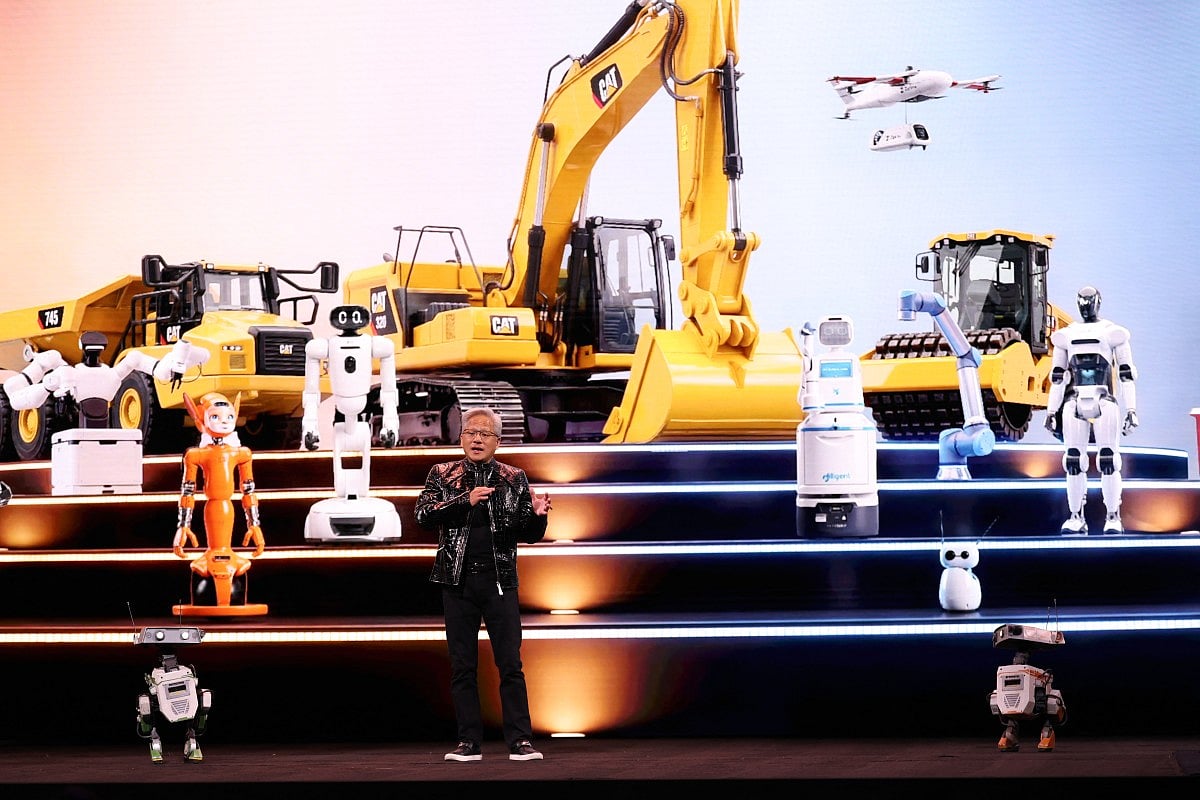
Nvidia founder and CEO Jensen Huang introduces robots powered by NVIDIA's technology as he speaks during Nvidia Live at CES 2026 ahead of the annual Consumer Electronics Show in Las Vegas, Nevada, on January 5, 2026.
AFP-PATRICK T. FALLON
Dubai: The future Jensen Huang described at CES did not revolve around screens or servers. It was about cars that can explain their decisions, robots trained before they ever touch the real world, and AI systems that sit on desks rather than in distant data centres.
From there, Nvidia laid out a sweeping update to its technology stack, showing how artificial intelligence is being reshaped for daily use. “Computing has been fundamentally reshaped as a result of accelerated computing, as a result of artificial intelligence,” he said. “Some $10 trillion or so of the last decade of computing is now being modernised to this new way of doing computing.”
A new engine for AI at scale
At the heart of Nvidia’s announcements was Rubin, the company’s next-generation AI computing platform and its first extreme codesigned, six-chip system now in full production. Rubin succeeds the Blackwell architecture and is designed to lower the cost of generating AI outputs to roughly one-tenth of previous platforms.
“The faster you train AI models, the faster you can get the next frontier out to the world,” Huang said. “This is your time to market. This is technology leadership.”
Rubin brings together GPUs, CPUs, networking, data processing units and software as a single integrated system. Nvidia says this approach is critical to scaling AI while reducing energy use and operating costs, a growing concern as demand for AI computing accelerates.
Teaching machines to reason in the real world
One of the most consumer-facing announcements was Alpamayo, an open family of reasoning-based AI models designed to help self-driving cars handle rare and unpredictable situations. These edge cases, often described as the long tail of driving, remain one of the biggest barriers to fully autonomous vehicles.
“Not only does it take sensor input and activate steering, brakes and acceleration, it also reasons about what action it is about to take,” Huang said, as footage showed a vehicle navigating busy city streets.
Alpamayo combines open models, simulation tools and large datasets, allowing carmakers to train systems that can explain their decisions rather than simply react. Nvidia said the first passenger car using Alpamayo on its full DRIVE platform will be the new Mercedes-Benz CLA, with AI-defined driving expected to reach US roads later this year.
“Our vision is that someday every single car and every single truck will be autonomous,” Huang said.
Nvidia CEO Jensen Huang speaks at an event ahead of the COMPUTEX forum.
AI moves from the cloud to the desk
Huang also made the case that AI is becoming personal. He demonstrated an AI agent running locally on the DGX Spark desktop system, interacting through a small robot and responding in real time without relying on the cloud.
“The amazing thing is that is utterly trivial now, but yet just a couple of years ago that would have been impossible,” he said.
Nvidia also announced updates to its RTX platform, expanding AI capabilities for creators and gamers. Over 250 games and applications now support DLSS 4 technology, with new releases adding advanced frame generation and improved visual quality. Nvidia also unveiled upgrades that bring AI-assisted gameplay, smarter non-player characters and smoother graphics to more devices, including TVs and Linux systems.
Factories, robots and physical AI
Beyond cars and PCs, Nvidia highlighted what it calls physical AI. These systems are trained in simulated worlds before operating in factories, warehouses and logistics networks. Huang said future manufacturing plants will operate like giant robots, with AI coordinating design, simulation and production.
“These manufacturing plants are going to be essentially giant robots,” he said.
Nvidia showcased partnerships with industrial and robotics firms, showing how robots trained in virtual environments can move safely and efficiently in the real world.
A full-stack bet on the AI era
Throughout the keynote, Huang returned to one theme. Nvidia now builds entire systems rather than individual chips, believing that breakthroughs in AI require tightly integrated hardware, software and models.
“Our job is to create the entire stack so that all of you can create incredible applications for the rest of the world,” he said.
From self-driving cars and personal AI agents to robots and next-generation gaming, Nvidia’s CES presentation made clear that the company sees AI becoming as embedded and essential as electricity. For consumers, that future is beginning to take shape far sooner than many expected.

Nivetha Dayanand is Assistant Business Editor at Gulf News, covering aviation, financial markets and commodities. A business and financial journalist with a strong interest in multimedia storytelling, she regularly takes complex financial and economic subjects beyond the written word, producing explainer videos that make them easier for a wider audience to understand. Nivetha has interviewed senior policymakers, business leaders and global financial figures both on and off camera. Her past guests include UAE Minister of Economy and Tourism Abdulla bin Touq Al Marri, Khaled bin Alwaleed Al Saud, a member of the House of Saud and the founder and CEO of KBW Ventures, Jihad Azour, Director of the Middle East and Central Asia Department at the International Monetary Fund and Indian ministers Hardeep Singh Puri and N. Chandrababu Naidu. She has also hosted and moderated panels, conferences and awards shows, bringing her newsroom experience to live conversations on business, finance and the economy. An Erasmus Mundus journalism alum, Nivetha is drawn to stories that affect people directly and to reporting that gives a platform to voices that might otherwise go unheard. She was among the first journalists to speak to Petrofac employees in the UAE about unpaid salaries, broke the news of the planned demolition of Dubai’s well-known “Toyota Building”, and helped set the record straight on widely circulated claims that a giant replica of the Moon was coming to Dubai. More recently, her exclusive interview with EDGE Group CEO Hamad Al Marar revealed how the UAE-based defence group deployed its systems along the country’s shore border and established a geofence around the UAE within 48 hours of the February 28 escalation. Prior to joining Gulf News, Nivetha worked at ITP Media, where she helped launch Finance Middle East, a new publication covering the region’s financial sector. Her role spanned reporting and editing, video production, interviews and events. Across print, digital, and video, she focuses on finding the people behind business stories and explaining why those stories matter to the audience reading or watching them.
Sign up for the Daily Briefing
Get the latest news and updates straight to your inbox
Network Links
GN StoreAbout Gulf NewsTerms & ConditionsReach by GNSitemapContact usPrivacy PolicyGN FocusHave your sayWork with usAdvertise with usGulf News epaperPrinting Services
Download our app
© Al Nisr Publishing LLC 2026. All rights reserved.